SLAU847F October 2022 – March 2026 MSPM0L1105 , MSPM0L1106 , MSPM0L1116 , MSPM0L1116-Q1 , MSPM0L1117 , MSPM0L1227 , MSPM0L1227-Q1 , MSPM0L1228 , MSPM0L1228-Q1 , MSPM0L1303 , MSPM0L1304 , MSPM0L1304-Q1 , MSPM0L1305 , MSPM0L1305-Q1 , MSPM0L1306 , MSPM0L1306-Q1 , MSPM0L1343 , MSPM0L1344 , MSPM0L1345 , MSPM0L1346 , MSPM0L2116 , MSPM0L2117 , MSPM0L2227 , MSPM0L2227-Q1 , MSPM0L2228 , MSPM0L2228-Q1
- 1
- Read This First
-
1 Architecture
- 1.1 Architecture Overview
- 1.2 Bus Organization
- 1.3 Platform Memory Map
- 1.4
Boot Configuration
- 1.4.1 Configuration Memory (NONMAIN)
- 1.4.2 Boot Configuration Routine (BCR)
- 1.4.3 Bootstrap Loader (BSL)
- 1.4.4 NONMAIN Layout Types
- 1.4.5 NONMAIN_TYPEA Registers
- 1.4.6 NONMAIN_TYPEC Registers
- 1.4.7 NONMAIN_TYPEE Registers
- 1.5 Factory Constants
-
2 PMCU
- 2.1 PMCU Overview
- 2.2 Power Management (PMU)
- 2.3
Clock Module (CKM)
- 2.3.1 Oscillators
- 2.3.2
Clocks
- 2.3.2.1 MCLK (Main Clock) Tree
- 2.3.2.2 CPUCLK (Processor Clock)
- 2.3.2.3 ULPCLK (Low-Power Clock)
- 2.3.2.4 MFCLK (Middle Frequency Clock)
- 2.3.2.5 MFPCLK (Middle Frequency Precision Clock)
- 2.3.2.6 LFCLK (Low-Frequency Clock)
- 2.3.2.7 HFCLK (High-Frequency External Clock)
- 2.3.2.8 HSCLK (High Speed Clock)
- 2.3.2.9 ADCCLK (ADC Sample Period Clock)
- 2.3.2.10 CANCLK (CAN-FD Functional Clock)
- 2.3.2.11 RTCCLK (RTC Clock)
- 2.3.2.12 External Clock Output (CLK_OUT)
- 2.3.2.13 Direct Clock Connections for Infrastructure
- 2.3.3 Clock Tree
- 2.3.4 Clock Monitors
- 2.3.5 Frequency Clock Counter (FCC)
- 2.4
System Controller (SYSCTL)
- 2.4.1 Resets and Device Initialization
- 2.4.2 Operating Mode Selection
- 2.4.3 Asynchronous Fast Clock Requests
- 2.4.4 SRAM Write Protection
- 2.4.5 Flash Wait States
- 2.4.6 Flash Bank Address Swap
- 2.4.7 Shutdown Mode Handling (if present)
- 2.4.8 Configuration Lockout
- 2.4.9 System Status
- 2.4.10 Error Handling
- 2.4.11 SYSCTL Events
- 2.5 SYSCTL Layout Types
- 2.6 SYSCTL_TYPEA Registers
- 2.7 SYSCTL_TYPEB Registers
- 2.8 SYSCTL_TYPEC Registers
- 2.9
Quick Start Reference
- 2.9.1 Default Device Configuration
- 2.9.2 Leveraging MFCLK
- 2.9.3 Optimizing Power Consumption in STOP Mode
- 2.9.4 Optimizing Power Consumption in STANDBY Mode
- 2.9.5 Increasing MCLK Precision
- 2.9.6 High Speed Clock (SYSPLL, HFCLK) Handling in Low-Power Modes
- 2.9.7 Optimizing for Lowest Wakeup Latency
- 2.9.8 Optimizing for Lowest Peak Current in RUN/SLEEP Mode
- 3 CPU
- 4 SECURITY
-
5 Direct Memory Access (DMA)
- 5.1 DMA Overview
- 5.2
DMA Operation
- 5.2.1 Addressing Modes
- 5.2.2 Channel Types
- 5.2.3 Transfer Modes
- 5.2.4 Extended Modes
- 5.2.5 Initiating DMA Transfers
- 5.2.6 Stopping DMA Transfers
- 5.2.7 Channel Priorities
- 5.2.8 Burst Block Mode
- 5.2.9 Using DMA with System Interrupts
- 5.2.10 DMA Controller Interrupts
- 5.2.11 DMA Trigger Event Status
- 5.2.12 DMA Operating Mode Support
- 5.2.13 DMA Address and Data Errors
- 5.2.14 Interrupt and Event Support
- 5.3 DMA Registers
-
6 NVM (Flash)
- 6.1 NVM Overview
- 6.2 Flash Memory Bank Organization
- 6.3 Flash Controller
- 6.4 Write Protection
- 6.5 Read Interface
- 6.6 FLASHCTL Registers
- 7 Events
- 8 IOMUX
- 9 General-Purpose Input/Output (GPIO)
-
10AES
- 10.1 AES Overview
- 10.2
AESADV Operation
- 10.2.1 Loading the Key
- 10.2.2 Writing Input Data
- 10.2.3 Reading Output Data
- 10.2.4
Operation Descriptions
- 10.2.4.1 Single Block Operation
- 10.2.4.2 Electronic Codebook (ECB) Mode
- 10.2.4.3 Cipher Block Chaining (CBC) Mode
- 10.2.4.4 Output Feedback (OFB) Mode
- 10.2.4.5 Cipher Feedback (CFB) Mode
- 10.2.4.6 Counter (CTR) Mode
- 10.2.4.7 Galois Counter (GCM) Mode
- 10.2.4.8 Counter With Cipher Block Chaining Message Authentication Code (CCM)
- 10.2.5 AES Events
- 10.3 AESADV Registers
- 11CRC
- 12Keystore
- 13TRNG
- 14Temperature Sensor
-
15ADC
- 15.1 ADC Overview
- 15.2
ADC Operation
- 15.2.1 ADC Core
- 15.2.2 Voltage Reference Options
- 15.2.3 Generic Resolution Modes
- 15.2.4 Hardware Averaging
- 15.2.5 ADC Clocking
- 15.2.6 Common ADC Use Cases
- 15.2.7 Power Down Behavior
- 15.2.8 Sampling Trigger Sources and Sampling Modes
- 15.2.9 Sampling Period
- 15.2.10 Conversion Modes
- 15.2.11 Data Format
- 15.2.12 Advanced Features
- 15.2.13 Status Register
- 15.2.14 ADC Events
- 15.3 ADC12 Registers
-
16COMP
- 16.1 Comparator Overview
- 16.2 Comparator Operation
- 16.3 COMP0 Registers
- 17OPA
- 18GPAMP
- 19VREF
-
20LCD
- 20.1 LCD Introduction
- 20.2 LCD Clocking
- 20.3
Voltage Generation
- 20.3.1 Mode 0 - Voltage Generation from external reference and external resistor divider
- 20.3.2 Mode 1 - Voltage Generation from AVDD and external resistor divider
- 20.3.3 Mode 2 - Voltage Generation from external reference and internal resistor divider
- 20.3.4 Mode 3 - Voltage Generation From AVDD and Internal Resistor Ladder
- 20.3.5 Mode 4 - Voltage Generation from charge pump with external supply
- 20.3.6 Mode 5 - Voltage Generation From Charge Pump With AVDD
- 20.3.7 Mode 6 - Voltage Generation From Charge Pump With External Reference on R13
- 20.3.8 Mode 7 - Voltage Generation From Charge Pump With Internal Reference on R13
- 20.3.9 Charge pump
- 20.3.10 Internal Reference Generation
- 20.4 Analog Mux
- 20.5 LCD Memory and output drive
- 20.6 IO Muxing
- 20.7 Interrupt Generation
- 20.8 Power Domains and Power Modes
- 20.9 LCD Registers
-
21UART
- 21.1 UART Overview
- 21.2
UART Operation
- 21.2.1 Clock Control
- 21.2.2 Signal Descriptions
- 21.2.3
General Architecture and Protocol
- 21.2.3.1 Transmit Receive Logic
- 21.2.3.2 Bit Sampling
- 21.2.3.3 Majority Voting Feature
- 21.2.3.4 Baud Rate Generation
- 21.2.3.5 Data Transmission
- 21.2.3.6 Error and Status
- 21.2.3.7 Local Interconnect Network (LIN) Support
- 21.2.3.8 Flow Control
- 21.2.3.9 Idle-Line Multiprocessor
- 21.2.3.10 9-Bit UART Mode
- 21.2.3.11 RS-485 Support
- 21.2.3.12 DALI Protocol
- 21.2.3.13 Manchester Encoding and Decoding
- 21.2.3.14 IrDA Encoding and Decoding
- 21.2.3.15 ISO7816 Smart Card Support
- 21.2.3.16 Address Detection
- 21.2.3.17 FIFO Operation
- 21.2.3.18 Loopback Operation
- 21.2.3.19 Glitch Suppression
- 21.2.4 Low Power Operation
- 21.2.5 Reset Considerations
- 21.2.6 Initialization
- 21.2.7 Interrupt and Events Support
- 21.2.8 Emulation Modes
- 21.3 UART Registers
-
22I2C
- 22.1 I2C Overview
- 22.2
I2C Operation
- 22.2.1 Clock Control
- 22.2.2 Signal Descriptions
- 22.2.3
General Architecture
- 22.2.3.1 I2C Bus Functional Overview
- 22.2.3.2 START and STOP Conditions
- 22.2.3.3 Data Format with 7-Bit Address
- 22.2.3.4 Acknowledge
- 22.2.3.5 Repeated Start
- 22.2.3.6 SCL Clock Low Timeout
- 22.2.3.7 Clock Stretching
- 22.2.3.8 Dual Address
- 22.2.3.9 Arbitration
- 22.2.3.10 Multiple Controller Mode
- 22.2.3.11 Glitch Suppression
- 22.2.3.12 FIFO operation
- 22.2.3.13 Loopback mode
- 22.2.3.14 Burst Mode
- 22.2.3.15 DMA Operation
- 22.2.3.16 Low-Power Operation
- 22.2.4 Protocol Descriptions
- 22.2.5 Reset Considerations
- 22.2.6 Initialization
- 22.2.7 Interrupt and Events Support
- 22.2.8 Emulation Modes
- 22.3 I2C Registers
-
23SPI
- 23.1 SPI Overview
- 23.2
SPI Operation
- 23.2.1 Clock Control
- 23.2.2 General Architecture
- 23.2.3 Protocol Descriptions
- 23.2.4 Reset Considerations
- 23.2.5 Initialization
- 23.2.6 Interrupt and Events Support
- 23.2.7 Emulation Modes
- 23.3 SPI Registers
- 24UNICOMM
-
25UNICOMM UART
- 25.1 UART Overview
- 25.2
UART Operation
- 25.2.1 Clock Control
- 25.2.2 General Architecture and Protocol
- 25.2.3
Additional Protocol and Feature
Support
- 25.2.3.1 Local Interconnect Network (LIN) Support
- 25.2.3.2 Flow Control
- 25.2.3.3 RS485 Support
- 25.2.3.4 FIFO Operation
- 25.2.3.5 Idle-Line Multiprocessor
- 25.2.3.6 9-Bit UART Mode
- 25.2.3.7 DALI Protocol
- 25.2.3.8 Manchester Encoding and Decoding
- 25.2.3.9 IrDA Encoding and Decoding
- 25.2.3.10 ISO7816 Smart Card Support
- 25.2.3.11 Address Detection
- 25.2.3.12 Glitch Suppression
- 25.2.4 Low Power Operation
- 25.2.5 Reset Considerations
- 25.2.6 UART Initialization
- 25.2.7 Interrupt and Events Support
- 25.2.8 Emulation Modes
- 25.3 UNICOMMUART Registers
-
26UNICOMM-I2C
- 26.1 UNICOMM-I2C Overview
- 26.2 UNICOMM Common Infrastructure
- 26.3
Peripheral Functional Description
- 26.3.1 Clock Control
- 26.3.2 Signal Descriptions
- 26.3.3
General Architecture
- 26.3.3.1 I2C Bus Functional Overview
- 26.3.3.2 START and STOP Conditions
- 26.3.3.3 Dual Address
- 26.3.3.4 Address Format
- 26.3.3.5 Acknowledge
- 26.3.3.6 Repeated Start
- 26.3.3.7 Clock Stretching
- 26.3.3.8 Clock Low Timeout
- 26.3.3.9 Burst Mode
- 26.3.3.10 Arbitration
- 26.3.3.11 Multiple Controller Mode
- 26.3.3.12 Glitch Suppression
- 26.3.3.13 DMA Operation
- 26.3.3.14 FIFO Operation
- 26.3.3.15 Suspend Communication
- 26.3.3.16 Low Power Operation
- 26.3.3.17
SMBUS 3.0 Support
- 26.3.3.17.1 Quick Command
- 26.3.3.17.2 SMBUS Enhanced Acknowledge Control
- 26.3.3.17.3 Clock Low Timeout Detection
- 26.3.3.17.4 Clock High Timeout Detection
- 26.3.3.17.5 Cumulative Clock Low Extended Timeout
- 26.3.3.17.6 Packet Error Checking (PEC)
- 26.3.3.17.7 Host Notify Protocol
- 26.3.3.17.8 Alert Response Protocol
- 26.3.3.17.9 Address Resolution Protocol
- 26.3.4 Protocol Descriptions & Initialization
- 26.3.5 Reset Considerations
- 26.3.6 Initialization
- 26.3.7 Interrupt and Events Support
- 26.3.8 Emulation Modes
- 26.4 UNICOMM I2C Registers
-
27UNICOMM-SPI
- 27.1 UNICOMM-SPI Overview
- 27.2
SPI Operation
- 27.2.1 Clock Frequency Support
- 27.2.2 General Architecture
- 27.2.3 FIFO Operation
- 27.2.4 Suspend communication
- 27.2.5 Internal Loopback Operation
- 27.2.6 Repeat Transfer mode
- 27.2.7 Receive Timeout
- 27.2.8 Line Timeout
- 27.2.9 Protocol Descriptions
- 27.2.10 Status Flags
- 27.2.11 Module configuration
- 27.2.12 Reset Considerations
- 27.2.13 Initialization
- 27.2.14 Interrupt and Events Support
- 27.2.15 Emulation Modes
- 27.3 UNICOMMSPI Registers
-
28Timers (TIMx)
- 28.1 TIMx Overview
- 28.2
TIMx Operation
- 28.2.1 Timer Counter
- 28.2.2 Counting Mode Control
- 28.2.3 Capture/Compare Module
- 28.2.4 Shadow Load and Shadow Compare
- 28.2.5 Output Generator
- 28.2.6 Fault Handler (TIMA only)
- 28.2.7 Synchronization With Cross Trigger
- 28.2.8 Low Power Operation
- 28.2.9 Interrupt and Event Support
- 28.2.10 Debug Handler (TIMA Only)
- 28.3 TIMx Registers
- 29TIMB
- 30Low Frequency Subsystem (LFSS)
- 31Low Frequency Subsystem (LFSS_B)
-
32RTC
- 32.1 Overview
- 32.2 Basic Operation
- 32.3
Configuration
- 32.3.1 Clocking
- 32.3.2 Reading and Writing to RTC Peripheral Registers
- 32.3.3 Binary vs. BCD
- 32.3.4 Leap Year Handling
- 32.3.5 Calendar Alarm Configuration
- 32.3.6 Interval Alarm Configuration
- 32.3.7 Periodic Alarm Configuration
- 32.3.8 Calibration
- 32.3.9 RTC Prescaler Extension
- 32.3.10 RTC Timestamp Capture
- 32.3.11 RTC Events
- 32.4 RTC Registers
- 33IWDT
- 34Window Watchdog Timer (WWDT)
- 35Debug
- 36Revision History
26.3.3.17.6 Packet Error Checking (PEC)
PEC is a CRC-8 error checking byte which is calculated using all the message bytes of a transaction, including addresses and read/write bits. The ACK/NACK, START, and STOP bits do not contribute to the PEC calculation. The PEC is appended to the message by the device that supplied the last data byte. PEC is cleared upon STOP condition in controller mode, and is cleared upon NACK in target mode.
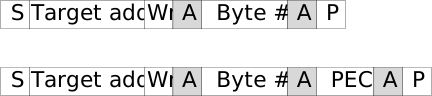 Figure 26-15 Send Byte Message with and without PEC
The PEC Polynomial calculation is the below.
The PECCTL register on Advanced UNICOMM-I2CC and UNICOMM-I2CT instances supports PEC transmission and checking for both controller and target modes. Each of the fields from the PECCTL register are described below.
- PECEN
- This bit enables the SMB Packet Error Checking (PEC) mechanism. When enabled, the PEC is calculated on all bits except the START, STOP, and ACK/NACK. The PEC LFSR and the Byte Counter is set to 0 when the State Machine is in the IDLE state, which occurs following a STOP condition or when a timeout occurs. The Counter is also set to 0 after the PEC byte is sent or received.
- PECCNT
- When this field is set to a non-zero value, the number of I2C data bytes are counted and compared against this value to keep track of each PEC byte in a transmission/reception.Note: For a I2C Target, dynamic changes made to PECCNT must be done while the SCL is being stretched and only if the previous PECCNT= 0.Note: For a I2C Controller, dynamic changes made to PECCNT must be done only if the previous PECCNT=0. A PECCNT value of 1 is an invalid configuration as this indicates one PEC byte and zero data bytes in the transaction, which is not possible per the SMBus standard.
- When this field is set to a non-zero value, the number of I2C data bytes are counted and compared against this value to keep track of each PEC byte in a transmission/reception.
For transmitting, an extra byte needs to be inserted into the transmit sequence for each transaction by writing a dummy byte to the TXDATA register. If PECEN is set, I2CC/I2CT calculates the PEC and replaces this dummy byte with the PEC value during transmission when the data byte count reaches the value in PECCNT. For reception, a PEC byte is received the same as a data byte through the RX FIFO. If PECEN is set and the data byte count is equal to the value programmed in PECCNT, the I2CC/I2CT checks the next received byte since that is the PEC. If the PEC byte is non-zero, the PEC_RX_ERR flag in RIS is set and a NACK is transmitted on the line automatically.
The PECSR register is also added to provide status flags relating to PEC operation and functionality for both UNICOMM-I2CC and UNICOMM-I2CT. Each of the fields from the PECSR register are described below.
- PECBYTECNT
- This is the current PEC Byte Count of the I2C controller or target.
- PECSTS_CHECK
- This status bit indicates if the PEC was checked in the transaction that occurred before the last STOP. The flag is updated on a STOP condition.
- PECSTS_ERROR
- This status bit indicates if a PEC check error has occurred in the transaction before the last STOP condition. The flag is updated on a STOP condition.
In a typical I2C Target use case, software can set PECEN=1 and PECCNT=0 and enabled the manual ACK override feature, by setting the ACKOEN bit, until the remaining packet length is known. Software then can set the PECCNT to the remaining packet length (including the PEC byte). Once transmission/reception of the packet is complete, manual ACK override mode can be disabled by clearing ACKOEN.