ZHCSIL6E June 2017 – March 2019 66AK2G12
PRODUCTION DATA.
- 1器件概述
- 2修订历史记录
- 3Device Comparison
-
4Terminal Configuration and Functions
- 4.1 Pin Diagram
- 4.2 Pin Attributes
- 4.3 Signal Descriptions
- 4.4 Pin Multiplexing
- 4.5 Connections for Unused Pins
-
5Specifications
- 5.1 Absolute Maximum Ratings
- 5.2 ESD Ratings
- 5.3 Power-On-Hour (POH) Limits
- 5.4 Recommended Operating Conditions
- 5.5 Operating Performance Points
- 5.6 Power Consumption Summary
- 5.7
Electrical Characteristics
- Table 5-2 DDR3L SSTL DC Electrical Characteristics
- Table 5-3 I2C OPEN DRAIN DC Electrical Characteristics
- Table 5-4 Oscillators DC Electrical Characteristics
- Table 5-5 LVDS Input Buffer DC Electrical Characteristics
- Table 5-6 LVDS Output Buffer DC Electrical Characteristics
- Table 5-7 MLB LVDS Buffers DC Electrical Characteristics
- Table 5-8 PORn DC Electrical Characteristics
- Table 5-9 1.8-Volt I/O LVCMOS DC Electrical Characteristics
- Table 5-10 3.3-Volt I/O LVCMOS DC Electrical Characteristics
- 5.7.1 USB0_PHY and USB1_PHY DC Electrical Characteristics
- 5.7.2 PCIe SERDES DC Electrical Characteristics
- 5.8 Thermal Resistance Characteristics for ABY Package
- 5.9
Timing and Switching Characteristics
- 5.9.1 Power Supply Sequencing
- 5.9.2 Reset Timing
- 5.9.3
Clock Specifications
- 5.9.3.1 Input Clocks / Oscillators
- 5.9.3.2 Optional LVDS Clock Inputs Not Used
- 5.9.3.3 Optional Audio Oscillator (AUDOSC) with External Crystal Circuit
- 5.9.3.4 Optional Audio Oscillator (AUDOSC) with External LVCMOS Clock Source
- 5.9.3.5 Optional Audio Oscillator (AUDOSC) Not Used
- 5.9.3.6 Optional USB PHY Reference Clock
- 5.9.3.7 PCIe Reference Clock
- 5.9.3.8 Output Clocks
- 5.9.3.9 PLLs
- 5.9.3.10 Recommended Clock and Control Signal Transition Behavior
- 5.9.4
Peripherals
- 5.9.4.1 DCAN
- 5.9.4.2 DSS
- 5.9.4.3 DDR EMIF
- 5.9.4.4
EMAC
- 5.9.4.4.1 EMAC MDIO Interface Timings
- 5.9.4.4.2
EMAC MII Timings
- Table 5-28 Timing Requirements for MII_RXCLK—MII Operation
- Table 5-29 Timing Requirements for MII_TXCLK—MII Operation
- Table 5-30 Timing Requirements for EMAC MII Receive 10 Mbps and 100 Mbps
- Table 5-31 Switching Characteristics Over Recommended Operating Conditions for EMAC MII Transmit 10 Mbps and 100 Mbps
- 5.9.4.4.3
EMAC RMII Timings
- Table 5-32 Timing Requirements for EMAC RMII_REFCLK—RMII Operation
- Table 5-33 Timing Requirements for EMAC RMII Receive
- Table 5-34 Switching Characteristics Over Recommended Operating Conditions for EMAC RMII_REFCLK —RMII Operation
- Table 5-35 Switching Characteristics Over Recommended Operating Conditions for EMAC RMII Transmit 10 Mbps and 100 Mbps
- 5.9.4.4.4
EMAC RGMII Timings
- Table 5-36 Timing Requirements for RGMII_RXC—RGMII Operation
- Table 5-37 Timing Requirements for EMAC RGMII Input Receive for 10 Mbps, 100 Mbps, and 1000 Mbps
- Table 5-38 Switching Characteristics Over Recommended Operating Conditions for Transmit - RGMII operation for 10 Mbps, 100 Mbps, and 1000 Mbps
- Table 5-39 Switching Characteristics Over Recommended Operating Conditions for EMAC RGMII Transmit - RGMII_TXD[3:0], and RGMII_TXCTL - RGMII Mode
- Table 5-40 Switching Characteristics Over Recommended Operating Conditions for EMAC RGMII Transmit - RGMII_TXD[3:0], and RGMII_TXCTL - RGMII ID Mode
- 5.9.4.5 GPMC
- 5.9.4.6 I2C
- 5.9.4.7 McASP
- 5.9.4.8 McBSP
- 5.9.4.9 MLB
- 5.9.4.10
MMC/SD
- Table 5-60 MMC Timing Conditions
- Table 5-61 Timing Requirements for MMC0_CMD and MMC0_DATn
- Table 5-62 Timing Requirements for MMC1_CMD and MMC1_DATn when operating in SDR mode
- Table 5-63 Timing Requirements for MMC1_CMD and MMC1_DATn when operating in DDR mode
- Table 5-64 Switching Characteristics for MMCi_CLK
- Table 5-65 Switching Characteristics for MMC0_CMD and MMC0_DATn—HSPE=0
- Table 5-66 Switching Characteristics for MMC1_CMD and MMC1_DATn—HSPE=0 when operating in SDR mode
- Table 5-67 Switching Characteristics for MMC1_CMD and MMC1_DATn—HSPE=0 when operating in DDR mode
- 5.9.4.11 PCIESS
- 5.9.4.12
PRU-ICSS
- 5.9.4.12.1 Programmable Real-Time Unit (PRU-ICSS PRU)
- 5.9.4.12.2 PRU-ICSS EtherCAT (PRU-ICSS ECAT)
- 5.9.4.12.3 PRU-ICSS MII_RT and Switch
- 5.9.4.12.4 PRU-ICSS Universal Asynchronous Receiver Transmitter (PRU-ICSS UART)
- 5.9.4.12.5 PRU-ICSS PRU Sigma Delta and EnDAT Modes
- 5.9.4.13 QSPI
- 5.9.4.14 SPI
- 5.9.4.15 Timers
- 5.9.4.16 UART
- 5.9.4.17 USB
- 5.9.5 Emulation and Debug Subsystem
- 6Detailed Description
-
7Applications, Implementation, and Layout
- 7.1
DDR3L Board Design and Layout Guidelines
- 7.1.1 DDR3L General Board Layout Guidelines
- 7.1.2
DDR3L Board Design and Layout Guidelines
- 7.1.2.1 Board Designs
- 7.1.2.2 DDR3L Device Combinations
- 7.1.2.3 DDR3L Interface Schematic
- 7.1.2.4 Compatible JEDEC DDR3L Devices
- 7.1.2.5 PCB Stackup
- 7.1.2.6 Placement
- 7.1.2.7 DDR3L Keepout Region
- 7.1.2.8 Bulk Bypass Capacitors
- 7.1.2.9 High-Speed Bypass Capacitors
- 7.1.2.10 Net Classes
- 7.1.2.11 DDR3L Signal Termination
- 7.1.2.12 VREF_DDR Routing
- 7.1.2.13 VTT
- 7.1.2.14 CK and ADDR_CTRL Topologies and Routing Definition
- 7.1.2.15 Data Topologies and Routing Definition
- 7.1.2.16 Routing Specification
- 7.2 High Speed Differential Signal Routing Guidance
- 7.3 Power Distribution Network (PDN) Implementation Guidance
- 7.4 Single-Ended Interfaces
- 7.5 Clock Routing Guidelines
- 7.1
DDR3L Board Design and Layout Guidelines
- 8Device and Documentation Support
- 9Mechanical Packaging and Orderable Information
5.9.3.1.2 System Oscillator (SYSOSC) with External LVCMOS Clock Source
The internal oscillator may be bypassed by connecting to an LVCMOS clock source as shown in Figure 5-11. The SYSOSC_IN pin is connected to the LVCMOS-Compatible clock source. The SYSOSC_OUT pin is left unconnected. The VSS_OSC_SYS pin is connected to board ground (VSS).
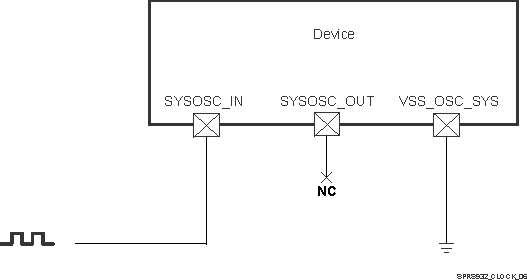 Figure 5-11 LVCMOS-Compatible Clock Input
 Table 5-17 details the SYSOSC_IN input clock timing requirements.
Table 5-17 SYSOSC_IN Input Clock Timing Requirements
| NAME | DESCRIPTION | MIN | TYP | MAX | UNIT | ||
|---|---|---|---|---|---|---|---|
| CK0 | fc(SYSOSC_IN) | Frequency, SYSOSC_IN | 19.2, 24, 25, 26 | MHz | |||
| CK1 | tw(SYSOSC_IN) | Pulse duration, SYSOSC_IN low or high | 1/(2.22 × fc(SYSOSC_IN)) | 1/(1.82 × fc(SYSOSC_IN)) | ns | ||
| tj(SYSOSC_IN) | Period jitter(1), SYSOSC_IN | 50 | ps | ||||
| tR(SYSOSC_IN) | Rise time, SYSOSC_IN | 5 | ns | ||||
| tF(SYSOSC_IN) | Fall time, SYSOSC_IN | 5 | ns | ||||
| fa(SYSOSC_IN) | Frequency accuracy(4), SYSOSC_IN | 50 | ppm | ||||
- Period jitter is meant here as follows:
- LVCMOS clock source frequency accuracy should include all components of frequency error - initial frequency tolerance, frequency stability across worst case environmental conditions, and frequency shifts due to aging.
– The maximum value is the difference between the longest measured clock period and the expected clock period
– The minimum value is the difference between the shortest measured clock period and the expected clock period
 Figure 5-12 SYSOSC_IN Input Clock