SWRU543B January 2019 – June 2025 CC3230S , CC3230SF , CC3235MODS , CC3235MODSF , CC3235S , CC3235SF
- 1
- Read This First
-
1 Architecture Overview
- 1.1 Introduction
- 1.2 Architecture Overview
- 1.3
Functional Overview
- 1.3.1 Processor Core
- 1.3.2 Memory
- 1.3.3 Micro-Direct Memory Access Controller (µDMA)
- 1.3.4 General-Purpose Timer (GPT)
- 1.3.5 Watchdog Timer (WDT)
- 1.3.6 Multichannel Audio Serial Port (McASP)
- 1.3.7 Serial Peripheral Interface (SPI)
- 1.3.8 Inter-Integrated Circuit (I2C) Interface
- 1.3.9 Universal Asynchronous Receiver/Transmitter (UART)
- 1.3.10 General-Purpose Input/Output (GPIO)
- 1.3.11 Analog-to-Digital Converter (ADC)
- 1.3.12 SD Card Host
- 1.3.13 Parallel Camera Interface
- 1.3.14 Debug Interface
- 1.3.15 Hardware Cryptography Accelerator
- 1.3.16 Clock, Reset, and Power Management
- 1.3.17 SimpleLink™ Subsystem
- 1.3.18 I/O Pads and Pin Multiplexing
-
2 Cortex®-M4 Processor
- 2.1 Overview
- 2.2 Functional Description
- 3 Cortex®-M4 Peripherals
- 4 Direct Memory Access (DMA)
- 5 General-Purpose Input/Outputs (GPIOs)
- 6 Universal Asynchronous Receivers/Transmitters (UARTs)
- 7 Inter-Integrated Circuit (I2C) Interface
-
8 SPI (Serial Peripheral Interface)
- 8.1 Overview
- 8.2
Functional Description
- 8.2.1 SPI
- 8.2.2 SPI Transmission
- 8.2.3 Master Mode
- 8.2.4 Slave Mode
- 8.2.5 Interrupts
- 8.2.6 DMA Requests
- 8.2.7 Reset
- 8.3 Initialization and Configuration
- 8.4 Access to Data Registers
- 8.5 Module Initialization
- 8.6 SPI Registers
- 9 General-Purpose Timers
- 10Watchdog Timer
- 11SD Host Controller Interface
-
12Inter-Integrated Sound (I2S) Multichannel Audio Serial Port
- 12.1 Overview
- 12.2 Functional Description
- 12.3 Programming Model
- 12.4
Peripheral Library APIs for I2S Configuration
- 12.4.1
Basic APIs for Enabling and Configuring the Interface
- 12.4.1.1 void I2SDisable (unsigned long ulBase)
- 12.4.1.2 void I2SEnable (unsigned long ulBase, unsigned long ulMode)
- 12.4.1.3 void I2SSerializerConfig (unsigned long ulBase, unsigned long ulDataLine, unsigned long ulSerMode, unsigned long ulInActState)
- 12.4.1.4 void I2SConfigSetExpClk (unsigned long ulBase, unsigned long ulI2SClk, unsigned long ulBitClk, unsigned long ulConfig)
- 12.4.2
APIs for Data Access if DMA is Not Used
- 12.4.2.1 void I2SDataGet (unsigned long ulBase, unsigned long ulDataLine, unsigned long * pulData)
- 12.4.2.2 long I2SDataGetNonBlocking (unsigned long ulBase, unsigned long ulDataLine, unsigned long * pulData)
- 12.4.2.3 void I2SDataPut (unsigned long ulBase, unsigned long ulDataLine, unsigned long ulData)
- 12.4.2.4 void I2SDataPut (unsigned long ulBase, unsigned long ulDataLine, unsigned long ulData)
- 12.4.3
APIs for Setting Up, Handling Interrupts, or Getting Status from I2S Peripheral
- 12.4.3.1 void I2SIntRegister (unsigned long ulBase, void(*)(void) pfnHandler)
- 12.4.3.2 void I2SIntEnable (unsigned long ulBase, unsigned long ulIntFlags)
- 12.4.3.3 void I2SIntDisable (unsigned long ulBase, unsigned long ulIntFlags)
- 12.4.3.4 unsigned long I2SIntStatus (unsigned long ulBase)
- 12.4.3.5 void I2SIntUnregister (unsigned long ulBase)
- 12.4.3.6 void I2SIntClear (unsigned long ulBase, unsigned long ulStatFlags)
- 12.4.3.7 Values that can be Passed to I2SIntEnable() and I2SIntDisable() as the ulIntFlags Parameter
- 12.4.3.8 Values that can be Passed to I2SIntClear() as the ulStatFlags Parameter and Returned from I2SIntStatus()
- 12.4.4
APIs to Control FIFO Structures Associated With I2S Peripheral
- 12.4.4.1 void I2SRxFIFODisable (unsigned long ulBase)
- 12.4.4.2 void I2SRxFIFOEnable (unsigned long ulBase, unsigned long ulRxLevel, unsigned long ulWordsPerTransfer)
- 12.4.4.3 unsigned long I2SRxFIFOStatusGet (unsigned long ulBase)
- 12.4.4.4 void I2STxFIFODisable (unsigned long ulBase)
- 12.4.4.5 void I2STxFIFOEnable (unsigned long ulBase, unsigned long ulTxLevel, unsigned long ulWordsPerTransfer)
- 12.4.4.6 unsigned long I2STxFIFOStatusGet (unsigned long ulBase)
- 12.4.1
Basic APIs for Enabling and Configuring the Interface
- 12.5 I2S Registers
-
13Analog-to-Digital Converter (ADC)
- 13.1 Overview
- 13.2 Key Features
- 13.3 ADC Register Mapping
- 13.4 ADC_MODULE Registers
- 13.5 Initialization and Configuration
- 13.6
Peripheral Library APIs for ADC Operation
- 13.6.1 Overview
- 13.6.2 Configuring the ADC Channels
- 13.6.3 Basic APIs for Enabling and Configuring the Interface
- 13.6.4
APIs for Data Transfer [Direct Access to FIFO and DMA Setup]
- 13.6.4.1 unsigned char ADCFIFOLvlGet (unsigned long ulBase, unsigned long ulChannel)
- 13.6.4.2 unsigned long ADCFIFORead (unsigned long ulBase, unsigned long ulChannel)
- 13.6.4.3 void ADCDMAEnable (unsigned long ulBase, unsigned long ulChannel)
- 13.6.4.4 void ADCDMADisable (unsigned long ulBase, unsigned long ulChannel)
- 13.6.5
APIs for Interrupt Usage
- 13.6.5.1 void ADCIntEnable (unsigned long ulBase, unsigned long ulChannel, unsigned long ulIntFlags)
- 13.6.5.2 void ADCIntDisable (unsigned long ulBase, unsigned long ulChannel, unsigned long ulIntFlags)
- 13.6.5.3 void ADCIntRegister (unsigned long ulBase, unsigned long ulChannel, void(*)(void) pfnHandler)
- 13.6.5.4 void ADCIntUnregister (unsigned long ulBase, unsigned long ulChannel)
- 13.6.5.5 unsigned long ADCIntStatus (unsigned long ulBase, unsigned long ulChannel)
- 13.6.5.6 void ADCIntClear (unsigned long ulBase, unsigned long ulChannel, unsigned long ulIntFlags)
- 13.6.6 APIs for Setting Up ADC Timer for Time-Stamping the Samples
- 14Parallel Camera Interface Module
- 15Power, Reset, and Clock Management
- 16I/O Pads and Pin Multiplexing
- 17Advance Encryption Standard Accelerator (AES)
- 18Data Encryption Standard Accelerator (DES)
-
19SHA/MD5 Accelerator
- 19.1
SHA/MD5 Functional Description
- 19.1.1 SHA/MD5 Block Diagram
- 19.1.2 µDMA and Interrupt Requests
- 19.1.3 Operation Description
- 19.1.4
SHA/MD5 Programming Guide
- 19.1.4.1
Global Initialization
- 19.1.4.1.1 Surrounding Modules Global Initialization
- 19.1.4.1.2 Starting a New HMAC using the SHA-1 Hash Function and HMAC Key Processing
- 19.1.4.1.3 Subsequence - Continuing a Prior HMAC Using the SHA-1 Hash Function
- 19.1.4.1.4 Subsequence - Hashing a Key Bigger than 512 Bits with the SHA-1 Hash Function
- 19.1.4.1.5 Operational Modes Configuration
- 19.1.4.1.6 SHA/MD5 Event Servicing
- 19.1.4.1
Global Initialization
- 19.2 SHA-MD5 Registers
- 19.1
SHA/MD5 Functional Description
- 20Cyclical Redundancy Check (CRC)
-
21On-Chip Parallel Flash
- 21.1 Flash Memory Configuration
- 21.2 Interrupts
- 21.3 Flash Memory Programming
- 21.4 32-Word Flash Memory Write Buffer
- 21.5 Flash Registers
- 21.6 CC323xSF Boot Flow
- 21.7 Flash User Application and Memory Partition
- 21.8 Programming, Bootstrapping, and Updating the Flash User Application
- 21.9 Image Authentication and Integrity Check
- 21.10 Debugging Flash User Application Using JTAG
- 22Revision History
- A Software Development Kit Examples
-
B CC323x Device Miscellaneous Registers
- 24.1 DMA_IMR Register (offset = 8Ch) [reset = FF0Fh]
- 24.2 DMA_IMS Register (offset = 90h) [reset = 0h]
- 24.3 DMA_IMC Register (offset = 94h) [reset = 0h]
- 24.4 DMA_ICR Register (offset = 9Ch) [reset = 0h]
- 24.5 DMA_MIS Register (offset = A0h) [reset = 0h]
- 24.6 DMA_RIS Register (offset = A4h) [reset = 0h]
- 24.7 GPTTRIGSEL Register (offset = B0h) [reset = 0h]
9.3.2.4 PWM Mode
The GPTM supports a simple PWM generation mode. In PWM mode, the timer is configured as a 24-bit down counter with a start value (and thus period) defined by the GPTMTnILR and GPTMTnPR registers. In this mode, the PWM frequency and period are synchronous events, and therefore ensured to be glitch-free. PWM mode is enabled in the GPTMTnMR register by setting the TnAMS bit to 0x1, the TnCMR bit to 0x0, and the TnMR field to 0x2. Table 9-7 lists the values loaded into the timer registers when the timer is enabled.
| Register | Count-Down Mode | Count-Up Mode |
|---|---|---|
| GPTMTnR | GPTMTnILR | Not available |
| GPTMTnV | GPTMTnILR | Not available |
When software writes the TnEN bit in the GPTMCTL register, the counter begins counting down until it reaches the 0x0 state. On the next counter cycle in periodic mode, the counter reloads its start value from the GPTMTnILR and GPTMTnPR registers, and continues counting until disabled by software clearing the TnEN bit in the GPTMCTL register. The timer can generate interrupts based on three types of events: rising edge, falling edge, or both. The event is configured by the TnEVENT field of the GPTMCTL register, and the interrupt is enabled by setting the TnPWMIE bit in the GPTMTnMR register. When the event occurs, the CnERIS bit is set in the GPTM Raw Interrupt Status (GPTMRIS) register, and is held until it is cleared by writing the GPTM Interrupt Clear (GPTMICR) register. If the capture mode event interrupt is enabled in the GPTM Interrupt Mask (GPTMIMR) register, the GPTM also sets the CnEMIS bit in the GPTM Masked Interrupt Status (GPTMMIS) register. The interrupt status bits are not updated unless the TnPWMIE bit is set.
In addition, when the TnPWMIE bit is set and a capture event occurs, the timer automatically generates triggers to the DMA if the trigger capability is enabled, by setting the TnOTE bit in the GPTMCTL register and the CnEDMAEN bit in the GPTMDMAEV register.
In this mode, the GPTMTnR and GPTMTnV registers always have the same value.
The output PWM signal asserts when the counter is at the value of the GPTMTnILR and GPTMTnPR registers (its start state), and is deasserted when the counter value equals the value in the GPTMTnMATCHR and GPTMTnPMR registers. Software can invert the output PWM signal by setting the TnPWML bit in the GPTMCTL register.
If PWM output inversion is enabled, edge-detection interrupt behavior is reversed. Thus, if a positive-edge interrupt trigger has been set and the PWM inversion generates a positive edge, no event-trigger interrupt asserts. Instead, the interrupt is generated on the negative edge of the PWM signal.
Figure 9-4 shows how to generate an output PWM with a 1-ms period and a 66% duty cycle assuming a 50-MHz input clock and TnPWML = 0 (duty cycle would be 33% for the TnPWML = 1 configuration). For this example, the start value is GPTMTnILR=0xC350, and the match value is GPTMTnMATCHR=0x411A.
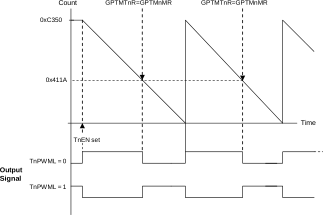 Figure 9-4 16-Bit PWM Mode Example