SPRUHM9H October 2014 – May 2024 TMS320F28075 , TMS320F28075-Q1 , TMS320F28076
- 1
- Read This First
- 1 C2000™ Microcontrollers Software Support
- 2 C28x Processor
-
3 System Control and Interrupt
- 3.1 Introduction
- 3.2 System Control Functional Description
- 3.3
Resets
- 3.3.1 Reset Sources
- 3.3.2 External Reset (XRS)
- 3.3.3 Power-On Reset (POR)
- 3.3.4 Debugger Reset (SYSRS)
- 3.3.5 Watchdog Reset (WDRS)
- 3.3.6 NMI Watchdog Reset (NMIWDRS)
- 3.3.7 DCSM Safe Code Copy Reset (SCCRESET)
- 3.3.8 Hibernate Reset (HIBRESET)
- 3.3.9 Hardware BIST Reset (HWBISTRS)
- 3.3.10 Test Reset (TRST)
- 3.4 Peripheral Interrupts
- 3.5 Exceptions and Non-Maskable Interrupts
- 3.6 Safety Features
- 3.7 Clocking
- 3.8 32-Bit CPU Timers 0/1/2
- 3.9 Watchdog Timers
- 3.10 Low-Power Modes
- 3.11
Memory Controller Module
- 3.11.1
Functional Description
- 3.11.1.1 Dedicated RAM (Dx RAM)
- 3.11.1.2 Local Shared RAM (LSx RAM)
- 3.11.1.3 Global Shared RAM (GSx RAM)
- 3.11.1.4 Message RAM (CLA MSGRAM)
- 3.11.1.5 Access Arbitration
- 3.11.1.6 Access Protection
- 3.11.1.7 Memory Error Detection, Correction and Error Handling
- 3.11.1.8 Application Test Hooks for Error Detection and Correction
- 3.11.1.9 RAM Initialization
- 3.11.1
Functional Description
- 3.12
Flash and OTP Memory
- 3.12.1 Features
- 3.12.2 Flash Tools
- 3.12.3 Default Flash Configuration
- 3.12.4 Flash Bank, One-Time Programmable (OTP) Memory, and Flash Pump
- 3.12.5 Flash Module Controller (FMC)
- 3.12.6 Flash and OTP Memory Power-Down Modes and Wakeup
- 3.12.7 Flash and OTP Memory Performance
- 3.12.8 Flash Read Interface
- 3.12.9 Erase/Program Flash
- 3.12.10 Error Correction Code (ECC) Protection
- 3.12.11 Reserved Locations Within Flash and OTP Memory
- 3.12.12 Procedure to Change the Flash Control Registers
- 3.12.13 Simple Procedure to Modify an Application from RAM Configuration to Flash Configuration
- 3.13
Dual Code Security Module (DCSM)
- 3.13.1 Functional Description
- 3.13.2 CSM Impact on Other On-Chip Resources
- 3.13.3
Incorporating Code Security in User Applications
- 3.13.3.1 Environments That Require Security Unlocking
- 3.13.3.2 CSM Password Match Flow
- 3.13.3.3 Unsecuring Considerations for Zones With and Without Code Security
- 3.13.3.4 Environments That Require ECSL Unlocking
- 3.13.3.5 ECSL Password Match Flow
- 3.13.3.6 ECSL Disable Considerations for any Zone
- 3.13.3.7 Device Unique ID
- 3.14 JTAG
- 3.15 System Control Register Configuration Restrictions
- 3.16 Software
- 3.17
System Control Registers
- 3.17.1 System Control Base Addresses
- 3.17.2 CPUTIMER_REGS Registers
- 3.17.3 PIE_CTRL_REGS Registers
- 3.17.4 WD_REGS Registers
- 3.17.5 NMI_INTRUPT_REGS Registers
- 3.17.6 XINT_REGS Registers
- 3.17.7 SYNC_SOC_REGS Registers
- 3.17.8 DMA_CLA_SRC_SEL_REGS Registers
- 3.17.9 DEV_CFG_REGS Registers
- 3.17.10 CLK_CFG_REGS Registers
- 3.17.11 CPU_SYS_REGS Registers
- 3.17.12 ROM_PREFETCH_REGS Registers
- 3.17.13 DCSM_Z1_REGS Registers
- 3.17.14 DCSM_Z2_REGS Registers
- 3.17.15 DCSM_COMMON_REGS Registers
- 3.17.16 MEM_CFG_REGS Registers
- 3.17.17 ACCESS_PROTECTION_REGS Registers
- 3.17.18 MEMORY_ERROR_REGS Registers
- 3.17.19 ROM_WAIT_STATE_REGS Registers
- 3.17.20 FLASH_CTRL_REGS Registers
- 3.17.21 FLASH_ECC_REGS Registers
- 3.17.22 UID_REGS Registers
- 3.17.23 DCSM_Z1_OTP Registers
- 3.17.24 DCSM_Z2_OTP Registers
- 3.17.25
Register to Driverlib Function Mapping
- 3.17.25.1 CPUTIMER Registers to Driverlib Functions
- 3.17.25.2 ASYSCTL Registers to Driverlib Functions
- 3.17.25.3 PIE Registers to Driverlib Functions
- 3.17.25.4 SYSCTL Registers to Driverlib Functions
- 3.17.25.5 NMI Registers to Driverlib Functions
- 3.17.25.6 XINT Registers to Driverlib Functions
- 3.17.25.7 DCSM Registers to Driverlib Functions
- 3.17.25.8 MEMCFG Registers to Driverlib Functions
- 3.17.25.9 FLASH Registers to Driverlib Functions
-
4 ROM Code and Peripheral Booting
- 4.1 Introduction
- 4.2 Boot ROM Registers
- 4.3 Device Boot Sequence
- 4.4 Device Boot Modes
- 4.5 Configuring Boot Mode Pins
- 4.6 Configuring Get Boot Options
- 4.7 Configuring Emulation Boot Options
- 4.8 Device Boot Flow Diagrams
- 4.9 Device Reset and Exception Handling
- 4.10 Boot ROM Description
- 5 Direct Memory Access (DMA)
-
6 Control Law Accelerator (CLA)
- 6.1 Introduction
- 6.2 CLA Interface
- 6.3 CLA and CPU Arbitration
- 6.4 CLA Configuration and Debug
- 6.5 Pipeline
- 6.6 Software
- 6.7
Instruction Set
- 6.7.1 Instruction Descriptions
- 6.7.2 Addressing Modes and Encoding
- 6.7.3
Instructions
- MABSF32 MRa, MRb
- MADD32 MRa, MRb, MRc
- MADDF32 MRa, #16FHi, MRb
- MADDF32 MRa, MRb, #16FHi
- MADDF32 MRa, MRb, MRc
- MADDF32 MRd, MRe, MRf||MMOV32 mem32, MRa
- MADDF32 MRd, MRe, MRf ||MMOV32 MRa, mem32
- MAND32 MRa, MRb, MRc
- MASR32 MRa, #SHIFT
- MBCNDD 16BitDest [, CNDF]
- MCCNDD 16BitDest [, CNDF]
- MCMP32 MRa, MRb
- MCMPF32 MRa, MRb
- MCMPF32 MRa, #16FHi
- MDEBUGSTOP
- MEALLOW
- MEDIS
- MEINVF32 MRa, MRb
- MEISQRTF32 MRa, MRb
- MF32TOI16 MRa, MRb
- MF32TOI16R MRa, MRb
- MF32TOI32 MRa, MRb
- MF32TOUI16 MRa, MRb
- MF32TOUI16R MRa, MRb
- MF32TOUI32 MRa, MRb
- MFRACF32 MRa, MRb
- MI16TOF32 MRa, MRb
- MI16TOF32 MRa, mem16
- MI32TOF32 MRa, mem32
- MI32TOF32 MRa, MRb
- MLSL32 MRa, #SHIFT
- MLSR32 MRa, #SHIFT
- MMACF32 MR3, MR2, MRd, MRe, MRf ||MMOV32 MRa, mem32
- MMAXF32 MRa, MRb
- MMAXF32 MRa, #16FHi
- MMINF32 MRa, MRb
- MMINF32 MRa, #16FHi
- MMOV16 MARx, MRa, #16I
- MMOV16 MARx, mem16
- MMOV16 mem16, MARx
- MMOV16 mem16, MRa
- MMOV32 mem32, MRa
- MMOV32 mem32, MSTF
- MMOV32 MRa, mem32 [, CNDF]
- MMOV32 MRa, MRb [, CNDF]
- MMOV32 MSTF, mem32
- MMOVD32 MRa, mem32
- MMOVF32 MRa, #32F
- MMOVI16 MARx, #16I
- MMOVI32 MRa, #32FHex
- MMOVIZ MRa, #16FHi
- MMOVZ16 MRa, mem16
- MMOVXI MRa, #16FLoHex
- MMPYF32 MRa, MRb, MRc
- MMPYF32 MRa, #16FHi, MRb
- MMPYF32 MRa, MRb, #16FHi
- MMPYF32 MRa, MRb, MRc||MADDF32 MRd, MRe, MRf
- MMPYF32 MRd, MRe, MRf ||MMOV32 MRa, mem32
- MMPYF32 MRd, MRe, MRf ||MMOV32 mem32, MRa
- MMPYF32 MRa, MRb, MRc ||MSUBF32 MRd, MRe, MRf
- MNEGF32 MRa, MRb[, CNDF]
- MNOP
- MOR32 MRa, MRb, MRc
- MRCNDD [CNDF]
- MSETFLG FLAG, VALUE
- MSTOP
- MSUB32 MRa, MRb, MRc
- MSUBF32 MRa, MRb, MRc
- MSUBF32 MRa, #16FHi, MRb
- MSUBF32 MRd, MRe, MRf ||MMOV32 MRa, mem32
- MSUBF32 MRd, MRe, MRf ||MMOV32 mem32, MRa
- MSWAPF MRa, MRb [, CNDF]
- MTESTTF CNDF
- MUI16TOF32 MRa, mem16
- MUI16TOF32 MRa, MRb
- MUI32TOF32 MRa, mem32
- MUI32TOF32 MRa, MRb
- MXOR32 MRa, MRb, MRc
- 6.8 CLA Registers
- 7 General-Purpose Input/Output (GPIO)
- 8 Crossbar (X-BAR)
- 9 Analog Subsystem
-
10Analog-to-Digital Converter (ADC)
- 10.1 Introduction
- 10.2 ADC Configurability
- 10.3 SOC Principle of Operation
- 10.4 SOC Configuration Examples
- 10.5 ADC Conversion Priority
- 10.6 Burst Mode
- 10.7 EOC and Interrupt Operation
- 10.8 Post-Processing Blocks
- 10.9 Opens/Shorts Detection Circuit (OSDETECT)
- 10.10 Power-Up Sequence
- 10.11 ADC Calibration
- 10.12 ADC Timings
- 10.13 Additional Information
- 10.14
Software
- 10.14.1
ADC Examples
- 10.14.1.1 ADC Software Triggering
- 10.14.1.2 ADC ePWM Triggering
- 10.14.1.3 ADC Temperature Sensor Conversion
- 10.14.1.4 ADC Synchronous SOC Software Force (adc_soc_software_sync)
- 10.14.1.5 ADC Continuous Triggering (adc_soc_continuous)
- 10.14.1.6 ADC PPB Offset (adc_ppb_offset)
- 10.14.1.7 ADC PPB Limits (adc_ppb_limits)
- 10.14.1.8 ADC PPB Delay Capture (adc_ppb_delay)
- 10.14.1.9 ADC ePWM Triggering Multiple SOC
- 10.14.1.10 ADC Burst Mode
- 10.14.1.11 ADC Burst Mode Oversampling
- 10.14.1.12 ADC SOC Oversampling
- 10.14.1.13 ADC PPB PWM trip (adc_ppb_pwm_trip)
- 10.14.1
ADC Examples
- 10.15 ADC Registers
- 11Buffered Digital-to-Analog Converter (DAC)
- 12Comparator Subsystem (CMPSS)
- 13Sigma Delta Filter Module (SDFM)
-
14Enhanced Pulse Width Modulator (ePWM)
- 14.1 Introduction
- 14.2 Configuring Device Pins
- 14.3 ePWM Modules Overview
- 14.4
Time-Base (TB) Submodule
- 14.4.1 Purpose of the Time-Base Submodule
- 14.4.2 Controlling and Monitoring the Time-Base Submodule
- 14.4.3 Calculating PWM Period and Frequency
- 14.4.4 Phase Locking the Time-Base Clocks of Multiple ePWM Modules
- 14.4.5 Simultaneous Writes to TBPRD and CMPx Registers Between ePWM Modules
- 14.4.6 Time-Base Counter Modes and Timing Waveforms
- 14.4.7 Global Load
- 14.5 Counter-Compare (CC) Submodule
- 14.6 Action-Qualifier (AQ) Submodule
- 14.7 Dead-Band Generator (DB) Submodule
- 14.8 PWM Chopper (PC) Submodule
- 14.9 Trip-Zone (TZ) Submodule
- 14.10 Event-Trigger (ET) Submodule
- 14.11 Digital Compare (DC) Submodule
- 14.12 ePWM Crossbar (X-BAR)
- 14.13
Applications to Power Topologies
- 14.13.1 Overview of Multiple Modules
- 14.13.2 Key Configuration Capabilities
- 14.13.3 Controlling Multiple Buck Converters With Independent Frequencies
- 14.13.4 Controlling Multiple Buck Converters With Same Frequencies
- 14.13.5 Controlling Multiple Half H-Bridge (HHB) Converters
- 14.13.6 Controlling Dual 3-Phase Inverters for Motors (ACI and PMSM)
- 14.13.7 Practical Applications Using Phase Control Between PWM Modules
- 14.13.8 Controlling a 3-Phase Interleaved DC/DC Converter
- 14.13.9 Controlling Zero Voltage Switched Full Bridge (ZVSFB) Converter
- 14.13.10 Controlling a Peak Current Mode Controlled Buck Module
- 14.13.11 Controlling H-Bridge LLC Resonant Converter
- 14.14
High-Resolution Pulse Width Modulator (HRPWM)
- 14.14.1
Operational Description of HRPWM
- 14.14.1.1 Controlling the HRPWM Capabilities
- 14.14.1.2 HRPWM Source Clock
- 14.14.1.3 Configuring the HRPWM
- 14.14.1.4 Configuring High-Resolution in Deadband Rising-Edge and Falling-Edge Delay
- 14.14.1.5 Principle of Operation
- 14.14.1.6 Deadband High-Resolution Operation
- 14.14.1.7 Scale Factor Optimizing Software (SFO)
- 14.14.1.8 HRPWM Examples Using Optimized Assembly Code
- 14.14.2 SFO Library Software - SFO_TI_Build_V8.lib
- 14.14.1
Operational Description of HRPWM
- 14.15 ePWM Registers
-
15Enhanced Capture (eCAP)
- 15.1 Introduction
- 15.2 Description
- 15.3 Configuring Device Pins for the eCAP
- 15.4 Capture and APWM Operating Mode
- 15.5
Capture Mode Description
- 15.5.1 Event Prescaler
- 15.5.2 Edge Polarity Select and Qualifier
- 15.5.3 Continuous/One-Shot Control
- 15.5.4 32-Bit Counter and Phase Control
- 15.5.5 CAP1-CAP4 Registers
- 15.5.6 eCAP Synchronization
- 15.5.7 Interrupt Control
- 15.5.8 DMA Interrupt
- 15.5.9 Shadow Load and Lockout Control
- 15.5.10 APWM Mode Operation
- 15.6
Application of the eCAP Module
- 15.6.1 Example 1 - Absolute Time-Stamp Operation Rising-Edge Trigger
- 15.6.2 Example 2 - Absolute Time-Stamp Operation Rising- and Falling-Edge Trigger
- 15.6.3 Example 3 - Time Difference (Delta) Operation Rising-Edge Trigger
- 15.6.4 Example 4 - Time Difference (Delta) Operation Rising- and Falling-Edge Trigger
- 15.7 Application of the APWM Mode
- 15.8 Software
- 15.9 eCAP Registers
-
16Enhanced Quadrature
Encoder Pulse (eQEP)
- 16.1 Introduction
- 16.2 Configuring Device Pins
- 16.3 Description
- 16.4 Quadrature Decoder Unit (QDU)
- 16.5 Position Counter and Control Unit (PCCU)
- 16.6 eQEP Edge Capture Unit
- 16.7 eQEP Watchdog
- 16.8 eQEP Unit Timer Base
- 16.9 eQEP Interrupt Structure
- 16.10 eQEP Registers
-
17Serial Peripheral Interface (SPI)
- 17.1 Introduction
- 17.2 System-Level Integration
- 17.3 SPI Operation
- 17.4 Programming Procedure
- 17.5 Software
- 17.6 SPI Registers
-
18Serial Communications Interface (SCI)
- 18.1 Introduction
- 18.2 Architecture
- 18.3 SCI Module Signal Summary
- 18.4 Configuring Device Pins
- 18.5 Multiprocessor and Asynchronous Communication Modes
- 18.6 SCI Programmable Data Format
- 18.7 SCI Multiprocessor Communication
- 18.8 Idle-Line Multiprocessor Mode
- 18.9 Address-Bit Multiprocessor Mode
- 18.10 SCI Communication Format
- 18.11 SCI Port Interrupts
- 18.12 SCI Baud Rate Calculations
- 18.13 SCI Enhanced Features
- 18.14 Software
- 18.15 SCI Registers
-
19Inter-Integrated Circuit Module (I2C)
- 19.1 Introduction
- 19.2 Configuring Device Pins
- 19.3
I2C Module Operational Details
- 19.3.1 Input and Output Voltage Levels
- 19.3.2 Selecting Pullup Resistors
- 19.3.3 Data Validity
- 19.3.4 Operating Modes
- 19.3.5 I2C Module START and STOP Conditions
- 19.3.6 Non-repeat Mode versus Repeat Mode
- 19.3.7 Serial Data Formats
- 19.3.8 Clock Synchronization
- 19.3.9 Arbitration
- 19.3.10 Digital Loopback Mode
- 19.3.11 NACK Bit Generation
- 19.4 Interrupt Requests Generated by the I2C Module
- 19.5 Resetting or Disabling the I2C Module
- 19.6
Software
- 19.6.1
I2C Examples
- 19.6.1.1 C28x-I2C Library source file for FIFO interrupts
- 19.6.1.2 C28x-I2C Library source file for FIFO using polling
- 19.6.1.3 C28x-I2C Library source file for FIFO interrupts
- 19.6.1.4 I2C Digital Loopback with FIFO Interrupts
- 19.6.1.5 I2C EEPROM
- 19.6.1.6 I2C Digital External Loopback with FIFO Interrupts
- 19.6.1.7 I2C EEPROM
- 19.6.1.8 I2C controller target communication using FIFO interrupts
- 19.6.1.9 I2C EEPROM
- 19.6.1
I2C Examples
- 19.7 I2C Registers
-
20Multichannel Buffered Serial Port (McBSP)
- 20.1 Introduction
- 20.2 Configuring Device Pins
- 20.3
McBSP Operation
- 20.3.1 Data Transfer Process of McBSPs
- 20.3.2 Companding (Compressing and Expanding) Data
- 20.3.3 Clocking and Framing Data
- 20.3.4 Frame Phases
- 20.3.5 McBSP Reception
- 20.3.6 McBSP Transmission
- 20.3.7 Interrupts and DMA Events Generated by a McBSP
- 20.4 McBSP Sample Rate Generator
- 20.5 McBSP Exception/Error Conditions
- 20.6
Multichannel Selection Modes
- 20.6.1 Channels, Blocks, and Partitions
- 20.6.2 Multichannel Selection
- 20.6.3 Configuring a Frame for Multichannel Selection
- 20.6.4 Using Two Partitions
- 20.6.5 Using Eight Partitions
- 20.6.6 Receive Multichannel Selection Mode
- 20.6.7 Transmit Multichannel Selection Modes
- 20.6.8 Using Interrupts Between Block Transfers
- 20.7 SPI Operation Using the Clock Stop Mode
- 20.8
Receiver Configuration
- 20.8.1 Programming the McBSP Registers for the Desired Receiver Operation
- 20.8.2 Resetting and Enabling the Receiver
- 20.8.3 Set the Receiver Pins to Operate as McBSP Pins
- 20.8.4 Digital Loopback Mode
- 20.8.5 Clock Stop Mode
- 20.8.6 Receive Multichannel Selection Mode
- 20.8.7 Receive Frame Phases
- 20.8.8 Receive Word Lengths
- 20.8.9 Receive Frame Length
- 20.8.10 Receive Frame-Synchronization Ignore Function
- 20.8.11 Receive Companding Mode
- 20.8.12 Receive Data Delay
- 20.8.13 Receive Sign-Extension and Justification Mode
- 20.8.14 Receive Interrupt Mode
- 20.8.15 Receive Frame-Synchronization Mode
- 20.8.16 Receive Frame-Synchronization Polarity
- 20.8.17 Receive Clock Mode
- 20.8.18 Receive Clock Polarity
- 20.8.19 SRG Clock Divide-Down Value
- 20.8.20 SRG Clock Synchronization Mode
- 20.8.21 SRG Clock Mode (Choose an Input Clock)
- 20.8.22 SRG Input Clock Polarity
- 20.9
Transmitter Configuration
- 20.9.1 Programming the McBSP Registers for the Desired Transmitter Operation
- 20.9.2 Resetting and Enabling the Transmitter
- 20.9.3 Set the Transmitter Pins to Operate as McBSP Pins
- 20.9.4 Digital Loopback Mode
- 20.9.5 Clock Stop Mode
- 20.9.6 Transmit Multichannel Selection Mode
- 20.9.7 XCERs Used in the Transmit Multichannel Selection Mode
- 20.9.8 Transmit Frame Phases
- 20.9.9 Transmit Word Lengths
- 20.9.10 Transmit Frame Length
- 20.9.11 Enable/Disable the Transmit Frame-Synchronization Ignore Function
- 20.9.12 Transmit Companding Mode
- 20.9.13 Transmit Data Delay
- 20.9.14 Transmit DXENA Mode
- 20.9.15 Transmit Interrupt Mode
- 20.9.16 Transmit Frame-Synchronization Mode
- 20.9.17 Transmit Frame-Synchronization Polarity
- 20.9.18 SRG Frame-Synchronization Period and Pulse Width
- 20.9.19 Transmit Clock Mode
- 20.9.20 Transmit Clock Polarity
- 20.10
Emulation and Reset Considerations
- 20.10.1 McBSP Emulation Mode
- 20.10.2 Resetting and Initializing McBSPs
- 20.11 Data Packing Examples
- 20.12 Interrupt Generation
- 20.13 McBSP Modes
- 20.14 Special Case: External Device is the Transmit Frame Master
- 20.15 Software
- 20.16 McBSP Registers
-
21Controller Area Network (CAN)
- 21.1 Introduction
- 21.2 Functional Description
- 21.3 Operating Modes
- 21.4 Multiple Clock Source
- 21.5 Interrupt Functionality
- 21.6 Parity Check Mechanism
- 21.7 Debug Mode
- 21.8 Module Initialization
- 21.9 Configuration of Message Objects
- 21.10
Message Handling
- 21.10.1 Message Handler Overview
- 21.10.2 Receive/Transmit Priority
- 21.10.3 Transmission of Messages in Event Driven CAN Communication
- 21.10.4 Updating a Transmit Object
- 21.10.5 Changing a Transmit Object
- 21.10.6 Acceptance Filtering of Received Messages
- 21.10.7 Reception of Data Frames
- 21.10.8 Reception of Remote Frames
- 21.10.9 Reading Received Messages
- 21.10.10 Requesting New Data for a Receive Object
- 21.10.11 Storing Received Messages in FIFO Buffers
- 21.10.12 Reading from a FIFO Buffer
- 21.11 CAN Bit Timing
- 21.12 Message Interface Register Sets
- 21.13 Message RAM
- 21.14 Software
- 21.15 CAN Registers
-
22Universal Serial Bus (USB) Controller
- 22.1 Introduction
- 22.2 Functional Description
- 22.3 Initialization and Configuration
- 22.4 USB Global Interrupts
- 22.5 Software
- 22.6
USB Registers
- 22.6.1 USB Base Address
- 22.6.2 USB Register Map
- 22.6.3
Register Descriptions
- 22.6.3.1 USB Device Functional Address Register (USBFADDR), offset 0x000
- 22.6.3.2 USB Power Management Register (USBPOWER), offset 0x001
- 22.6.3.3 USB Transmit Interrupt Status Register
- 22.6.3.4 USB Receive Interrupt Status Register
- 22.6.3.5 USB Transmit Interrupt Enable Register
- 22.6.3.6 USB Receive Interrupt Enable Register
- 22.6.3.7 USB General Interrupt Status Register (USBIS), offset 0x00A
- 22.6.3.8 USB Interrupt Enable Register (USBIE), offset 0x00B
- 22.6.3.9 USB Frame Value Register (USBFRAME), offset 0x00C
- 22.6.3.10 USB Endpoint Index Register (USBEPIDX), offset 0x00E
- 22.6.3.11 USB Test Mode Register (USBTEST), offset 0x00F
- 22.6.3.12 USB FIFO Endpoint n Register (USBFIFO[0]-USBFIFO[3])
- 22.6.3.13 USB Device Control Register (USBDEVCTL), offset 0x060
- 22.6.3.14 USB Transmit Dynamic FIFO Sizing Register (USBTXFIFOSZ), offset 0x062
- 22.6.3.15 USB Receive Dynamic FIFO Sizing Register (USBRXFIFOSZ), offset 0x063
- 22.6.3.16 USB Transmit FIFO Start Address Register (USBTXFIFOADD), offset 0x064
- 22.6.3.17 USB Receive FIFO Start Address Register (USBRXFIFOADD), offset 0x066
- 22.6.3.18 USB Connect Timing Register (USBCONTIM), offset 0x07A
- 22.6.3.19 USB Full-Speed Last Transaction to End of Frame Timing Register (USBFSEOF), offset 0x07D
- 22.6.3.20 USB Low-Speed Last Transaction to End of Frame Timing Register (USBLSEOF), offset 0x07E
- 22.6.3.21 USB Transmit Functional Address Endpoint n Registers (USBTXFUNCADDR[0]-USBTXFUNCADDR[n])
- 22.6.3.22 USB Transmit Hub Address Endpoint n Registers (USBTXHUBADDR[0]-USBTXHUBADDR[n])
- 22.6.3.23 USB Transmit Hub Port Endpoint n Registers (USBTXHUBPORT[0]-USBTXHUBPORT[n])
- 22.6.3.24 USB Receive Functional Address Endpoint n Registers (USBRXFUNCADDR[1]-USBRXFUNCADDR[n)
- 22.6.3.25 USB Receive Hub Address Endpoint n Registers (USBRXHUBADDR[1]-USBRXHUBADDR[n])
- 22.6.3.26 USB Receive Hub Port Endpoint n Register (USBRXHUBPORT[1]-USBRXHUBPORT[n])
- 22.6.3.27 USB Maximum Transmit Data Endpoint n Registers (USBTXMAXP[1]-USBTXMAXP[n])
- 22.6.3.28 USB Control and Status Endpoint 0 Low Register (USBCSRL0), offset 0x102
- 22.6.3.29 USB Control and Status Endpoint 0 High Register (USBCSRH0), offset 0x103
- 22.6.3.30 USB Receive Byte Count Endpoint 0 Register (USBCOUNT0), offset 0x108
- 22.6.3.31 USB Type Endpoint 0 Register (USBTYPE0), offset 0x10A
- 22.6.3.32 USB NAK Limit Register (USBNAKLMT), offset 0x10B
- 22.6.3.33 USB Transmit Control and Status Endpoint n Low Register (USBTXCSRL[1]-USBTXCSRL[n])
- 22.6.3.34 USB Transmit Control and Status Endpoint n High Register (USBTXCSRH[1]-USBTXCSRH[n])
- 22.6.3.35 USB Maximum Receive Data Endpoint n Registers (USBRXMAXP[1]-USBRXMAXP[n])
- 22.6.3.36 USB Receive Control and Status Endpoint n Low Register (USBRXCSRL[1]-USBRXCSRL[n])
- 22.6.3.37 USB Receive Control and Status Endpoint n High Register (USBRXCSRH[1]-USBRXCSRH[n])
- 22.6.3.38 USB Receive Byte Count Endpoint n Register (USBRXCOUNT[1]-USBRXCOUNT[n])
- 22.6.3.39 USB Host Transmit Configure Type Endpoint n Registers (USBTXTYPE[1]-USBTXTYPE[n])
- 22.6.3.40 USB Host Transmit Interval Endpoint n Registers (USBTXINTERVAL[1]-USBTXINTERVAL[n])
- 22.6.3.41 USB Host Configure Receive Type Endpoint n Register (USBRXTYPE[1]-USBRXTYPE[n])
- 22.6.3.42 USB Host Receive Polling Interval Endpoint n Registers (USBRXINTERVAL[1]-USBRXINTERVAL[n])
- 22.6.3.43 USB Request Packet Count in Block Transfer Endpoint n Registers (USBRQPKTCOUNT[1]-USBRQPKTCOUNT[n])
- 22.6.3.44 USB Receive Double Packet Buffer Disable Register (USBRXDPKTBUFDIS), offset 0x340
- 22.6.3.45 USB Transmit Double Packet Buffer Disable Register (USBTXDPKTBUFDIS), offset 0x342
- 22.6.3.46 USB External Power Control Register (USBEPC), offset 0x400
- 22.6.3.47 USB External Power Control Raw Interrupt Status Register (USBEPCRIS), offset 0x404
- 22.6.3.48 USB External Power Control Interrupt Mask Register (USBEPCIM), offset 0x408
- 22.6.3.49 USB External Power Control Interrupt Status and Clear Register (USBEPCISC), offset 0x40C
- 22.6.3.50 USB Device RESUME Raw Interrupt Status Register (USBDRRIS), offset 0x410
- 22.6.3.51 USB Device RESUME Raw Interrupt Mask Register (USBDRIM), offset 0x414
- 22.6.3.52 USB Device RESUME Interrupt Status and Clear Register (USBDRISC), offset 0x418
- 22.6.3.53 USB General-Purpose Control and Status Register (USBGPCS), offset 0x41C
- 22.6.3.54 USB DMA Select Register (USBDMASEL), offset 0x450
- 22.6.4 USB Registers to Driverlib Functions
-
23External Memory Interface (EMIF)
- 23.1 Introduction
- 23.2
EMIF Module Architecture
- 23.2.1 EMIF Clock Control
- 23.2.2 EMIF Requests
- 23.2.3 EMIF Signal Descriptions
- 23.2.4 EMIF Signal Multiplexing Control
- 23.2.5
SDRAM Controller and Interface
- 23.2.5.1 SDRAM Commands
- 23.2.5.2 Interfacing to SDRAM
- 23.2.5.3 SDRAM Configuration Registers
- 23.2.5.4 SDRAM Auto-Initialization Sequence
- 23.2.5.5 SDRAM Configuration Procedure
- 23.2.5.6 EMIF Refresh Controller
- 23.2.5.7 Self-Refresh Mode
- 23.2.5.8 Power-Down Mode
- 23.2.5.9 SDRAM Read Operation
- 23.2.5.10 SDRAM Write Operations
- 23.2.5.11 Mapping from Logical Address to EMIF Pins
- 23.2.6 Asynchronous Controller and Interface
- 23.2.7 Data Bus Parking
- 23.2.8 Reset and Initialization Considerations
- 23.2.9 Interrupt Support
- 23.2.10 DMA Event Support
- 23.2.11 EMIF Signal Multiplexing
- 23.2.12 Memory Map
- 23.2.13 Priority and Arbitration
- 23.2.14 System Considerations
- 23.2.15 Power Management
- 23.2.16 Emulation Considerations
- 23.3
Example Configuration
- 23.3.1 Hardware Interface
- 23.3.2
Software Configuration
- 23.3.2.1
Configuring the SDRAM Interface
- 23.3.2.1.1 PLL Programming for EMIF to K4S641632H-TC(L)70 Interface
- 23.3.2.1.2 SDRAM Timing Register (SDRAM_TR) Settings for EMIF to K4S641632H-TC(L)70 Interface
- 23.3.2.1.3 SDRAM Self Refresh Exit Timing Register (SDR_EXT_TMNG) Settings for EMIF to K4S641632H-TC(L)70 Interface
- 23.3.2.1.4 SDRAM Refresh Control Register (SDRAM_RCR) Settings for EMIF to K4S641632H-TC(L)70 Interface
- 23.3.2.1.5 SDRAM Configuration Register (SDRAM_CR) Settings for EMIF to K4S641632H-TC(L)70 Interface
- 23.3.2.2 Configuring the Flash Interface
- 23.3.2.1
Configuring the SDRAM Interface
- 23.4 EMIF Registers
-
24Configurable Logic Block (CLB)
- 24.1 Introduction
- 24.2 Description
- 24.3 CLB Input/Output Connection
- 24.4 CLB Tile
- 24.5 CPU Interface
- 24.6 DMA Access
- 24.7
Software
- 24.7.1
CLB Examples
- 24.7.1.1 CLB Empty Project
- 24.7.1.2 CLB Combinational Logic
- 24.7.1.3 CLB GPIO Input Filter
- 24.7.1.4 CLB Auxilary PWM
- 24.7.1.5 CLB PWM Protection
- 24.7.1.6 CLB Event Window
- 24.7.1.7 CLB Signal Generator
- 24.7.1.8 CLB State Machine
- 24.7.1.9 CLB External Signal AND Gate
- 24.7.1.10 CLB Timer
- 24.7.1.11 CLB Timer Two States
- 24.7.1.12 CLB Interrupt Tag
- 24.7.1.13 CLB Output Intersect
- 24.7.1.14 CLB PUSH PULL
- 24.7.1.15 CLB Multi Tile
- 24.7.1.16 CLB Tile to Tile Delay
- 24.7.1.17 CLB based One-shot PWM
- 24.7.1.18 CLB Trip Zone Timestamp
- 24.7.1
CLB Examples
- 24.8 CLB Registers
- 25Revision History
20.4.1.3 Choosing a Polarity for the Input Clock
As shown in Figure 20-18, when the input clock is received from a pin, you can choose the polarity of the input clock. The rising edge of CLKSRG generates CLKG and FSG, but you can determine which edge of the input clock causes a rising edge on CLKSRG. The polarity options and their effects are described in Table 20-6.
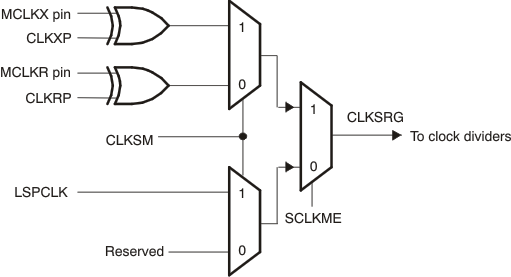 Figure 20-18 Possible Inputs to the Sample Rate Generator
and the Polarity Bits
Figure 20-18 Possible Inputs to the Sample Rate Generator
and the Polarity Bits
Table 20-6 Polarity Options for the Input to the Sample
Rate Generator
| Input Clock | Polarity Option | Effect |
|---|---|---|
| LSPCLK | Always positive polarity | Rising edge of CPU clock generates transitions on CLKG and FSG. |
| Signal on MCLKR pin | CLKRP = 0 in PCR | Falling edge on MCLKR pin generates transitions on CLKG and FSG. |
| CLKRP = 1 in PCR | Rising edge on MCLKR pin generates transitions on CLKG and FSG. | |
| Signal on MCLKX pin | CLKXP = 0 in PCR | Rising edge on MCLKX pin generates transitions on CLKG and FSG. |
| CLKXP = 1 in PCR | Falling edge on MCLKX pin generates transitions on CLKG and FSG. |