SLUSFR7 August   2025 BQ24810

PRODUCTION DATA  

  1.   1
  2. Features
  3. Applications
  4. Description
  5. Pin Configuration and Functions
  6. Specifications
    1. 5.1 Absolute Maximum Ratings
    2. 5.2 ESD Ratings
    3. 5.3 Recommended Operating Conditions
    4. 5.4 Thermal Information
    5. 5.5 Electrical Characteristics
    6. 5.6 Timing Requirements
    7. 5.7 Typical Characteristics
  7. Detailed Description
    1. 6.1 Overview
    2. 6.2 Functional Block Diagram
    3. 6.3 Feature Description
      1. 6.3.1 Device Power Up
        1. 6.3.1.1 Battery Only
        2. 6.3.1.2 Adapter Detect and ACOK Output
          1. 6.3.1.2.1 Adapter Overvoltage (ACOV)
        3. 6.3.1.3 REGN LDO
      2. 6.3.2 System Power Selection
      3. 6.3.3 Current and Power Monitor
        1. 6.3.3.1 High Accuracy Current Sense Amplifier (IADP and IDCHG)
        2. 6.3.3.2 High Accuracy Power Sense Amplifier (PMON)
      4. 6.3.4 Processor Hot Indication for CPU Throttling
      5. 6.3.5 Input Current Dynamic Power Management
        1. 6.3.5.1 Setting Input Current Limit
      6. 6.3.6 Two-Level Adapter Current Limit (Peak Power Mode)
      7. 6.3.7 EMI Switching Frequency Adjust
      8. 6.3.8 Device Protections Features
        1. 6.3.8.1 Charger Timeout
        2. 6.3.8.2 Input Overcurrent Protection (ACOC)
        3. 6.3.8.3 Charge Overcurrent Protection (CHG_OCP)
        4. 6.3.8.4 Battery Overvoltage Protection (BATOVP)
        5. 6.3.8.5 Battery Short
        6. 6.3.8.6 Thermal Shutdown Protection (TSHUT)
        7. 6.3.8.7 Inductor Short, MOSFET Short Protection
    4. 6.4 Device Functional Modes
      1. 6.4.1 Battery Charging in Buck Mode
        1. 6.4.1.1 Setting the Charge Current
        2. 6.4.1.2 Setting the Charge Voltage
        3. 6.4.1.3 Automatic Internal Soft-Start Charger Current
      2. 6.4.2 Hybrid Power Boost Mode
      3. 6.4.3 Battery Only Boost Mode
        1. 6.4.3.1 Setting AC_PLUG_EXIT_DEG in Battery Only Boost Mode
        2. 6.4.3.2 Setting Minimum System Voltage in Battery Only Boost Mode
      4. 6.4.4 Battery Discharge Current Regulation in Hybrid Boost Mode and Battery Only Boost Mode
      5. 6.4.5 Battery LEARN Cycle
      6. 6.4.6 Converter Operational Modes
        1. 6.4.6.1 Continuous Conduction Mode (CCM)
        2. 6.4.6.2 Discontinuous Conduction Mode (DCM)
        3. 6.4.6.3 Non-Sync Mode and Light Load Comparator
    5. 6.5 Programming
      1. 6.5.1 SMBus Interface
        1. 6.5.1.1 SMBus Write-Word and Read-Word Protocols
        2. 6.5.1.2 Timing Diagrams
    6. 6.6 Register Maps
      1. 6.6.1  Battery-Charger Commands
      2. 6.6.2  Setting Charger Options
        1. 6.6.2.1 ChargeOption0 Register
      3. 6.6.3  ChargeOption1 Register
      4. 6.6.4  ChargeOption2 Register
      5. 6.6.5  ChargeOption3 Register
      6. 6.6.6  ChargeOption4 Register
      7. 6.6.7  ProchotOption0 Register
      8. 6.6.8  ProchotOption1 Register
      9. 6.6.9  ProchotStatus Register
      10. 6.6.10 Charge Current Register
      11. 6.6.11 Charge Voltage Register
      12. 6.6.12 Discharge Current Register
      13. 6.6.13 Minimum System Voltage Register
      14. 6.6.14 Input Current Register
      15. 6.6.15 Register Exceptions
  8. Application and Implementation
    1. 7.1 Application Information
    2. 7.2 Typical Applications
      1. 7.2.1 Typical System Schematic
        1. 7.2.1.1 Design Requirements
        2. 7.2.1.2 Detailed Design Procedure
          1. 7.2.1.2.1  Adapter Current Sense Filter
          2. 7.2.1.2.2  Negative Output Voltage Protection
          3. 7.2.1.2.3  Reverse Input Voltage Protection
          4. 7.2.1.2.4  Reduce Battery Quiescent Current
          5. 7.2.1.2.5  CIN Capacitance
          6. 7.2.1.2.6  L1 Inductor Selection
          7. 7.2.1.2.7  CBATT Capacitance
          8. 7.2.1.2.8  Buck Charging Internal Compensation
          9. 7.2.1.2.9  CSYS Capacitance
          10. 7.2.1.2.10 Battery Only Boost Internal Compensation
          11. 7.2.1.2.11 Power MOSFETs Selection
          12. 7.2.1.2.12 Input Filter Design
        3. 7.2.1.3 Application Curves
      2. 7.2.2 Migration from Previous Devices (Does Not Support Battery Only Boost)
        1. 7.2.2.1 Design Requirements
        2. 7.2.2.2 Detailed Design Procedure
          1. 7.2.2.2.1 CSYS Capacitance
        3. 7.2.2.3 Application Curves
    3. 7.3 Power Supply Recommendations
    4. 7.4 Layout
      1. 7.4.1 Layout Guidelines
      2. 7.4.2 Layout Examples
        1. 7.4.2.1 Layout Consideration of Current Path
        2. 7.4.2.2 Layout Consideration of Short Circuit Protection
        3. 7.4.2.3 Layout Consideration for Short Circuit Protection
  9. Device and Documentation Support
    1. 8.1 Third-Party Products Disclaimer
    2. 8.2 Documentation Support
      1. 8.2.1 Related Documentation
    3. 8.3 Receiving Notification of Documentation Updates
    4. 8.4 Support Resources
    5. 8.5 Trademarks
    6. 8.6 Electrostatic Discharge Caution
    7. 8.7 Glossary
  10. Revision History
  11. 10Mechanical, Packaging, and Orderable Information

封装选项

请参考 PDF 数据表获取器件具体的封装图。

机械数据 (封装 | 引脚)
  • RUY|28
散热焊盘机械数据 (封装 | 引脚)
订购信息
Reverse Input Voltage Protection

Q6, R12, and R13 in Figure 7-2 give system and IC protection from reversed adapter voltage. In normal operation, Q6 is turned off by negative Vgs. When adapter voltage is reversed, Q6 Vgs is positive. As a result, Q6 turns on to short gate and source of Q2 so that Q2 is off. Q2 body diode blocks negative voltage to system. However, CMSRC and ACDRV pins need R3 and R4 to limit the current due to the ESD diode of these pins when turned on. Q6 must have low Vgs threshold voltage and low Qgs gate charge so that it turns on before Q2. R3 and R4 must have sufficient power rating for the power dissipation when the ESD diode is on. If Q1 is replaced by Schottky diode for reverse adapter voltage protection, Q2, R3 and R4 are not needed.
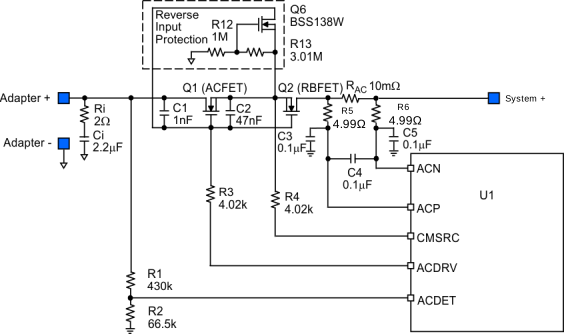
BQ24810 Reverse
                    Input Voltage Protection Circuit Figure 7-2 Reverse Input Voltage Protection Circuit