SPRUJD3A July 2025 – October 2025 F28E120SB , F28E120SC
- 1
- Read This First
- 1 C2000™ Microcontrollers Software Support
- 2 C28x Processor
-
3 System Control and
Interrupts
- 3.1 Introduction
- 3.2 Power Management
- 3.3 Device Identification and Configuration Registers
- 3.4
Resets
- 3.4.1 Reset Sources
- 3.4.2 External Reset (XRS)
- 3.4.3 Power-On Reset (POR)
- 3.4.4 Brown-Out-Reset (BOR)
- 3.4.5 Watchdog Reset (WDRS)
- 3.4.6 NMI Watchdog Reset (NMIWDRS)
- 3.4.7 Debugger Reset (SYSRS)
- 3.4.8 DCSM Safe Code Copy Reset (SCCRESET)
- 3.4.9 Simulate External Reset (SIMRESET.XRS)
- 3.4.10 Simulate CPU Reset (SIMRESET_CPU1RS)
- 3.5 Peripheral Interrupts
- 3.6 Exceptions and Non-Maskable Interrupts
- 3.7
Clocking
- 3.7.1 Clock Sources
- 3.7.2 Derived Clocks
- 3.7.3 Device Clock Domains
- 3.7.4 XCLKOUT
- 3.7.5 Clock Connectivity
- 3.7.6 Clock Source and PLL Setup
- 3.7.7 Using an External Crystal or Resonator
- 3.7.8 Using an External Oscillator
- 3.7.9 Choosing PLL Settings
- 3.7.10 System Clock Setup
- 3.7.11 SYS PLL Bypass
- 3.7.12 Clock (OSCCLK) Failure Detection
- 3.8 32-Bit CPU Timers 0/1/2
- 3.9 Watchdog Timer
- 3.10 Low-Power Modes
- 3.11 Memory Controller Module
- 3.12 JTAG
- 3.13 System Control Register Configuration Restrictions
- 3.14 Software
- 3.15
SYSCTRL Registers
- 3.15.1 SYSCTRL Base Address Table
- 3.15.2 CPUTIMER_REGS Registers
- 3.15.3 PIE_CTRL_REGS Registers
- 3.15.4 WD_REGS Registers
- 3.15.5 NMI_INTRUPT_REGS Registers
- 3.15.6 XINT_REGS Registers
- 3.15.7 SYNC_SOC_REGS Registers
- 3.15.8 DMA_CLA_SRC_SEL_REGS Registers
- 3.15.9 DEV_CFG_REGS Registers
- 3.15.10 CLK_CFG_REGS Registers
- 3.15.11 CPU_SYS_REGS Registers
- 3.15.12 SYS_STATUS_REGS Registers
- 3.15.13 MEM_CFG_REGS Registers
- 3.15.14 MEMORY_ERROR_REGS Registers
- 3.15.15 ROM_WAIT_STATE_REGS Registers
- 3.15.16 TEST_ERROR_REGS Registers
- 3.15.17 UID_REGS Registers
-
4 ROM Code and Peripheral Booting
- 4.1 Introduction
- 4.2 Device Boot Sequence
- 4.3 Device Boot Modes
- 4.4 Device Boot Configurations
- 4.5 Device Boot Flow Diagrams
- 4.6 Device Reset and Exception Handling
- 4.7 Boot ROM Description
- 4.8 Application Notes for Using the Bootloaders
- 4.9 Software
-
5 Dual Code Security Module (DCSM)
- 5.1 Introduction
- 5.2 Functional Description
- 5.3 Flash and OTP Erase/Program
- 5.4 Secure Copy Code
- 5.5 SecureCRC
- 5.6 CSM Impact on Other On-Chip Resources
- 5.7
Incorporating Code Security in User Applications
- 5.7.1 Environments That Require Security Unlocking
- 5.7.2 CSM Password Match Flow
- 5.7.3 C Code Example to Unsecure C28x Zone1
- 5.7.4 C Code Example to Resecure C28x Zone1
- 5.7.5 Environments That Require ECSL Unlocking
- 5.7.6 ECSL Password Match Flow
- 5.7.7 ECSL Disable Considerations for any Zone
- 5.7.8 Device Unique ID
- 5.8 Software
- 5.9 DCSM Registers
-
6 Flash Module
- 6.1 Introduction to Flash and OTP Memory
- 6.2 Flash Bank, OTP, and Pump
- 6.3 Flash Wrapper
- 6.4 Flash and OTP Memory Performance
- 6.5 Flash Read Interface
- 6.6 Flash Erase and Program
- 6.7 Error Correction Code (ECC) Protection
- 6.8 Reserved Locations Within Flash and OTP
- 6.9 Migrating an Application from RAM to Flash
- 6.10 Procedure to Change the Flash Control Registers
- 6.11 Software
- 6.12 FLASH Registers
- 7 Dual-Clock Comparator (DCC)
-
8 General-Purpose Input/Output (GPIO)
- 8.1 Introduction
- 8.2 Configuration Overview
- 8.3 Digital Inputs on ADC Pins (AIOs)
- 8.4 Digital Inputs and Outputs on ADC Pins (AGPIOs)
- 8.5 Digital General-Purpose I/O Control
- 8.6 Input Qualification
- 8.7 GPIO and Peripheral Muxing
- 8.8 Internal Pullup Configuration Requirements
- 8.9 Open-Drain Configuration Requirements
- 8.10 Software
- 8.11 GPIO Registers
- 9 Crossbar (X-BAR)
- 10Direct Memory Access (DMA)
- 11Analog Subsystem
-
12Analog-to-Digital Converter (ADC)
- 12.1 Introduction
- 12.2 ADC Configurability
- 12.3 SOC Principle of Operation
- 12.4 SOC Configuration Examples
- 12.5 ADC Conversion Priority
- 12.6 EOC and Interrupt Operation
- 12.7 Post-Processing Blocks
- 12.8 Opens/Shorts Detection Circuit (OSDETECT)
- 12.9 Power-Up Sequence
- 12.10 ADC Calibration
- 12.11 ADC Timings
- 12.12 Additional Information
- 12.13
Software
- 12.13.1
ADC Examples
- 12.13.1.1 ADC Software Triggering
- 12.13.1.2 ADC MCPWM Triggering
- 12.13.1.3 ADC Temperature Sensor Conversion
- 12.13.1.4 ADC Continuous Conversions Read by DMA (adc_soc_continuous_dma)
- 12.13.1.5 ADC PPB Offset (adc_ppb_offset)
- 12.13.1.6 ADC PPB Limits (adc_ppb_limits)
- 12.13.1.7 ADC SOC Oversampling
- 12.13.1.8 ADC Trigger Repeater Oversampling
- 12.13.1
ADC Examples
- 12.14 ADC Registers
- 13Comparator Subsystem (CMPSS)
-
14Programmable Gain Amplifier
(PGA)
- 14.1 Programmable Gain Amplifier (PGA) Overview
- 14.2 Linear Output Range
- 14.3 Gain Values
- 14.4 Modes of Operation
- 14.5 External Filtering
- 14.6 Error Calibration
- 14.7 Chopping Feature
- 14.8 Enabling and Disabling the PGA Clock
- 14.9 Lock Register
- 14.10 Analog Front-End Integration
- 14.11 Examples
- 14.12 Software
- 14.13 PGA Registers
-
15Multi-Channel Pulse Width Modulator (MCPWM)
- 15.1 Introduction
- 15.2 Configuring Device Pins
- 15.3 MCPWM Modules Overview
- 15.4 Time-Base (TB) Submodule
- 15.5 Counter-Compare (CC) Submodule
- 15.6 Action-Qualifier (AQ) Submodule
- 15.7 Dead-Band Generator (DB) Submodule
- 15.8 Trip-Zone (TZ) Submodule
- 15.9 Event-Trigger (ET) Submodule
- 15.10 PWM Crossbar (X-BAR)
- 15.11
Software
- 15.11.1
MCPWM Examples
- 15.11.1.1 MCPWM Basic PWM Generation and Updates
- 15.11.1.2 MCPWM Basic PWM Generation and Updates
- 15.11.1.3 MCPWM Basic PWM generation With DeadBand
- 15.11.1.4 MCPWM Basic PWM Generation and Updates without Sysconfig
- 15.11.1.5 MCPWM PWM Tripzone Feature Showcase
- 15.11.1.6 MCPWM Global Load Feature Showcase
- 15.11.1.7 MCPWM DMA Configuration for Dynamic PWM Control
- 15.11.1
MCPWM Examples
- 15.12 MCPWM Registers
-
16Enhanced Capture (eCAP)
- 16.1 Introduction
- 16.2 Description
- 16.3 Configuring Device Pins for the eCAP
- 16.4 Capture and APWM Operating Mode
- 16.5 Capture Mode Description
- 16.6
Application of the eCAP Module
- 16.6.1 Example 1 - Absolute Time-Stamp Operation Rising-Edge Trigger
- 16.6.2 Example 2 - Absolute Time-Stamp Operation Rising- and Falling-Edge Trigger
- 16.6.3 Example 3 - Time Difference (Delta) Operation Rising-Edge Trigger
- 16.6.4 Example 4 - Time Difference (Delta) Operation Rising- and Falling-Edge Trigger
- 16.7 Application of the APWM Mode
- 16.8 Software
- 16.9 ECAP Registers
-
17Enhanced Quadrature
Encoder Pulse (eQEP)
- 17.1 Introduction
- 17.2 Configuring Device Pins
- 17.3 Description
- 17.4 Quadrature Decoder Unit (QDU)
- 17.5 Position Counter and Control Unit (PCCU)
- 17.6 eQEP Edge Capture Unit
- 17.7 eQEP Watchdog
- 17.8 eQEP Unit Timer Base
- 17.9 QMA Module
- 17.10 eQEP Interrupt Structure
- 17.11 Software
- 17.12 EQEP Registers
-
18Universal Asynchronous Receiver/Transmitter (UART)
- 18.1 Introduction
- 18.2 Functional Description
- 18.3 Initialization and Configuration
- 18.4 Software
- 18.5 UART Registers
-
19Serial Peripheral Interface (SPI)
- 19.1 Introduction
- 19.2 System-Level Integration
- 19.3 SPI Operation
- 19.4 Programming Procedure
- 19.5 Software
- 19.6 SPI Registers
-
20Inter-Integrated Circuit Module (I2C)
- 20.1 Introduction
- 20.2 Configuring Device Pins
- 20.3
I2C Module Operational Details
- 20.3.1 Input and Output Voltage Levels
- 20.3.2 Selecting Pullup Resistors
- 20.3.3 Data Validity
- 20.3.4 Operating Modes
- 20.3.5 I2C Module START and STOP Conditions
- 20.3.6 Non-repeat Mode versus Repeat Mode
- 20.3.7 Serial Data Formats
- 20.3.8 Clock Synchronization
- 20.3.9 Clock Stretching
- 20.3.10 Arbitration
- 20.3.11 Digital Loopback Mode
- 20.3.12 NACK Bit Generation
- 20.4 Interrupt Requests Generated by the I2C Module
- 20.5 Resetting or Disabling the I2C Module
- 20.6 Software
- 20.7 I2C Registers
-
21Serial Communications Interface (SCI)
- 21.1 Introduction
- 21.2 Architecture
- 21.3 SCI Module Signal Summary
- 21.4 Configuring Device Pins
- 21.5 Multiprocessor and Asynchronous Communication Modes
- 21.6 SCI Programmable Data Format
- 21.7 SCI Multiprocessor Communication
- 21.8 Idle-Line Multiprocessor Mode
- 21.9 Address-Bit Multiprocessor Mode
- 21.10 SCI Communication Format
- 21.11 SCI Port Interrupts
- 21.12 SCI Baud Rate Calculations
- 21.13 SCI Enhanced Features
- 21.14 Software
- 21.15 SCI Registers
- 22Revision History
15.9.1 Operational Overview of the MCPWM Event-Trigger Submodule
The event-trigger submodule monitors various event conditions (shown as inputs on the left side of Figure 15-35) and can be configured to prescale these events before issuing an Interrupt request or an ADC start of conversion. The event-trigger prescaling logic can issue interrupt requests and ADC start-of-conversion at:
- Every event
- Every second event
- Up to every seventh event
 Figure 15-35 Event-Trigger Submodule Showing Event Inputs and Prescaled Outputs
- ETSEL - This selects which of the possible events trigger events ET1 or ET2.
- ETPERIOD - This programs the event prescaling options mentioned above.
- ETCNT - This indicates how many events have occurred if the prescaling feature is used.
- INTEN - This enables interrupt sources for the MCPWM.
- INTFLAG - These are flag bits indicating whether an E1x or trip event has occurred.
- INTCLR - These bits allow clearing the flag bits in the INTFLAG register using software.
- INTFRC - These bits allow software forcing of an event. Useful for debugging or software intervention.
- SOCEN - This enables ADC start of conversion events.
- SOCSEL - This selects the trigger sources for the ADC start of conversion events.
- SOCPERIOD - This programs the event prescaling options for SOC events.
- SOCCNT - This indicates how many SOC events have been generated when using the prescaling feature.
- SOCFLAG - This indicates which SOC events have been generated.
- SOCCLR - This clears the SOCFLAG bits when written to using software.
A more detailed look at how the various register bits interact with the interrupt and ADC start-of-conversion logic are shown in Figure 15-36 and Figure 15-37.
Figure 15-36 shows the event-trigger interrupt generation logic. The interrupt-period (ETPERIOD[ETx_PERIOD]) bits specify the number of events required to cause an interrupt pulse to be generated. The choices available are:
- Do not generate an interrupt.
- Generate an interrupt on every event.
- Generate an interrupt on every second event.
- Generate an interrupt on up to every seventh event.
The event that can cause an interrupt is configured by the interrupt enable(INTEN) register and event trigger selection (ETSEL) register. The event can be one of the following:
- Time-base counter equal to zero (TBCTR = 0x00).
- Time-base counter equal to period (TBCTR = TBPRD).
- Time-base counter equal to zero or period (TBCTR = 0x00 || TBCTR = TBPRD).
- Time-base counter equal to the compare A register (CMPA) when the timer is incrementing.
- Time-base counter equal to the compare A register (CMPA) when the timer is decrementing.
- Time-base counter equal to the compare B register (CMPB) when the timer is incrementing.
- Time-base counter equal to the compare B register (CMPB) when the timer is decrementing.
- Time-base counter equal to the compare C register (CMPC) when the timer is incrementing.
- Time-base counter equal to the compare C register (CMPC) when the timer is decrementing.
- Time-base counter equal to the compare D register (CMPD) when the timer is incrementing.
- Time-base counter equal to the compare D register (CMPD) when the timer is decrementing.
- One-shot trip event.
- Cycle-by-cycle trip event.
The number of events that have occurred can be read from the interrupt event counter ETCNT[ETx_CNT] register bits based off of the selection made using ETSEL. The specified event increments the ETCNT[ETx_CNT] bits until the bits reach the value specified by ETPERIOD[ETx_PERIOD]. When ETPS[INTCNT] = ETPS[INTPRD], the counter stops counting and the counter output is set. The counter is cleared when an INTFLAG[ETx] event is generated.
When ETCNT[ETx_CNT] reaches ETPERIOD[ETx_PERIOD], the following behavior occurs:
If interrupts are enabled, INTEN[ETx] = 1 and the interrupt flag is clear,INTFLAG[ETx] = 0, then an interrupt pulse is generated and the interrupt flag is set, INTFLAG[ETx] = 1. The counter is reset and begins counting events again- If interrupts are disabled, INTEN[ETx] = 0, or the interrupt flag is set, INTFLAG[ETx] = 1, the counter stops counting events when the counter reaches the period value ETCNT[ETx_CNT] = ETPERIOD[ETx_PERIOD].
- If interrupts are enabled, but the interrupt flag is already set, then the counter holds the output high until the INTFLAG[ETx] flag is cleared. This allows for one interrupt to be pending while one is serviced.
Writing a 0 or a value that is less than the current ETCNT value to the ETPERIOD bits results in the counter going to an undefined state.
The previous definition means that an interrupt on every event up to 7 events if using the ETCNT and ETPERIOD can be generated.
ETINTMIX, ETSOCAMIX and ETSOCBMIX Signals
The event-trigger submodule can generate and use ETINTMIX, ETSOCAMIX, and ETSOCBMIX signals:
- ETINTMIX: This signal is a generated from the ORed combination of the sources enabled in the ETINTMIXEN register. The ETINTMIX signal can be used as a source for the PWMx interrupt.
- ETSOCAMIX: This signal is a generated from the ORed combination of the sources enabled in the ETSOCAMIXEN register. The ETSOCAMIX signal can be used as a source for the PWMxSOCA trigger signal.
- ETSOCBMIX: This signal is a generated from the ORed combination of the sources enabled in the ETSOCBMIXEN register. The ETSOCBMIX signal can be used as a source for the PWMxSOCB trigger signal
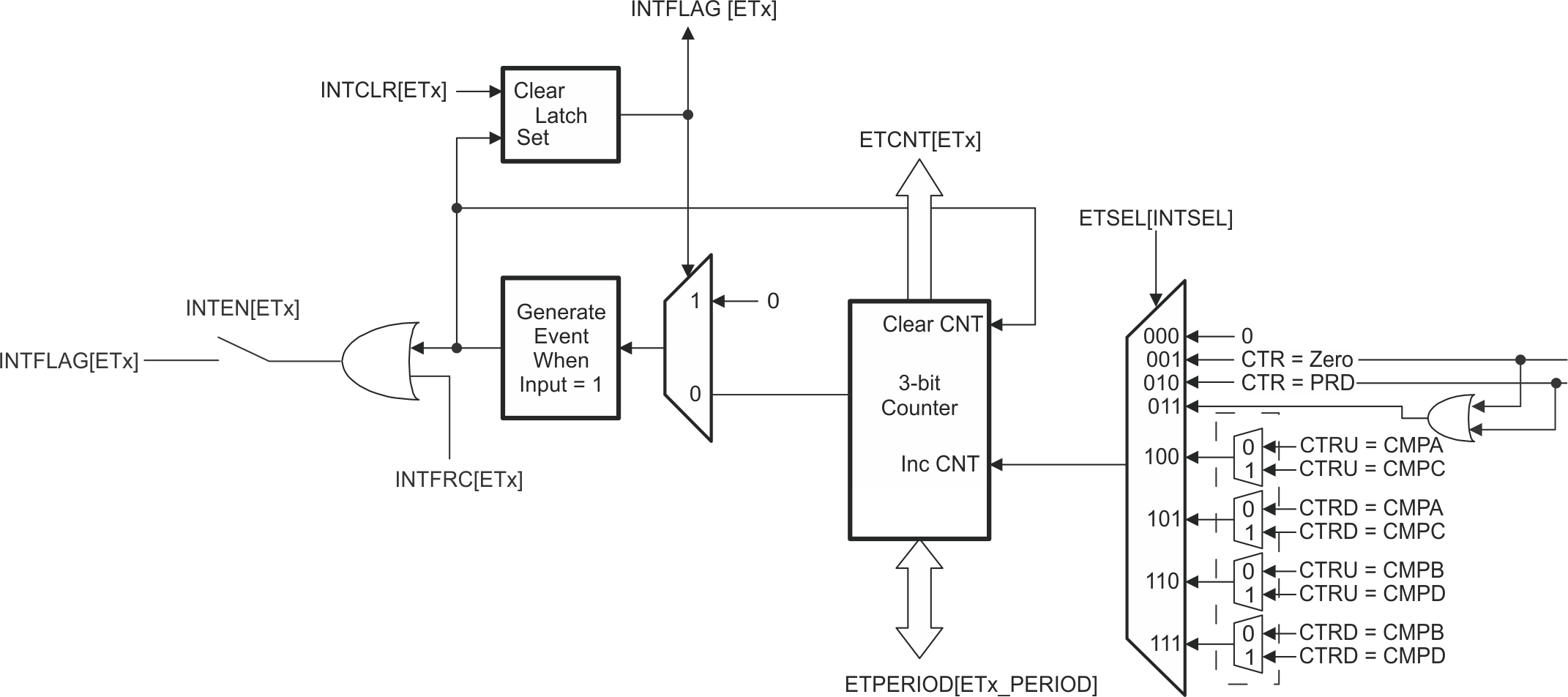 Figure 15-36 Event-Trigger Interrupt Generator
Figure 15-37 shows the operation of the event-trigger's start-of-conversion (SOCx) pulse generator. The SOCCNT[SOCx_CNT] counters and SOCPERIOD[SOCx_PERIOD] period values behave similarly to the interrupt generator except that the pulses are continuously generated. That is, the pulse flag SOCFLAG[SOCx] is latched when a pulse is generated, but the interrupt generator does not stop further pulse generation. The enable and disable bit SOCEN[SOCx_ENABLE] stops pulse generation, but input events can still be counted until the period value is reached as with the interrupt generation logic. The event that triggers an SOCx pulse can be configured separately in the SOCSEL[SOCx_SEL] bits. The possible events are the same events that can be specified for the interrupt generation logic.
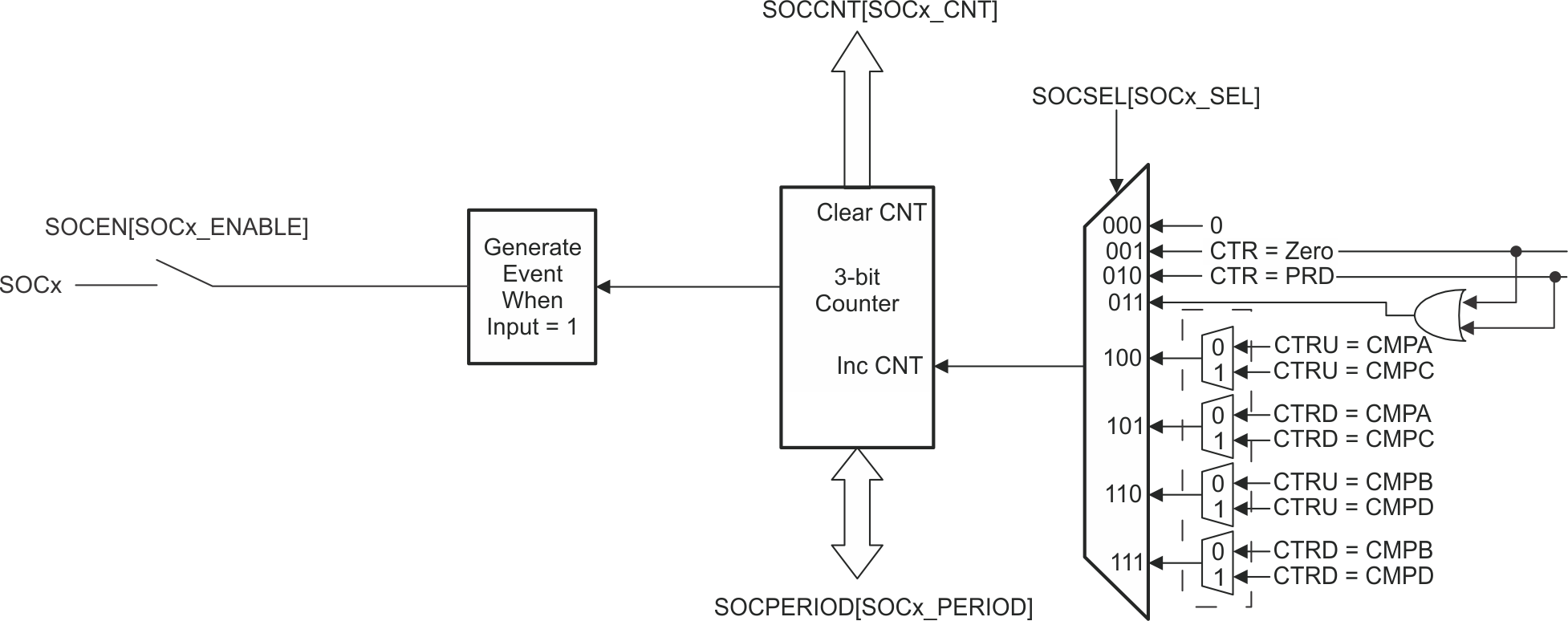 Figure 15-37 Event-Trigger Start-of-Conversion (SOC) Pulse Generator