SLVSHK4 December   2025 MCT8376Z-Q1

PRODUCTION DATA  

  1.   1
  2. Features
  3. Applications
  4. Description
  5. Device Comparison Table
  6. Pin Configuration and Functions
  7. Specifications
    1. 6.1 Absolute Maximum Ratings
    2. 6.2 ESD Ratings AUTO
    3. 6.3 Recommended Operating Conditions
    4. 6.4 Thermal Information
    5. 6.5 Electrical Characteristics
    6. 6.6 SPI Timing Requirements
    7. 6.7 SPI Slave Mode Timings
  8. Detailed Description
    1. 7.1 Overview
    2. 7.2 Functional Block Diagram
    3. 7.3 Feature Description
      1. 7.3.1  Output Stage
      2. 7.3.2  PWM Control Mode (1x PWM Mode)
        1. 7.3.2.1 Analog Hall Input Configuration
        2. 7.3.2.2 Digital Hall Input Configuration
        3. 7.3.2.3 Asynchronous Modulation
        4. 7.3.2.4 Synchronous Modulation
        5. 7.3.2.5 Motor Operation
      3. 7.3.3  Device Interface Modes
        1. 7.3.3.1 Serial Peripheral Interface (SPI)
        2. 7.3.3.2 Hardware Interface
      4. 7.3.4  AVDD and GVDD Linear Voltage Regulator
      5. 7.3.5  Charge Pump
      6. 7.3.6  Slew Rate Control
      7. 7.3.7  Cross Conduction (Dead Time)
      8. 7.3.8  Propagation Delay
      9. 7.3.9  Pin Diagrams
        1. 7.3.9.1 Logic Level Input Pin (Internal Pulldown)
        2. 7.3.9.2 Logic Level Input Pin (Internal Pullup)
        3. 7.3.9.3 Open Drain Pin
        4. 7.3.9.4 Push Pull Pin
        5. 7.3.9.5 Seven Level Input Pin
      10. 7.3.10 Current Sense Amplifier Output (SO)
      11. 7.3.11 Active Demagnetization
        1. 7.3.11.1 Automatic Synchronous Rectification Mode (ASR Mode)
          1. 7.3.11.1.1 Automatic Synchronous Rectification in Commutation
          2. 7.3.11.1.2 Automatic Synchronous Rectification in PWM Mode
        2. 7.3.11.2 Automatic Asynchronous Rectification Mode (AAR Mode)
      12. 7.3.12 Cycle-by-Cycle Current Limit
        1. 7.3.12.1 Cycle by Cycle Current Limit with 100% Duty Cycle Input
      13. 7.3.13 Hall Comparators (Analog Hall Inputs)
      14. 7.3.14 Advance Angle
      15. 7.3.15 FGOUT Signal
      16. 7.3.16 Protections
        1. 7.3.16.1 VM Supply Undervoltage Lockout (RESET)
        2. 7.3.16.2 AVDD Undervoltage Protection (AVDD_UV)
        3. 7.3.16.3 GVDD Undervoltage Lockout (GVDD_UV)
        4. 7.3.16.4 VCP Charge Pump Undervoltage Lockout (CPUV)
        5. 7.3.16.5 Overvoltage Protections (OV)
        6. 7.3.16.6 Overcurrent Protection (OCP)
          1. 7.3.16.6.1 OCP Latched Shutdown (OCP_MODE = 00b)
          2. 7.3.16.6.2 OCP Automatic Retry (OCP_MODE = 01b)
          3. 7.3.16.6.3 OCP Report Only (OCP_MODE = 10b)
          4. 7.3.16.6.4 OCP Disabled (OCP_MODE = 11b)
        7. 7.3.16.7 Motor Lock (MTR_LOCK)
          1. 7.3.16.7.1 MTR_LOCK Latched Shutdown (MTR_LOCK_MODE = 00b)
          2. 7.3.16.7.2 MTR_LOCK Automatic Retry (MTR_LOCK_MODE = 01b)
          3. 7.3.16.7.3 MTR_LOCK Report Only (MTR_LOCK_MODE= 10b)
          4. 7.3.16.7.4 MTR_LOCK Disabled (MTR_LOCK_MODE = 11b)
        8. 7.3.16.8 Thermal Warning (OTW)
        9. 7.3.16.9 Thermal Shutdown (OTS)
    4. 7.4 Device Functional Modes
      1. 7.4.1 Functional Modes
        1. 7.4.1.1 Sleep Mode
        2. 7.4.1.2 Operating Mode
        3. 7.4.1.3 Fault Reset (CLR_FLT or nSLEEP Reset Pulse)
      2. 7.4.2 DRVOFF Functionality
    5. 7.5 SPI Communication
      1. 7.5.1 Programming
        1. 7.5.1.1 SPI Format
  9. Register Map
    1. 8.1 STATUS Registers
    2. 8.2 CONTROL Registers
  10. Application and Implementation
    1. 9.1 Application Information
    2. 9.2 Hall Sensor Configuration and Connection
      1. 9.2.1 Typical Configuration
      2. 9.2.2 Open Drain Configuration
      3. 9.2.3 Series Configuration
      4. 9.2.4 Parallel Configuration
    3. 9.3 Power Supply Recommendations
      1. 9.3.1 Bulk Capacitance
    4. 9.4 Layout
      1. 9.4.1 Layout Guidelines
      2. 9.4.2 Layout Example
      3. 9.4.3 Thermal Considerations
        1. 9.4.3.1 Power Dissipation
  11. 10Device and Documentation Support
    1. 10.1 Documentation Support
    2. 10.2 Support Resources
    3. 10.3 Trademarks
    4. 10.4 Electrostatic Discharge Caution
    5. 10.5 Glossary
  12. 11Revision History
  13. 12Mechanical, Packaging, and Orderable Information

封装选项

机械数据 (封装 | 引脚)
散热焊盘机械数据 (封装 | 引脚)
订购信息

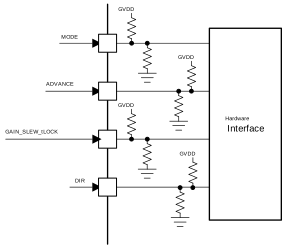
Hardware Interface

Hardware interface devices convert the four SPI pins into four resistor-configurable inputs which are ADVANCE, MODE, GAIN_SLEW_tLOCK and DIR. DIR pin is two level input (logic levels) where as ADVANCE, MODE, GAIN_SLEW_tCLK are seven level configuration inputs.

The hardware interface lets the application designer to configure the most common device by tying the pin logic high or logic low, or with a simple pullup or pull-down resistor. This removes the requirement for an SPI bus from the external controller. General fault information can still be obtained through the nFAULT pin.

  • The MODE pin configures the PWM control mode.
  • The GAIN_SLEW_tLOCK pin configures the CSA GAIN, output voltage slew rate and motor lock detection time.
  • The ADVANCE pin configures the lead angle of the output with respect to hall signals.
  • The DIR pin is used to configure the direction of rotation of the motor.

For more information on the hardware interface, see Section 7.3.9.
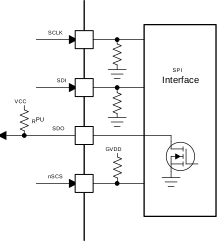
Note: VCC is external pull up voltage
MCT8376Z-Q1 MCT8376ZS-Q1 SPIFigure 7-7 MCT8376ZS-Q1 SPI
MCT8376Z-Q1 MCT8376ZH-Q1 Hardware InterfaceFigure 7-8 MCT8376ZH-Q1 Hardware Interface