SWCU194 March 2023 CC1314R10 , CC1354P10 , CC1354R10 , CC2674P10 , CC2674R10
- Read This First
-
1 Architectural Overview
- 1.1 Target Applications
- 1.2 Overview
- 1.3
Functional Overview
- 1.3.1 ArmCortex-M33 with FPU
- 1.3.2 On-Chip Memory
- 1.3.3 Radio
- 1.3.4 Security Core
- 1.3.5 Runtime Security
- 1.3.6 General-Purpose Timers
- 1.3.7 Direct Memory Access
- 1.3.8 System Control and Clock
- 1.3.9 Serial Communication Peripherals
- 1.3.10 Programmable I/Os
- 1.3.11 Sensor Controller
- 1.3.12 Random Number Generator
- 1.3.13 cJTAG and JTAG
- 1.3.14 Power Supply System
-
2
Arm
Cortex-M33 Processor with FPU
- 2.1 Arm Cortex-M33 Processor Introduction
- 2.2 Block Diagram
- 2.3 Overview
- 2.4 Programming Model
- 2.5 Arm® Cortex®-M33 Registers
- 3 Memory Map
- 4 Arm Cortex-M33 Peripherals
- 5 Interrupts and Events
- 6 JTAG Interface
- 7 Power, Reset, and Clock Management (PRCM)
- 8 Versatile Instruction Memory System (VIMS)
- 9 SRAM
-
10Bootloader
- 10.1 Bootloader Functionality
- 10.2
Bootloader Interfaces
- 10.2.1 Packet Handling
- 10.2.2 Transport Layer
- 10.2.3
Serial Bus Commands
- 10.2.3.1 COMMAND_PING
- 10.2.3.2 COMMAND_DOWNLOAD
- 10.2.3.3 COMMAND_GET_STATUS
- 10.2.3.4 COMMAND_SEND_DATA
- 10.2.3.5 COMMAND_RESET
- 10.2.3.6 COMMAND_SECTOR_ERASE
- 10.2.3.7 COMMAND_CRC32
- 10.2.3.8 COMMAND_GET_CHIP_ID
- 10.2.3.9 COMMAND_MEMORY_READ
- 10.2.3.10 COMMAND_MEMORY_WRITE
- 10.2.3.11 COMMAND_BANK_ERASE
- 10.2.3.12 COMMAND_SET_CCFG
- 10.2.3.13 COMMAND_DOWNLOAD_CRC
- 11Device Configuration
-
12AES and Hash Cryptoprocessor
- 12.1 Introduction
- 12.2 Functional Description
- 12.3 DMA Controller
- 12.4 AES and Hash Cryptoprocessor Performance
- 12.5
Programming Guidelines
- 12.5.1 One-Time Initialization After a Reset
- 12.5.2 DMAC and Master Control
- 12.5.3 Hashing
- 12.5.4 Encryption and Decryption
- 12.5.5 Exceptions Handling
- 12.6 Conventions and Compliances
- 12.7 CRYPTO Registers
- 13PKA Engine
- 14True Random Number Generator (TRNG)
- 15I/O Controller (IOC)
-
16Micro Direct Memory Access (µDMA)
- 16.1 Introduction
- 16.2 Block Diagram
- 16.3 Functional Description
- 16.4 Initialization and Configuration
- 16.5 UDMA Registers
- 17Timers
- 18Real-Time Clock (RTC)
- 19Watchdog Timer (WDT)
-
20AUX Domain Sensor Controller and Peripherals
- 20.1 Introduction
- 20.2 Power and Clock Management
- 20.3
Sensor Controller
- 20.3.1 Sensor Controller Studio
- 20.3.2 Sensor Controller Engine (SCE)
- 20.4
Digital Peripheral Modules
- 20.4.1 Overview
- 20.4.2 Analog I/O Digital I/O (AIODIO)
- 20.4.3 Semaphore (SMPH)
- 20.4.4 SPI Master (SPIM)
- 20.4.5 Time-to-Digital Converter (TDC)
- 20.4.6 Timer01
- 20.4.7 Timer2
- 20.5
Analog Peripheral Modules
- 20.5.1 Overview
- 20.5.2 Analog-to-Digital Converter (ADC)
- 20.5.3 Comparator A (COMPA)
- 20.5.4 Comparator B (COMPB)
- 20.5.5 Reference Digital-to-Analog Converter (DAC)
- 20.5.6 Current Source (ISRC)
- 20.6 Event Routing and Usage
- 20.7 Sensor Controller Alias Register Space
- 20.8
AUX Domain Sensor Controller and Peripherals Registers
- 20.8.1 ADI_4_AUX Registers
- 20.8.2 AUX_AIODIO Registers
- 20.8.3 AUX_EVCTL Registers
- 20.8.4 AUX_SMPH Registers
- 20.8.5 AUX_TDC Registers
- 20.8.6 AUX_TIMER01 Registers
- 20.8.7 AUX_TIMER2 Registers
- 20.8.8 AUX_ANAIF Registers
- 20.8.9 AUX_SYSIF Registers
- 20.8.10 AUX_SPIM Registers
- 20.8.11 AUX_MAC Registers
- 20.8.12 AUX_SCE Registers
- 21Battery Monitor and Temperature Sensor (BATMON)
-
22Universal Asynchronous Receiver/Transmitter (UART)
- 22.1 Introduction
- 22.2 Block Diagram
- 22.3 Signal Description
- 22.4 Functional Description
- 22.5 Interface to µDMA
- 22.6 Initialization and Configuration
- 22.7 UART Registers
-
23Serial Peripheral Interface (SPI)
- 23.1 Introduction
- 23.2 Block Diagram
- 23.3 Signal Description
- 23.4
Functional Description
- 23.4.1 Bit Rate Generation
- 23.4.2 FIFO Operation
- 23.4.3 Interrupts
- 23.4.4 Data Format
- 23.4.5 Delayed Data Sampling
- 23.4.6
Frame Formats
- 23.4.6.1 Texas Instruments Synchronous Serial Frame Format
- 23.4.6.2 Motorola SPI Frame Format
- 23.4.6.3 Motorola SPI Frame Format with SPO = 0 and SPH = 0
- 23.4.6.4 Motorola SPI Frame Format with SPO = 0 and SPH = 1
- 23.4.6.5 Motorola SPI Frame Format with SPO = 1 and SPH = 0
- 23.4.6.6 Motorola SPI Frame Format with SPO = 1 and SPH = 1
- 23.4.6.7 MICROWIRE Frame Format
- 23.5 μDMA Operation
- 23.6 Initialization and Configuration
- 23.7 SPI Registers
- 24Inter-Integrated Circuit (I2C)
-
25Inter-IC Sound (I2S)
- 25.1 Introduction
- 25.2 Block Diagram
- 25.3 Signal Description
- 25.4 Functional Description
- 25.5 Memory Interface
- 25.6 Samplestamp Generator
- 25.7 Error Detection
- 25.8 Usage
- 25.9 I2S Registers
-
26Radio
- 26.1 RF Core
- 26.2 Radio Doorbell
- 26.3
RF Core HAL
- 26.3.1 Hardware Support
- 26.3.2 Firmware Support
- 26.3.3
Command Definitions
- 26.3.3.1
Protocol-Independent Radio Operation Commands
- 26.3.3.1.1 CMD_NOP: No Operation Command
- 26.3.3.1.2 CMD_RADIO_SETUP: Set Up Radio Settings Command
- 26.3.3.1.3 CMD_FS_POWERUP: Power Up Frequency Synthesizer
- 26.3.3.1.4 CMD_FS_POWERDOWN: Power Down Frequency Synthesizer
- 26.3.3.1.5 CMD_FS: Frequency Synthesizer Controls Command
- 26.3.3.1.6 CMD_FS_OFF: Turn Off Frequency Synthesizer
- 26.3.3.1.7 CMD_RX_TEST: Receiver Test Command
- 26.3.3.1.8 CMD_TX_TEST: Transmitter Test Command
- 26.3.3.1.9 CMD_SYNC_STOP_RAT: Synchronize and Stop Radio Timer Command
- 26.3.3.1.10 CMD_SYNC_START_RAT: Synchronously Start Radio Timer Command
- 26.3.3.1.11 CMD_COUNT: Counter Command
- 26.3.3.1.12 CMD_SCH_IMM: Run Immediate Command as Radio Operation
- 26.3.3.1.13 CMD_COUNT_BRANCH: Counter Command with Branch of Command Chain
- 26.3.3.1.14 CMD_PATTERN_CHECK: Check a Value in Memory Against a Pattern
- 26.3.3.2
Protocol-Independent Direct and Immediate Commands
- 26.3.3.2.1 CMD_ABORT: ABORT Command
- 26.3.3.2.2 CMD_STOP: Stop Command
- 26.3.3.2.3 CMD_GET_RSSI: Read RSSI Command
- 26.3.3.2.4 CMD_UPDATE_RADIO_SETUP: Update Radio Settings Command
- 26.3.3.2.5 CMD_TRIGGER: Generate Command Trigger
- 26.3.3.2.6 CMD_GET_FW_INFO: Request Information on the Firmware Being Run
- 26.3.3.2.7 CMD_START_RAT: Asynchronously Start Radio Timer Command
- 26.3.3.2.8 CMD_PING: Respond with Interrupt
- 26.3.3.2.9 CMD_READ_RFREG: Read RF Core Register
- 26.3.3.2.10 CMD_SET_RAT_CMP: Set RAT Channel to Compare Mode
- 26.3.3.2.11 CMD_SET_RAT_CPT: Set RAT Channel to Capture Mode
- 26.3.3.2.12 CMD_DISABLE_RAT_CH: Disable RAT Channel
- 26.3.3.2.13 CMD_SET_RAT_OUTPUT: Set RAT Output to a Specified Mode
- 26.3.3.2.14 CMD_ARM_RAT_CH: Arm RAT Channel
- 26.3.3.2.15 CMD_DISARM_RAT_CH: Disarm RAT Channel
- 26.3.3.2.16 CMD_SET_TX_POWER: Set Transmit Power
- 26.3.3.2.17 CMD_SET_TX20_POWER: Set Transmit Power of the 20 dBm PA
- 26.3.3.2.18 CMD_MODIFY_FS: Set New Synthesizer Frequency Without Recalibration
- 26.3.3.2.19 CMD_BUS_REQUEST: Request System BUS Available for RF Core
- 26.3.3.1
Protocol-Independent Radio Operation Commands
- 26.3.4 Immediate Commands for Data Queue Manipulation
- 26.4
Data Queue Usage
- 26.4.1
Operations on Data Queues Available Only for Internal Radio CPU Operations
- 26.4.1.1 PROC_ALLOCATE_TX: Allocate TX Entry for Reading
- 26.4.1.2 PROC_FREE_DATA_ENTRY: Free Allocated Data Entry
- 26.4.1.3 PROC_FINISH_DATA_ENTRY: Finish Use of First Data Entry From Queue
- 26.4.1.4 PROC_ALLOCATE_RX: Allocate RX Buffer for Storing Data
- 26.4.1.5 PROC_FINISH_RX: Commit Received Data to RX Data Entry
- 26.4.2 Radio CPU Usage Model
- 26.4.1
Operations on Data Queues Available Only for Internal Radio CPU Operations
- 26.5
IEEE 802.15.4
- 26.5.1 IEEE 802.15.4 Commands
- 26.5.2 Interrupts
- 26.5.3 Data Handling
- 26.5.4 Radio Operation Commands
- 26.5.5 Immediate Commands
- 26.6 Bluetooth® Low Energy
- 26.7 Data Handling
- 26.8
Radio Operation Command Descriptions
- 26.8.1 Bluetooth® 5 Radio Setup Command
- 26.8.2 Radio Operation Commands for Bluetooth® Low Energy Packet Transfer
- 26.8.3 Coding Selection for Coded PHY
- 26.8.4 Parameter Override
- 26.8.5 Link Layer Connection
- 26.8.6 Slave Command
- 26.8.7 Master Command
- 26.8.8 Legacy Advertiser
- 26.8.9 Bluetooth® 5 Advertiser Commands
- 26.8.10 Scanner Commands
- 26.8.11
Initiator Command
- 26.8.11.1 Initiator Receiving Legacy Advertising Packets on Primary Channel
- 26.8.11.2 Initiator Receiving Extended Advertising Packets on Primary Channel
- 26.8.11.3 Initiator Receiving Extended Advertising Packets on Secondary Channel
- 26.8.11.4 Automatic Window Offset Insertion
- 26.8.11.5 End of Initiator Commands
- 26.8.12 Generic Receiver Command
- 26.8.13 PHY Test Transmit Command
- 26.8.14 Whitelist Processing
- 26.8.15 Backoff Procedure
- 26.8.16 AUX Pointer Processing
- 26.8.17 Dynamic Change of Device Address
- 26.9 Immediate Commands
- 26.10
Proprietary Radio
- 26.10.1 Packet Formats
- 26.10.2 Commands
- 26.10.3 Interrupts
- 26.10.4 Data Handling
- 26.10.5 Radio Operation Command Descriptions
- 26.10.6 Immediate Commands
- 26.11 Radio Registers
- 27Revision History
17.3.2.4 PWM Mode
The GPTM supports a simple PWM generation mode. In PWM mode, the timer is configured as a 16-bit down counter with a start value (and thus, period) defined by the GPT:TnILR and the GPT:TnPR registers. In this mode, the PWM frequency and period are synchronous events; therefore, they are ensured to be glitch-free. PWM mode is enabled with the GPT:TnMR register by setting the TnAMS bit to 0x1, setting the TnCM bit to 0x0, and setting the TnMR field to 0x2. Table 17-5 lists the values that are loaded into the timer registers when the timer is enabled.
Wait on trigger (daisy chaining) is not supported in PWM mode. The timer starts as soon as it is enabled and does not wait for a trigger from the previous timer.
| Register | Count Down Mode | Count Up Mode |
|---|---|---|
| GPT:TnR | GPT:TnILR | Not Available |
| GPT:TnV | GPT:TnILR | Not Available |
| GPT:TnPV | GPT:TnPR | Not Available |
When software writes to the GPT:CTL.TnEN register bit, the counter begins counting down until it reaches the 0x0 state. Alternatively, if the GPT:TnMR.TnWOT register bit is set when the TnEN bit is set, the timer waits for a trigger to begin counting. On the next counter cycle in periodic mode, the counter reloads its start value from the GPT:TnILR and the GPT:TnPR registers, and continues counting until disabled by software clearing the GPT:CTL.TnEN register bit. The timer is capable of generating interrupts based on three types of events: rising edge, falling edge, or both. The event is configured by the GPT:CTL.TnEVENT register field, and the interrupt is enabled by setting the GPT:TnMR.TnPWMIE bit. When the event occurs, the GPT:RIS.CnERIS bit is set, and holds the bit until it is cleared by writing the GPTM Interrupt Clear register (GPT:ICLR). If the capture mode event interrupt is enabled in the GPTM Interrupt Mask register (GPT:IMR), the GPTM also sets the GPT:MIS.CnEMIS bit.
The interrupt status bits are not updated unless the TnPWMIE bit is set.
In PWM mode, the GPT:TnR and the GPT:TnV registers always have the same value, as do the GPT:TnPS and the GPT:TnPV registers.
The output PWM signal asserts when the counter is at the value of the GPT:TnILR and the GPT:TnPR registers (its start state), and is deasserted when the counter value equals the value in the GPT:TnMATCHR and the GPT:TnPMR registers. Software can invert the output PWM signal by setting the GPT:CTL.TnPWML bit. Inverting the output PWM does not affect the edge detection interrupt. Therefore, if a positive-edge interrupt trigger has been set, the event-trigger interrupt is asserted when the PWM inversion generates a positive edge.
If TnILR is altered to a value smaller than the current counter value LD_TO_EN must be enabled to avoid transients on the PWM output. This is true even when the “Time Out UPDATE” mode is enabled.
Figure 17-4 shows how to generate an output PWM with a 1-ms period and a 66% duty cycle assuming a 50 MHz input clock and TnPWML = 0 (duty cycle would be 33% for the TnPWML = 1 configuration). For this example, the start value is GPT:TnILR = 0xC34F and the match value is GPT:TnMATCHR = 0x411A.
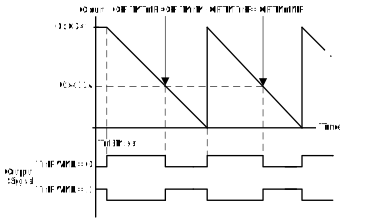 Figure 17-4 16-Bit PWM Mode Example
When synchronizing the timers using the GPT:SYNC register, the timer must be properly configured to avoid glitches on the CCP outputs. Both the GPT:TnMR.TnPLO and the GPT:TnMR.TnMRSU bits must be set. Figure 17-5 shows how the CCP output operates when the TnPLO and TnMRSU bits are set and the GPT:TnMATCHR register value is greater than the GPT:TnILR register value.
 Figure 17-5 CCP Output, GPT:TnMATCHR > GPT:TnILR
Figure 17-6 shows how the CCP output operates when the GPT:TnMR.TnPLO and GPT:TnMR.TnMRSU bits are set and the GPT:TnMATCHR register value is the same as the GPT:TnILR register value. In this situation, if the TnPLO bit is 0, the CCP signal goes high when the GPT:TnILR register value is loaded, and the match would be essentially ignored.
 Figure 17-6 CCP Output, GPT:TnMATCHR = GPT:TnILR
Figure 17-7 shows how the CCP output operates when the GPT:TnMR.TnPLO and GPT:TnMR.TnMRSU bits are set and the GPT:TnILR register value is greater than the GPT:TnMATCHR register value.
 Figure 17-7 CCP Output, GPT:TnILR > GPT:TnMATCHR