SLLSFT3 November   2025 MC121-Q1

ADVANCE INFORMATION  

  1.   1
  2. Features
  3. Applications
  4. Description
  5. Pin Configuration and Functions
  6. Specifications
    1. 5.1 Absolute Maximum Ratings
    2. 5.2 ESD Ratings Auto
    3. 5.3 Recommended Operating Conditions
    4. 5.4 Thermal Information
    5. 5.5 Electrical Characteristics
    6. 5.6 I2C Timing Requirements
    7. 5.7 Timing Diagrams
  7. Detailed Description
    1. 6.1 Overview
    2. 6.2 Functional Block Diagram
    3. 6.3 Feature Description
      1. 6.3.1 Motor Control
        1. 6.3.1.1 Duty Input
        2. 6.3.1.2 Duty Curve
        3. 6.3.1.3 Motor Start, Speed Change, and Stop
        4. 6.3.1.4 Open-Loop (Duty Cycle) Control
        5. 6.3.1.5 Closed-Loop (Speed) Control
        6. 6.3.1.6 Commutation
          1. 6.3.1.6.1 Hall Sensor
            1. 6.3.1.6.1.1 Field Direction Definition
            2. 6.3.1.6.1.2 Internal Hall Latch Sensor Output
          2. 6.3.1.6.2 Hall Offset
          3. 6.3.1.6.3 Square Commutation
          4. 6.3.1.6.4 Soft Commutation
        7. 6.3.1.7 PWM Modulation Modes
      2. 6.3.2 Protections
        1. 6.3.2.1 Locked Rotor Protection
        2. 6.3.2.2 Current Limit
        3. 6.3.2.3 Overcurrent Protection (OCP)
        4. 6.3.2.4 VM Undervoltage Lockout (UVLO)
        5. 6.3.2.5 VM Over Voltage Protection (OVP)
        6. 6.3.2.6 Thermal Shutdown (TSD)
        7. 6.3.2.7 Integrated Supply (VM) Clamp
    4. 6.4 Device Functional Modes
      1. 6.4.1 Active Mode
      2. 6.4.2 Sleep and Standby Mode
      3. 6.4.3 Fault Mode
      4. 6.4.4 Test Mode and One-Time Programmable Memory
    5. 6.5 Programming
      1. 6.5.1 I2C Communication
        1. 6.5.1.1 I2C Read
        2. 6.5.1.2 I2C Write
  8. Register Map
    1. 7.1 USR_OTP Registers
    2. 7.2 USR_TM Registers
  9. Application and Implementation
    1. 8.1 Application Information
      1. 8.1.1 External Components
    2. 8.2 Typical Application
      1. 8.2.1 Design Requirements
      2. 8.2.2 Detailed Design Procedure
      3. 8.2.3 Application Curves
    3. 8.3 Power Supply Recommendations
      1. 8.3.1 Bulk Capacitance
    4. 8.4 Layout
      1. 8.4.1 Layout Guidelines
      2. 8.4.2 Layout Example
  10. Device and Documentation Support
    1. 9.1 Device Support
    2. 9.2 Documentation Support
      1. 9.2.1 Related Documentation
    3. 9.3 Receiving Notification of Documentation Updates
    4. 9.4 Support Resources
    5. 9.5 Trademarks
    6. 9.6 Electrostatic Discharge Caution
    7. 9.7 Glossary
  11. 10Revision History

封装选项

机械数据 (封装 | 引脚)
  • DYM|6
  • DEZ|6
散热焊盘机械数据 (封装 | 引脚)
订购信息

Test Mode and One-Time Programmable Memory

The MC121-Q1 integrates a test and programming mode where the PWM/DC and FG/RD pins support an I2C interface for device configuration and testing. The I2C interface also gives access to the one-time programmable (OTP) memory. Programming the registers selects the device configurations described in the previous sections. Figure 6-31 shows the basic hardware configuration for configuring and programming the MC121-Q1.
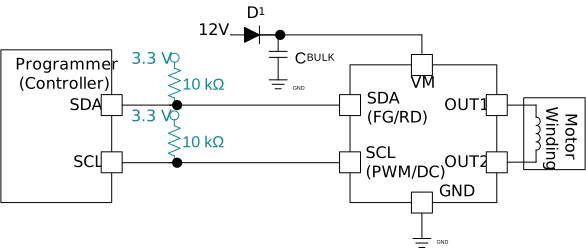
MC121-Q1 I2C Programmer and
                    Fan Module Figure 6-31 I2C Programmer and Fan Module

The MC121-Q1 enters test mode and OTP mode with the following procedure.

  1. Pull the FG/RD pin low and apply a high frequency signal in the range of (416-833) kHz at any duty between (20-80)% for 15 to 20 cycles to the PWM/DC pin to enter the test mode. The I2C interface is active in test mode.
  2. Communicate with MC121-Q1 over I2C to read and write to the registers in Section 7 to configure the registers.
  3. To maintain reliable OTP memory programming through I2C communication, maintain the MC121-Q1 power supply pin voltage (VM) above 8V throughout the entire duration of the communication.
  4. Write the OTP mode entry key 02h, 01h, 04h to the USR_OTP_PRG_UNLOCK register in successive write-frames to unlock OTP mode.
  5. To burn the OTP memory, write 1b to the USR_OTP_PROG_ALL bit in USR_OTP_CFG Register.