SLLSFT3 November 2025 MC121-Q1
ADVANCE INFORMATION
- 1
- 1 Features
- 2 Applications
- 3 Description
- 4 Pin Configuration and Functions
- 5 Specifications
-
6 Detailed Description
- 6.1 Overview
- 6.2 Functional Block Diagram
- 6.3 Feature Description
- 6.4 Device Functional Modes
- 6.5 Programming
- 7 Register Map
- 8 Application and Implementation
- 9 Device and Documentation Support
- 10Revision History
6.3.2.1 Locked Rotor Protection
When the MC121-Q1 does not detect a Hall transition for longer than the locked rotor detection time (tLRD), a locked rotor fault is recognized, all FETs are disabled (Hi-Z) and the FG/RD pin indicates the locked rotor fault according to Table 6-4. tLRD is set by tLRD_START during start-up sequence, while tLRD is set by tLRD_RUN during motor run (steady state). The locked rotor retry sequence (when LRD_RETRY_DIS = 0x0) during start-up is as shown in Figure 6-22. During the first start-up after power-up/wake-up, the number of quick retry attempts is set by LRD_NRETRY_STARTUP; the quick retry time is same as the locked rotor detection time (tLRD_START). If the locked rotor condition persists after LRD_NRETRY_START attempts are completed, MC121-Q1 enters a long retry time (tlock_long_retry) which is (LRD_LONG_RETRY_SEL x tLRD_START). Once the long retry time lapses, MC121-Q1 attempts to spin the motor again; on the second start-up attempt after power-up/wake-up, the number of quick retry attempts is set by LRD_NRETRY_RUN while the locked rotor detection time (tLRD_START) and quick retry time remain the same. If the locked rotor condition persists after LRD_NRETRY_RUN attempts are completed, MC121-Q1 enters a long retry time (tlock_long_retry) again. Subsequent motor start-up sequences uses the same retry pattern as the second start-up cycle as shown in Figure 6-22. Every motor start-up attempt after retry time lapse (quick or long retry) is initiated from the pre-start phase as shown in Figure 6-6.
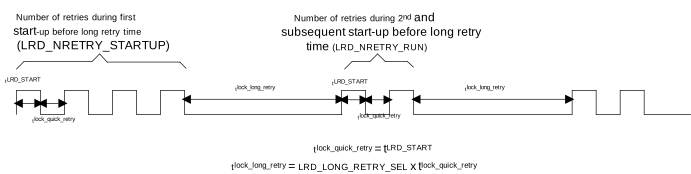 Figure 6-22 Locked rotor retry sequence and timing
during start-up when LRD_RETRY_DIS = 0x0
Figure 6-22 Locked rotor retry sequence and timing
during start-up when LRD_RETRY_DIS = 0x0When a locked rotor condition is detected during motor run (no Hall transition for tLRD_RUN), all FETs are in disabled (Hi-Z) and the FG/RD pin indicates the locked rotor fault according to Table 6-4. MC121-Q1 waits for one interval of long retry time before starting the locked rotor retry sequence as shown in Figure 6-23.
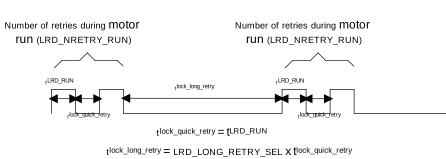 Figure 6-23 Locked rotor retry sequence and timing
during run when LRD_RETRY_DIS = 0x0
Figure 6-23 Locked rotor retry sequence and timing
during run when LRD_RETRY_DIS = 0x0MC121-Q1 provides the option of latching a locked rotor fault after 5 consecutive start attempts result in a locked rotor by setting LRD_RETRY_DIS = 0x1 as shown in Figure 6-24. Motor operation can resumed either by a power reset or wake-up (sleep exit).
 Figure 6-24 Locked rotor retry sequence and timing
when LRD_RETRY_DIS = 0x1
Figure 6-24 Locked rotor retry sequence and timing
when LRD_RETRY_DIS = 0x1