SLLSFT3 November   2025 MC121-Q1

ADVANCE INFORMATION  

  1.   1
  2. Features
  3. Applications
  4. Description
  5. Pin Configuration and Functions
  6. Specifications
    1. 5.1 Absolute Maximum Ratings
    2. 5.2 ESD Ratings Auto
    3. 5.3 Recommended Operating Conditions
    4. 5.4 Thermal Information
    5. 5.5 Electrical Characteristics
    6. 5.6 I2C Timing Requirements
    7. 5.7 Timing Diagrams
  7. Detailed Description
    1. 6.1 Overview
    2. 6.2 Functional Block Diagram
    3. 6.3 Feature Description
      1. 6.3.1 Motor Control
        1. 6.3.1.1 Duty Input
        2. 6.3.1.2 Duty Curve
        3. 6.3.1.3 Motor Start, Speed Change, and Stop
        4. 6.3.1.4 Open-Loop (Duty Cycle) Control
        5. 6.3.1.5 Closed-Loop (Speed) Control
        6. 6.3.1.6 Commutation
          1. 6.3.1.6.1 Hall Sensor
            1. 6.3.1.6.1.1 Field Direction Definition
            2. 6.3.1.6.1.2 Internal Hall Latch Sensor Output
          2. 6.3.1.6.2 Hall Offset
          3. 6.3.1.6.3 Square Commutation
          4. 6.3.1.6.4 Soft Commutation
        7. 6.3.1.7 PWM Modulation Modes
      2. 6.3.2 Protections
        1. 6.3.2.1 Locked Rotor Protection
        2. 6.3.2.2 Current Limit
        3. 6.3.2.3 Overcurrent Protection (OCP)
        4. 6.3.2.4 VM Undervoltage Lockout (UVLO)
        5. 6.3.2.5 VM Over Voltage Protection (OVP)
        6. 6.3.2.6 Thermal Shutdown (TSD)
        7. 6.3.2.7 Integrated Supply (VM) Clamp
    4. 6.4 Device Functional Modes
      1. 6.4.1 Active Mode
      2. 6.4.2 Sleep and Standby Mode
      3. 6.4.3 Fault Mode
      4. 6.4.4 Test Mode and One-Time Programmable Memory
    5. 6.5 Programming
      1. 6.5.1 I2C Communication
        1. 6.5.1.1 I2C Read
        2. 6.5.1.2 I2C Write
  8. Register Map
    1. 7.1 USR_OTP Registers
    2. 7.2 USR_TM Registers
  9. Application and Implementation
    1. 8.1 Application Information
      1. 8.1.1 External Components
    2. 8.2 Typical Application
      1. 8.2.1 Design Requirements
      2. 8.2.2 Detailed Design Procedure
      3. 8.2.3 Application Curves
    3. 8.3 Power Supply Recommendations
      1. 8.3.1 Bulk Capacitance
    4. 8.4 Layout
      1. 8.4.1 Layout Guidelines
      2. 8.4.2 Layout Example
  10. Device and Documentation Support
    1. 9.1 Device Support
    2. 9.2 Documentation Support
      1. 9.2.1 Related Documentation
    3. 9.3 Receiving Notification of Documentation Updates
    4. 9.4 Support Resources
    5. 9.5 Trademarks
    6. 9.6 Electrostatic Discharge Caution
    7. 9.7 Glossary
  11. 10Revision History

封装选项

机械数据 (封装 | 引脚)
  • DYM|6
  • DEZ|6
散热焊盘机械数据 (封装 | 引脚)
订购信息

Overcurrent Protection (OCP)

The overcurrent protection (OCP) feature protects the integrated power FETs on the OUTx pins from shorts to the supply (VM), ground, and between the OUTx pins. When the current through a FET stays higher than the OCP threshold (IOCP) for longer than the OCP deglitch time (tOCP) as shown in Figure 6-27, all FETs in the H-bridge are disabled (Hi-Z) and the FG/RD pin indicates the locked rotor fault according to Table 6-4. The OCP fault recovery is set by OCP_RETRY_MODE.
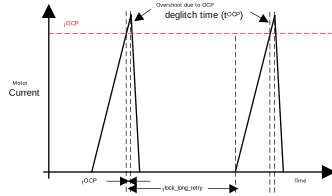
MC121-Q1 OCP Operation Figure 6-27 OCP Operation

When OCP_RETRY_MODE is set to 0x0, MC121-Q1 starts driving the motor (from pre-start phase) after tlock_long_retry lapses as shown in Figure 6-28. tlock_long_retry is set by (LRD_LONG_RETRY_SEL x tLRD_START). When OCP_RETRY_MODE is set to 0x1, MC121-Q1 latches the fault after 3 retry attempts (retry time is set by tlock_long_retry); subsequent motor operation is possible only after a subsequent power reset or wake-up (sleep exit) to clear the fault condition.

MC121-Q1 OCP retry Modes Figure 6-28 OCP retry Modes