SLLSFT3 November 2025 MC121-Q1
ADVANCE INFORMATION
- 1
- 1 Features
- 2 Applications
- 3 Description
- 4 Pin Configuration and Functions
- 5 Specifications
-
6 Detailed Description
- 6.1 Overview
- 6.2 Functional Block Diagram
- 6.3 Feature Description
- 6.4 Device Functional Modes
- 6.5 Programming
- 7 Register Map
- 8 Application and Implementation
- 9 Device and Documentation Support
- 10Revision History
封装选项
机械数据 (封装 | 引脚)
- DYM|6
- DEZ|6
散热焊盘机械数据 (封装 | 引脚)
8.1.1 External Components
This section presents recommended external components for the MC121-Q1 in a fan application.
Supply Components
Figure 8-1 shows typical components used on the supply connection in a fan module. The D1 diode in series with the power supply protects the MC121-Q1 in case of accidental reverse supply connection. A power supply decoupling capacitor is required for proper functioning of MC121-Q1 and a minimum value of 0.1 uF is recommended. The optional bulk capacitor, CBULK, placed near the VM pin helps to stabilize the VVM supply voltage during motor operation. A ceramic capacitor with low electrical series resistance (ESR) and a voltage rating twice the supply voltage is recommended to provide margin during transients. A capacitance value between 1 μF and 10 μF based on application is recommended.
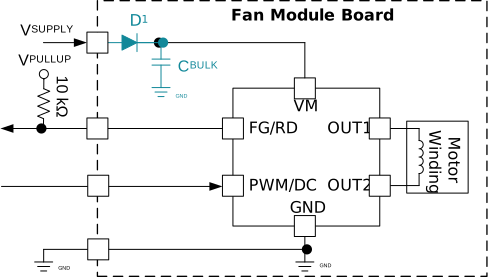 Figure 8-1 Typical Fan Module External
Components
Figure 8-1 Typical Fan Module External
ComponentsMotor systems requiring large motor currents and high rotor inertia can experience high currents flowing into the VM node from the H-bridge due to stored inductor energy during commutation. The additional charge in the CBULK capacitor increases the VVM supply voltage. Although the MC121-Q1 has overvoltage protection, adding protective clamp components on the supply rail can reduce the magnitude of voltage spikes. These components can also help protect against ESD strikes on the supply.
Figure 8-2 shows an example using a Zener diode or TVS diode (D2) on the VM node. The diode clamping voltage needs to be higher than the fan system maximum operating voltage and lower than the MC121-Q1 maximum operating voltage from the Recommended Operating Conditions table. An RC snubber on the supply also can protect the driver against voltage spikes and ESD (Figure 8-3). TI recommends using 1 μF for CSNUBBER and 2 Ω for RSNUBBER. Alternatively, an electrolyic capacitor can be used in parallel with CBULK.
 Figure 8-2 Clamping Diode on
VM
Figure 8-2 Clamping Diode on
VM Figure 8-3 Snubber on VM
PWM and FG/RD Pin Components
Figure 8-1 shows the minimal external components needed for fan module PWM control and speed/fault feedback. The FG/RD pin is an open drain output and requires an external pull-up resistor to provide an output signal at the proper voltage. The pull-up resistor value must be chosen to limit the current into the FG/RD pin to less than 5 mA when the open drain output asserts low. Adding resistors inline with the PWM input and FG/RD output can help protect the driver from ESD strikes on the connector wires, as shown in Figure 8-4. Clamping or TVS diodes on the FG/RD and PWM signals provides additional protection against ESD strikes as shown in Figure 8-5.
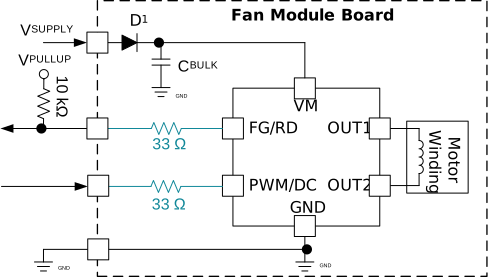 Figure 8-4 Resistors on PWM and
FG/RD
Figure 8-4 Resistors on PWM and
FG/RD Figure 8-5 Resistors and zener diodes
on PWM and FG/RD
Figure 8-5 Resistors and zener diodes
on PWM and FG/RDSome single phase fan modules require an open-collector interface for the FG/RD and PWM pins. Figure 8-6 and Figure 8-7 show examples for connecting components inside and outside of the fan module for the open-collector interface.
 Figure 8-6 Open Collector on
FG/RD
Figure 8-6 Open Collector on
FG/RD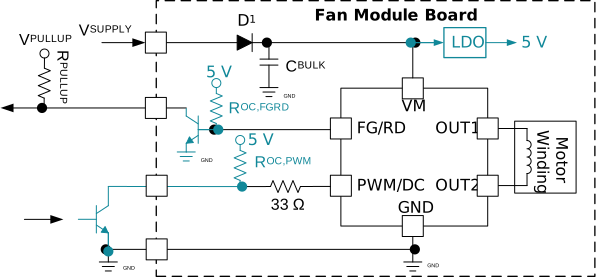 Figure 8-7 Open Collector on PWM and
FG/RD
Figure 8-7 Open Collector on PWM and
FG/RDOTP and Test Mode Programming
The MC121-Q1 supports an I2C interface on the FG/RD and PWM pins in OTP (one-time programmable) mode. The OTP mode allows the designer to test various device settings and program the device OTP in production. Figure 8-8 shows an example of the external component connections for the MC121-Q1 for device programming. Additional details on OTP and test mode programming are in Section 6.4.4.
 Figure 8-8 OTP Memory Programmer and Fan
Module
Figure 8-8 OTP Memory Programmer and Fan
Module