SLLSFT3 November 2025 MC121-Q1
ADVANCE INFORMATION
- 1
- 1 Features
- 2 Applications
- 3 Description
- 4 Pin Configuration and Functions
- 5 Specifications
-
6 Detailed Description
- 6.1 Overview
- 6.2 Functional Block Diagram
- 6.3 Feature Description
- 6.4 Device Functional Modes
- 6.5 Programming
- 7 Register Map
- 8 Application and Implementation
- 9 Device and Documentation Support
- 10Revision History
6.3.1.2 Duty Curve
MC121-Q1 supports configurable duty curve as shown in Figure 6-3. This allows user to set the target output duty cycle (DOUT_TARGET) as a function of input duty (DIN) depending on the specific use-case enabling a single platform (MC121-Q1) BLDC driver designs for different end applications.
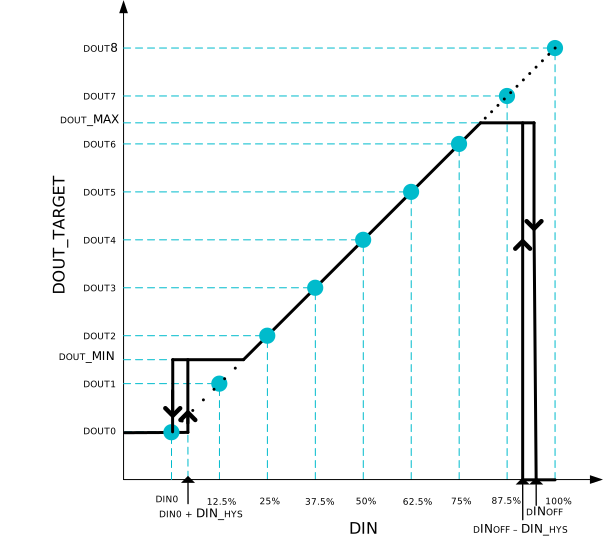 Figure 6-3 Duty Curve
The configurable points on the duty curve are as follows,
- DIN0, DOUT0: DIN0 can be used to set the minimum input (starting) duty cycle to start driving the motor - when STBY_EN = 0x1, motor is not driven till DIN ≥ (DIN0 + DINHYS). DINHYS sets the hysteresis around DIN0 to start/stop driving the motor. MC121-Q1 also provides the option of driving the motor even when DIN < DIN0 by setting STBY_EN to 0x0 and DOUT0 to a non-zero value. The device state when DIN = 0% is set by SLEEP_EN and STBY_EN bits as listed in Table 6-5.
- DINOFF: DINOFF sets the maximum input duty cycle (DIN) above which target output duty cycle (DOUT_TARGET) is set to zero to stop driving the motor, DOUT_TARGET = 0% when DIN ≥ DINOFF. The motor driving resumes when DIN < (DINOFF - DINHYS).
- DOUT_MIN: DOUT_MIN sets the minimum target output duty cycle (DOUT_TARGET) when DIN0 < DIN < DINOFF.
- DOUT_MAX: DOUT_MAX sets the maximum target output duty cycle (DOUT_TARGET) when DIN < DINOFF.
- DOUTx: DOUTx sets the output duty at fixed intervals of input duty. DOUT1 sets the target output duty at DIN = 12.5%, DOUT2 sets the target output duty at DIN = 25% and so forth such that DOUT8 sets the target output duty at DIN = 100% . DOUTx can be used to configure positive slope duty curve as shown in Duty Curve. DOUTx can be also used to configure negative slope as shown in Figure 6-4. DOUTx can also be used to configure mixed slope (positive, negative and zero) as shown in Figure 6-5.
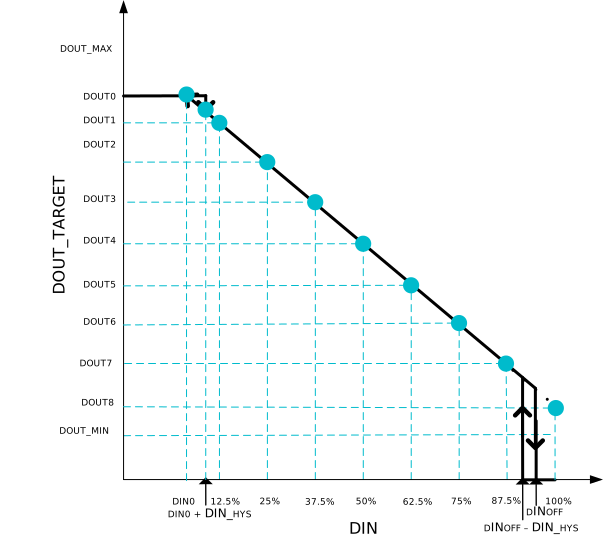 Figure 6-4 Duty Curve - Negative
Slope
Figure 6-4 Duty Curve - Negative
Slope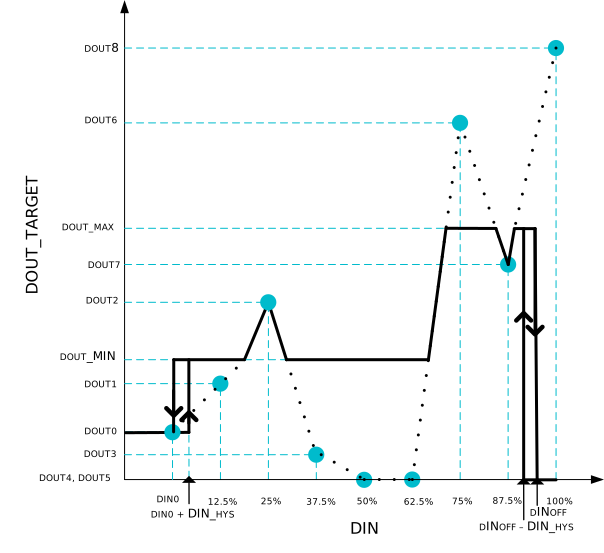 Figure 6-5 Duty Curve - Mixed
Slope
Figure 6-5 Duty Curve - Mixed
Slope