SBOSA47 February   2026 OPA2591 , OPA591

ADVANCE INFORMATION  

  1.   1
  2. 1Features
  3. 2Applications
  4. 3Description
  5. 4Pin Configuration and Functions
  6. 5Specifications
    1. 5.1 Absolute Maximum Ratings
    2. 5.2 ESD Ratings
    3. 5.3 Recommended Operating Conditions
    4. 5.4 Thermal Information for OPA591
    5. 5.5 Thermal Information OPA2591
    6. 5.6 Electrical Characteristics
  7. 6Detailed Description
    1. 6.1 Overview
    2. 6.2 Functional Block Diagram
    3. 6.3 Feature Description
      1. 6.3.1 MUX-Friendly Inputs
      2. 6.3.2 Thermal Protection
      3. 6.3.3 Advanced Slew Boost
      4. 6.3.4 Full-Power Bandwidth Improved
      5. 6.3.5 Overload Recovery
    4. 6.4 Device Functional Modes
  8. 7Application and Implementation
    1. 7.1 Application Information
    2. 7.2 Typical Applications
      1. 7.2.1 High Voltage Instrumentation Amplifier
        1. 7.2.1.1 Design Requirements
        2. 7.2.1.2 Detailed Design Procedure
        3. 7.2.1.3 Application Curves
      2. 7.2.2 DAC Output Gain and Buffer
      3. 7.2.3 Single-Supply Piezoelectric Driver
      4. 7.2.4 Current Booster
    3. 7.3 Creepage and Clearance
    4. 7.4 Power Supply Recommendations
    5. 7.5 Layout
      1. 7.5.1 Layout Guidelines
        1. 7.5.1.1 Thermal Considerations
      2. 7.5.2 Layout Example
  9. 8Device and Documentation Support
    1. 8.1 Receiving Notification of Documentation Updates
    2. 8.2 Support Resources
    3. 8.3 Trademarks
    4. 8.4 Electrostatic Discharge Caution
    5. 8.5 Glossary
  10. 9Mechanical, Packaging, and Orderable Information

封装选项

机械数据 (封装 | 引脚)
散热焊盘机械数据 (封装 | 引脚)
订购信息

Full-Power Bandwidth Improved

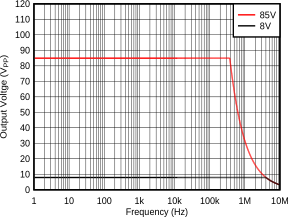
The full-power bandwidth curve has been a staple in data sheets for decades. The full-power bandwidth of an op amp provides some indication about where designers can expect slew-induced distortion on a signal of a given amplitude and frequency. The full-power bandwidth curve is generated using Equation 2.

Equation 2. FPBW=SR2πVOUT_MAX

Figure 6-3 shows the full-power bandwidth of the OPAx591. The curve is a good reference for designers that need to achieve high-voltage, high-frequency output swings with little concern for distortion performance. Unfortunately, the curve provides little indication of the true distortion at any given point on the curve. The full-power bandwidth curve is, after all, only a theoretical value and slew-induced distortion appears gradually as the output nears the maximum rate of change. Furthermore, slew-induced distortion is only one of several sources of op-amp distortion. Therefore, the curve is a decent starting point, but not a reliable source for distortion performance.

Figure 6-4 shows the full power bandwidth in terms of total harmonic distortion (THD) performance for the OPAx591. This curve provides a better indication of the level of distortion that a designer can expect for a signal of a given amplitude and frequency. For example, the OPAx591 can achieve approximately −100dB or better of THD at 70VPP up to approximately 1kHz. As a second example, the OPAx591 can achieve approximately −130dB or better of THD at 10VPP up to about 1kHz. As a result of limitations in measurement bandwidth, only 20kHz data are recorded.

OPA591 OPA2591 Full-Power
                        BandwidthFigure 6-3 Full-Power Bandwidth
OPA591 OPA2591 Full-Power Bandwidth
                        ImprovedFigure 6-4 Full-Power Bandwidth Improved