SLLSFV1 March   2025 MCF8329A-Q1

PRODUCTION DATA  

  1.   1
  2. Features
  3. Applications
  4. Description
  5. Pin Configuration and Functions
  6. Specifications
    1. 5.1 Absolute Maximum Ratings
    2. 5.2 ESD Ratings Auto
    3. 5.3 Recommended Operating Conditions
    4. 5.4 Thermal Information
    5. 5.5 Electrical Characteristics
    6. 5.6 Characteristics of the SDA and SCL bus for Standard and Fast mode
    7. 5.7 Typical Characteristics
  7. Detailed Description
    1. 6.1 Overview
    2. 6.2 Functional Block Diagram
    3. 6.3 Feature Description
      1. 6.3.1  Three Phase BLDC Gate Drivers
      2. 6.3.2  Gate Drive Architecture
        1. 6.3.2.1 Dead time and Cross Conduction Prevention
      3. 6.3.3  AVDD Linear Voltage Regulator
      4. 6.3.4  Low-Side Current Sense Amplifier
      5. 6.3.5  Device Interface Modes
        1. 6.3.5.1 Interface - Control and Monitoring
        2. 6.3.5.2 I2C Interface
      6. 6.3.6  Motor Control Input Options
        1. 6.3.6.1 Analog-Mode Motor Control
        2. 6.3.6.2 PWM-Mode Motor Control
        3. 6.3.6.3 Frequency-Mode Motor Control
        4. 6.3.6.4 I2C based Motor Control
        5. 6.3.6.5 Input Control Signal Profiles
          1. 6.3.6.5.1 Linear Control Profiles
          2. 6.3.6.5.2 Staircase Control Profiles
          3. 6.3.6.5.3 Forward-Reverse Profiles
        6. 6.3.6.6 Control Input Transfer Function without Profiler
      7. 6.3.7  Bootstrap Capacitor Initial Charging
      8. 6.3.8  Starting the Motor Under Different Initial Conditions
        1. 6.3.8.1 Case 1 – Motor is Stationary
        2. 6.3.8.2 Case 2 – Motor is Spinning in the Forward Direction
        3. 6.3.8.3 Case 3 – Motor is Spinning in the Reverse Direction
      9. 6.3.9  Motor Start Sequence (MSS)
        1. 6.3.9.1 Initial Speed Detect (ISD)
        2. 6.3.9.2 Motor Resynchronization
        3. 6.3.9.3 Reverse Drive
          1. 6.3.9.3.1 Reverse Drive Tuning
        4. 6.3.9.4 Motor Start-up
          1. 6.3.9.4.1 Align
          2. 6.3.9.4.2 Double Align
          3. 6.3.9.4.3 Initial Position Detection (IPD)
            1. 6.3.9.4.3.1 IPD Operation
            2. 6.3.9.4.3.2 IPD Release
            3. 6.3.9.4.3.3 IPD Advance Angle
          4. 6.3.9.4.4 Slow First Cycle Startup
          5. 6.3.9.4.5 Open loop
          6. 6.3.9.4.6 Transition from Open to Closed Loop
      10. 6.3.10 Closed Loop Operation
        1. 6.3.10.1 Closed loop accelerate
        2. 6.3.10.2 Speed PI Control
        3. 6.3.10.3 Current PI Control
        4. 6.3.10.4 Power Loop
        5. 6.3.10.5 Modulation Index Control
      11. 6.3.11 Maximum Torque Per Ampere (MTPA) Control
      12. 6.3.12 Flux Weakening Control
      13. 6.3.13 Motor Parameters
        1. 6.3.13.1 Motor Resistance
        2. 6.3.13.2 Motor Inductance
        3. 6.3.13.3 Motor Back-EMF constant
      14. 6.3.14 Motor Parameter Extraction Tool (MPET)
      15. 6.3.15 Anti-Voltage Surge (AVS)
      16. 6.3.16 Active Braking
      17. 6.3.17 Output PWM Switching Frequency
      18. 6.3.18 Dead Time Compensation
      19. 6.3.19 Voltage Sense Scaling
      20. 6.3.20 Motor Stop Options
        1. 6.3.20.1 Coast (Hi-Z) Mode
        2. 6.3.20.2 Recirculation Mode
        3. 6.3.20.3 Low-Side Braking
        4. 6.3.20.4 Active Spin-Down
      21. 6.3.21 FG Configuration
        1. 6.3.21.1 FG Output Frequency
        2. 6.3.21.2 FG in Open-Loop
        3. 6.3.21.3 FG During Motor Stop
        4. 6.3.21.4 FG Behavior During Fault
      22. 6.3.22 DC Bus Current Limit
      23. 6.3.23 Protections
        1. 6.3.23.1  PVDD Supply Undervoltage Lockout (PVDD_UV)
        2. 6.3.23.2  AVDD Power on Reset (AVDD_POR)
        3. 6.3.23.3  GVDD Undervoltage Lockout (GVDD_UV)
        4. 6.3.23.4  BST Undervoltage Lockout (BST_UV)
        5. 6.3.23.5  MOSFET VDS Overcurrent Protection (VDS_OCP)
        6. 6.3.23.6  VSENSE Overcurrent Protection (SEN_OCP)
        7. 6.3.23.7  Thermal Shutdown (OTSD)
        8. 6.3.23.8  Hardware Lock Detection Current Limit (HW_LOCK_ILIMIT)
          1. 6.3.23.8.1 HW_LOCK_ILIMIT Latched Shutdown (HW_LOCK_ILIMIT_MODE = 00xxb)
          2. 6.3.23.8.2 HW_LOCK_ILIMIT Automatic recovery (HW_LOCK_ILIMIT_MODE = 01xxb)
          3. 6.3.23.8.3 HW_LOCK_ILIMIT Report Only (HW_LOCK_ILIMIT_MODE = 1000b)
          4. 6.3.23.8.4 HW_LOCK_ILIMIT Disabled (HW_LOCK_ILIMIT_MODE= 1001b to 1111b)
        9. 6.3.23.9  Lock Detection Current Limit (LOCK_ILIMIT)
          1. 6.3.23.9.1 LOCK_ILIMIT Latched Shutdown (LOCK_ILIMIT_MODE = 00xxb)
          2. 6.3.23.9.2 LOCK_ILIMIT Automatic Recovery (LOCK_ILIMIT_MODE = 01xxb)
          3. 6.3.23.9.3 LOCK_ILIMIT Report Only (LOCK_ILIMIT_MODE = 1000b)
          4. 6.3.23.9.4 LOCK_ILIMIT Disabled (LOCK_ILIMIT_MODE = 1xx1b)
        10. 6.3.23.10 Motor Lock (MTR_LCK)
          1. 6.3.23.10.1 MTR_LCK Latched Shutdown (MTR_LCK_MODE = 00xxb)
          2. 6.3.23.10.2 MTR_LCK Automatic Recovery (MTR_LCK_MODE= 01xxb)
          3. 6.3.23.10.3 MTR_LCK Report Only (MTR_LCK_MODE = 1000b)
          4. 6.3.23.10.4 MTR_LCK Disabled (MTR_LCK_MODE = 1xx1b)
        11. 6.3.23.11 Motor Lock Detection
          1. 6.3.23.11.1 Lock 1: Abnormal Speed (ABN_SPEED)
          2. 6.3.23.11.2 Lock 2: Abnormal BEMF (ABN_BEMF)
          3. 6.3.23.11.3 Lock3: No-Motor Fault (NO_MTR)
        12. 6.3.23.12 MPET Faults
        13. 6.3.23.13 IPD Faults
    4. 6.4 Device Functional Modes
      1. 6.4.1 Functional Modes
        1. 6.4.1.1 Sleep Mode
        2. 6.4.1.2 Standby Mode
        3. 6.4.1.3 Fault Reset (CLR_FLT)
    5. 6.5 External Interface
      1. 6.5.1 DRVOFF - Gate Driver Shutdown Functionality
      2. 6.5.2 Oscillator Source
        1. 6.5.2.1 External Clock Source
    6. 6.6 EEPROM access and I2C interface
      1. 6.6.1 EEPROM Access
        1. 6.6.1.1 EEPROM Write
        2. 6.6.1.2 EEPROM Read
      2. 6.6.2 I2C Serial Interface
        1. 6.6.2.1 I2C Data Word
        2. 6.6.2.2 I2C Write Operation
        3. 6.6.2.3 I2C Read Operation
        4. 6.6.2.4 Examples of I2C Communication Protocol Packets
        5. 6.6.2.5 Internal Buffers
        6. 6.6.2.6 CRC Byte Calculation
  8. EEPROM (Non-Volatile) Register Map
    1. 7.1 Algorithm_Configuration Registers
    2. 7.2 Fault_Configuration Registers
    3. 7.3 Hardware_Configuration Registers
    4. 7.4 Internal_Algorithm_Configuration Registers
  9. RAM (Volatile) Register Map
    1. 8.1 Fault_Status Registers
    2. 8.2 Algorithm_Control Registers
    3. 8.3 System_Status Registers
    4. 8.4 Device_Control Registers
    5. 8.5 Algorithm_Variables Registers
  10. Application and Implementation
    1. 9.1 Application Information
    2. 9.2 Typical Applications
      1.      Detailed Design Procedure
      2.      Bootstrap Capacitor and GVDD Capacitor Selection
      3.      Gate Drive Current
      4.      Gate Resistor Selection
      5.      System Considerations in High Power Designs
      6.      Capacitor Voltage Ratings
      7.      External Power Stage Components
    3. 9.3 Power Supply Recommendations
      1. 9.3.1 Bulk Capacitance
    4. 9.4 Layout
      1. 9.4.1 Layout Guidelines
      2. 9.4.2 Layout Example
      3. 9.4.3 Thermal Considerations
        1. 9.4.3.1 Power Dissipation
  11. 10Device and Documentation Support
    1. 10.1 Documentation Support
      1. 10.1.1 Related Documentation
    2. 10.2 Support Resources
    3. 10.3 Trademarks
    4. 10.4 Electrostatic Discharge Caution
    5. 10.5 Glossary
  12. 11Revision History
  13. 12Mechanical, Packaging, and Orderable Information

封装选项

机械数据 (封装 | 引脚)
散热焊盘机械数据 (封装 | 引脚)
订购信息

Recirculation Mode

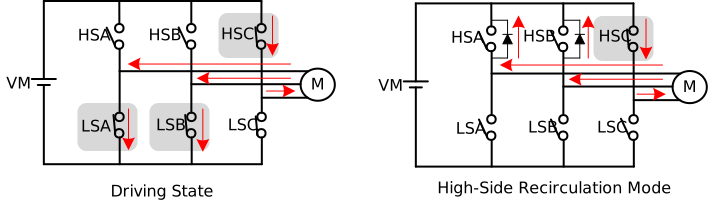
Recirculation mode is configured by setting MTR_STOP to 001b. In order to prevent the inductive energy from returning to DC input supply during motor stop, the MCF8329A-Q1 allows current to circulate within the external MOSFETs by selectively turning OFF some of the active (ON) MOSFETs for a certain time (auto calculated recirculation time to allow the inductive current to decay to zero) before transitioning into Hi-Z by turning OFF the remaining MOSFETs.

Depending on the phase voltage pattern at the time of receiving the stop command, either low-side (see Figure 6-38) or high-side recirculation (see Figure 6-39) will be used to stop the motor without sending the inductive energy back to the DC input supply.
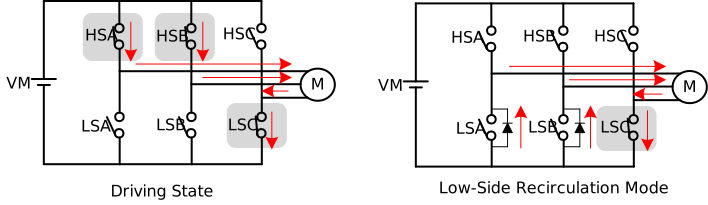
MCF8329A-Q1 Low-Side RecirculationFigure 6-38 Low-Side Recirculation
MCF8329A-Q1 High-Side RecirculationFigure 6-39 High-Side Recirculation
Note:
  1. Recirculation stop is not supported when the motor is in flux weakening zone or MTPA or in active brake mode, and when motor is in any of these states then recirculation stop mode is over written with Hi-Z.
  2. Recirculation mode is not supported in modulation index control mode and TI recommends to use other stop modes if modulation index control mode is used.