ZHCSEG6F December   2015  – May 2025 TCAN330 , TCAN330G , TCAN332 , TCAN332G , TCAN334 , TCAN334G , TCAN337 , TCAN337G

PRODUCTION DATA  

  1.   1
  2. 1特性
  3. 2应用
  4. 3说明
  5.   Device Options
  6. 4Pin Configuration and Functions
  7. 5Specifications
    1. 5.1 Absolute Maximum Ratings
    2. 5.2 ESD Ratings
    3. 5.3 Recommended Operating Conditions
    4. 5.4 Thermal Information
    5. 5.5 Electrical Characteristics
    6. 5.6 Switching Characteristics
    7. 5.7 Typical Characteristics
    8. 5.8 Typical Characteristics, TCAN330 Receiver
    9. 5.9 Typical Characteristics, TCAN330 Driver
  8.   Parameter Measurement Information
  9. 6Detailed Description
    1. 6.1 Overview
    2. 6.2 Functional Block Diagram
    3. 6.3 Feature Description
      1. 6.3.1 TXD Dominant Timeout (TXD DTO)
      2. 6.3.2 RXD Dominant Timeout (RXD DTO)
      3. 6.3.3 Thermal Shutdown
      4. 6.3.4 Undervoltage Lockout and Unpowered Device
      5. 6.3.5 Fault Pin (TCAN337)
      6. 6.3.6 Floating Pins
      7. 6.3.7 CAN Bus Short Circuit Current Limiting
      8. 6.3.8 ESD Protection
      9. 6.3.9 Digital Inputs and Outputs
    4. 6.4 Device Functional Modes
      1. 6.4.1 CAN Bus States
      2. 6.4.2 Normal Mode
      3. 6.4.3 Silent Mode
      4. 6.4.4 Standby Mode with Wake
      5. 6.4.5 Bus Wake via RXD Request (BWRR) in Standby Mode
      6. 6.4.6 Shutdown Mode
      7. 6.4.7 Driver and Receiver Function Tables
  10. 7Application Information Disclaimer
    1. 7.1 Application Information
      1. 7.1.1 Bus Loading, Length and Number of Nodes
    2. 7.2 Typical Application
      1. 7.2.1 Design Requirements
        1. 7.2.1.1 CAN Termination
      2. 7.2.2 Detailed Design Procedure
      3. 7.2.3 Application Curves
    3. 7.3 System Examples
      1. 7.3.1 ISO11898 Compliance of TCAN33x Family of 3.3V CAN Transceivers Introduction
      2. 7.3.2 Differential Signal
      3. 7.3.3 Common-Mode Signal and EMC Performance
    4. 7.4 Power Supply Recommendations
    5. 7.5 Layout
      1. 7.5.1 Layout Guidelines
      2. 7.5.2 Layout Example
  11.   Device and Documentation Support
    1. 8.1 接收文档更新通知
    2. 8.2 支持资源
    3. 8.3 商标
    4. 8.4 静电放电警告
    5. 8.5 术语表
  12. 8Revision History
  13. 9Mechanical, Packaging, and Orderable Information

封装选项

机械数据 (封装 | 引脚)
散热焊盘机械数据 (封装 | 引脚)
订购信息

ESD Protection

The bus pins of the TCAN33x family possess on-chip ESD protection against ±25kV human body model (HBM) and ±12kV IEC61000-4-2 contact discharge. The IEC-ESD test is far more severe than the HBM-ESD test. The 50% higher charge capacitance, CS, and 78% lower discharge resistance, RD of the IEC model produce significantly higher discharge currents than the HBM-model.

As stated in the IEC 61000-4-2 standard, contact discharge is the preferred test method; although IEC air-gap testing is less repeatable than contact testing, air discharge protection levels are inferred from the contact discharge test results.
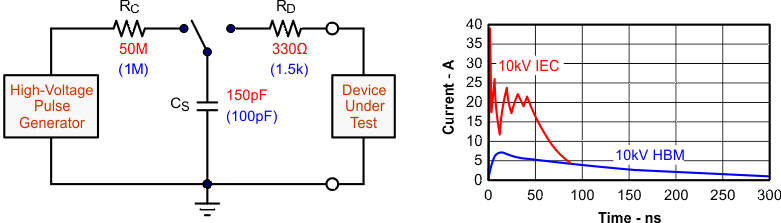
TCAN330 TCAN332 TCAN334 TCAN337 TCAN330G TCAN332G TCAN334G TCAN337G HBM and IEC-ESD Models and Currents in Comparison (HBM Values in Parenthesis)Figure 6-2 HBM and IEC-ESD Models and Currents in Comparison (HBM Values in Parenthesis)