SLVK227 October 2025 TPS7H4012-SP , TPS7H4013-SP
- 1
- TPS7H4012-SP and TPS7H4013-SP Single-Event Effects (SEE)
- Trademarks
- 1 Introduction
- 2 Single-Event Effects (SEE)
- 3 Device and Test Board Information
- 4 Irradiation Facility and Setup
- 5 Depth, Range, and LETEFF Calculation
- 6 Test Setup and Procedures
- 7 Destructive Single-Event Effects (DSEE)
- 8 Single-Event Transients (SET)
- 9 Event Rate Calculations
- 10Summary
- A References
4 Irradiation Facility and Setup
The heavy-ion species used for the SEE studies on this product were provided and delivered by the TAMU Cyclotron Radiation Effects Facility using a superconducting cyclotron and an advanced electron cyclotron resonance (ECR) ion source. At the fluxes used, ion beams had good flux stability and high irradiation uniformity over a 1in diameter circular cross-sectional area for the in-air station. Uniformity is achieved by magnetic defocusing. The flux of the beam is regulated over a broad range spanning several orders of magnitude. For these studies, ion flux of 8.44 × 10⁴ to 1.33 × 10⁵ ions/cm2/s were used to provide heavy-ion fluences of 1.00 × 10⁶ to 1.00 × 10⁷ ions/cm2.
For the experiments conducted on this report, there was one ion used 165Ho. 165Ho was used to obtain LETEFF of 75 MeV×cm2/mg. The total kinetic energies for the ion was:
- 165Ho = 2.474GeV (15MeV/nucleon)
- Ion uniformity for these experiments was between 95% and 96%
Figure 4-1 and Figure 4-2 shows the TPS7H401xEVM used for data collection at the TAMU facility. Although not visible in this photo, the beam port has a 1mil Aramica window to allow in-air testing while maintaining the vacuum within the accelerator with only minor ion energy loss. The in-air gap between the device and the ion beam port window was maintained at 40mm for all runs.
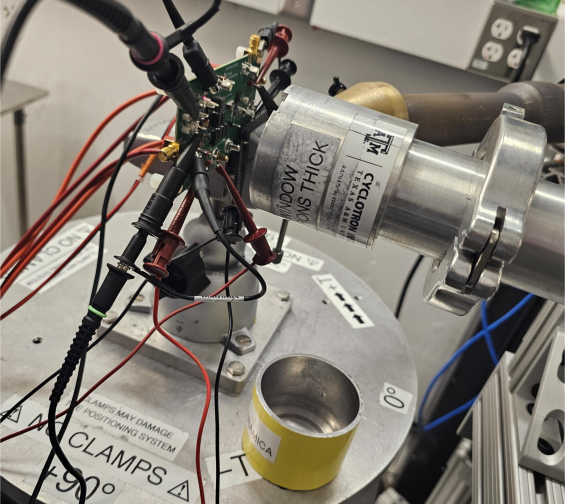 Figure 4-1 Photograph of the TPS7H4012-SP EVM in Front of the Heavy-Ion Beam Exit Port at the Texas A&M Cyclotron
 Figure 4-2 Photograph of the TPS7H4013-SP EVM in Front of the Heavy-Ion Beam Exit Port at the Texas A&M Cyclotron