SBOSA42B June 2024 – December 2025 OPA2596 , OPA596
PRODUCTION DATA
- 1
- 1 Features
- 2 Applications
- 3 Description
- 4 Pin Configuration and Functions
- 5 Specifications
- 6 Detailed Description
-
7 Application and Implementation
- 7.1 Application Information
- 7.2 Typical Applications
- 7.3 Creepage and Clearance
- 7.4 Power Supply Recommendations
- 7.5 Layout
- 8 Device and Documentation Support
- 9 Revision History
- 10Mechanical, Packaging, and Orderable Information
6.3.5 Full-Power Bandwidth Improved
The full-power bandwidth curve has been a staple in data sheets for decades. The full-power bandwidth of an op amp provides some indication about where designers can expect slew-induced distortion on a signal of a given amplitude and frequency. The full-power bandwidth curve is generated using Equation 2.
Figure 6-3 shows the full-power bandwidth of the OPAx596. The curve is a good reference for designers that need to achieve high-voltage, high-frequency output swings with little concern for distortion performance. Unfortunately, the curve provides little indication of the true distortion at any given point on the curve. The full-power bandwidth curve is, after all, only a theoretical value and slew-induced distortion appears gradually as the output nears the maximum rate of change. Furthermore, slew-induced distortion is only one of several sources of op-amp distortion. Therefore, the curve is a decent starting point, but not a reliable source for distortion performance.
Figure 6-4 shows the full power bandwidth in terms of total harmonic distortion (THD) performance for the OPAx596. This curve provides a better indication of the level of distortion that a designer can expect for a signal of a given amplitude and frequency. For example, the OPAx596 can achieve approximately −100dB or better of THD at 70VPP up to approximately 1kHz. As a second example, the OPAx596 can achieve approximately −130dB or better of THD at 10VPP up to about 1kHz. As a result of limitations in measurement bandwidth, only 20kHz data are recorded.
 Figure 6-3 Full-Power
Bandwidth
Figure 6-3 Full-Power
Bandwidth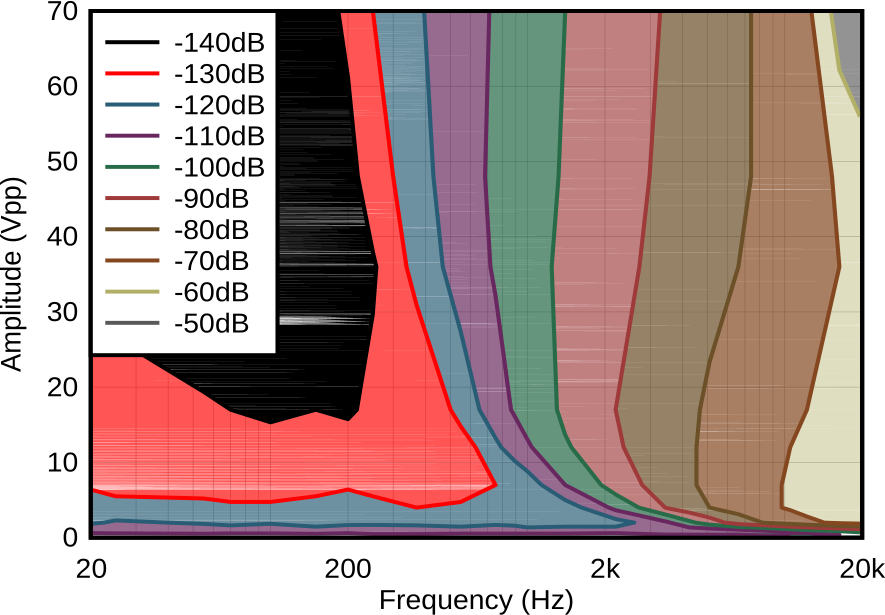 Figure 6-4 Full-Power Bandwidth
Improved
Figure 6-4 Full-Power Bandwidth
Improved