SBOSA42B June   2024  – December 2025 OPA2596 , OPA596

PRODUCTION DATA  

  1.   1
  2. Features
  3. Applications
  4. Description
  5. Pin Configuration and Functions
  6. Specifications
    1. 5.1 Absolute Maximum Ratings
    2. 5.2 ESD Ratings
    3. 5.3 Recommended Operating Conditions
    4. 5.4 Thermal Information OPA596
    5. 5.5 Thermal Information OPA596
    6. 5.6 Electrical Characteristics
    7. 5.7 Typical Characteristics
  7. Detailed Description
    1. 6.1 Overview
    2. 6.2 Functional Block Diagram
    3. 6.3 Feature Description
      1. 6.3.1 MUX-Friendly Inputs
      2. 6.3.2 Thermal Protection
      3. 6.3.3 Advanced Slew Boost
      4. 6.3.4 Overload Recovery
      5. 6.3.5 Full-Power Bandwidth Improved
    4. 6.4 Device Functional Modes
  8. Application and Implementation
    1. 7.1 Application Information
    2. 7.2 Typical Applications
      1. 7.2.1 Bridge-Connected Piezoelectric Driver
        1. 7.2.1.1 Design Requirements
        2. 7.2.1.2 Detailed Design Procedure
        3. 7.2.1.3 Application Curves
      2. 7.2.2 DAC Output Gain and Buffer
        1. 7.2.2.1 Design Requirements
        2. 7.2.2.2 Detailed Design Procedure
      3. 7.2.3 Single-Supply Piezoelectric Driver
      4. 7.2.4 High-Side Current Sense
      5. 7.2.5 High-Voltage Instrumentation Amplifier
      6. 7.2.6 Composite Amplifier
    3. 7.3 Creepage and Clearance
    4. 7.4 Power Supply Recommendations
    5. 7.5 Layout
      1. 7.5.1 Layout Guidelines
        1. 7.5.1.1 Thermal Considerations
      2. 7.5.2 Layout Example
  9. Device and Documentation Support
    1. 8.1 Receiving Notification of Documentation Updates
    2. 8.2 Support Resources
    3. 8.3 Trademarks
    4. 8.4 Electrostatic Discharge Caution
    5. 8.5 Glossary
  10. Revision History
  11. 10Mechanical, Packaging, and Orderable Information

封装选项

请参考 PDF 数据表获取器件具体的封装图。

机械数据 (封装 | 引脚)
  • DGK|8
散热焊盘机械数据 (封装 | 引脚)
订购信息

Creepage and Clearance

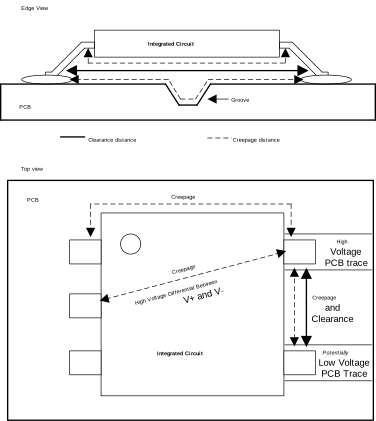
When designing and building electrical systems with high voltage, two important concepts to consider are creepage and clearance. Creepage distance refers to the shortest path that an electric current can take along the surface of an insulating material, such as a printed circuit board (PCB) or a plastic enclosure. Clearance distance refers to the shortest distance between two conductive parts, such as wires, terminals, or components, through the air. Figure 7-8 illustrates creepage and clearance for a typical integrated circuit (IC).
OPA596 OPA2596 Creepage and Clearance in
                    Integrated Circuits Figure 7-8 Creepage and Clearance in Integrated Circuits

Several standards exist with creepage and clearance guidance, but how the standards pertain to operational amplifiers and other integrated circuits is largely left to interpretation and internal requirements. The guidance distances are significantly affected by pollution degree, maximum voltage, and the underlying application. In the case of creepage, the comparative tracking index (CTI) rating of the insulating material is a major factor. Different design techniques exist to improve creepage and clearance if deemed necessary, including adding PBC grooves, conformal coating, and, or derating the operating voltage.

Texas Instruments offers modern packaging with small dimensions that are designed to minimize PCB area. However, the requirement to meet any creepage or clearance specifications depends on the designer’s interpretation and implementation of any relevant IEC or system-level standards. For more information on this topic, visit the Demystifying Clearance and Creepage Distance for High-Voltage End Equipment document.