ZHCSTV0L November   2001  – February 2025 LP2992

PRODUCTION DATA  

  1.   1
  2. 特性
  3. 应用
  4. 说明
  5. Pin Configuration and Functions
  6. Specifications
    1. 5.1 Absolute Maximum Ratings
    2. 5.2 ESD Ratings
    3. 5.3 Recommended Operating Conditions
    4. 5.4 Thermal Information
    5. 5.5 Electrical Characteristics
    6. 5.6 Typical Characteristics
  7. Detailed Description
    1. 6.1 Overview
    2. 6.2 Functional Block Diagram
    3. 6.3 Feature Description
      1. 6.3.1 Output Enable
      2. 6.3.2 Dropout Voltage
      3. 6.3.3 Current Limit
        1. 6.3.3.1 Current Limit (Legacy Chip)
        2. 6.3.3.2 Current Limit (New Chip)
      4. 6.3.4 Undervoltage Lockout (UVLO)
      5. 6.3.5 Output Pulldown
      6. 6.3.6 Thermal Shutdown
    4. 6.4 Device Functional Modes
      1. 6.4.1 Normal Operation
      2. 6.4.2 Dropout Operation
      3. 6.4.3 Disabled
  8. Application and Implementation
    1. 7.1 Application Information
      1. 7.1.1 Estimating Junction Temperature
      2. 7.1.2 Input and Output Capacitor Requirements
      3. 7.1.3 Noise Bypass Capacitor (CBYPASS)
      4. 7.1.4 Power Dissipation (PD)
      5. 7.1.5 Recommended Capacitor Types
        1. 7.1.5.1 Recommended Capacitors (Legacy Chip)
          1. 7.1.5.1.1 Tantalum Capacitors (Legacy Chip)
        2. 7.1.5.2 Recommended Capacitors (New Chip)
      6. 7.1.6 Reverse Current
    2. 7.2 Typical Application
      1. 7.2.1 Design Requirements
      2. 7.2.2 Detailed Design Procedure
        1. 7.2.2.1 ON/OFF Operation
      3. 7.2.3 Application Curves
    3. 7.3 Power Supply Recommendations
    4. 7.4 Layout
      1. 7.4.1 Layout Guidelines
      2. 7.4.2 Layout Examples
  9. Device and Documentation Support
    1. 8.1 Device Nomenclature
    2. 8.2 Documentation Support
      1. 8.2.1 Related Documentation
    3. 8.3 Receiving Notification of Documentation Updates
    4. 8.4 支持资源
    5. 8.5 Trademarks
    6. 8.6 静电放电警告
    7. 8.7 术语表
  10. Revision History
  11. 10Mechanical, Packaging, and Orderable Information

封装选项

机械数据 (封装 | 引脚)
散热焊盘机械数据 (封装 | 引脚)
订购信息

Reverse Current

Excessive reverse current can damage this device. Reverse current flows through the intrinsic body diode of the pass transistor instead of the normal conducting channel. At high magnitudes, this current flow degrades the long-term reliability of the device.

Conditions where reverse current can occur are outlined in this section, all of which can exceed the absolute maximum rating of VOUT ≤ VIN + 0.3 V.

  • If the device has a large COUT and the input supply collapses with little or no load current
  • The output is biased when the input supply is not established
  • The output is biased above the input supply

If reverse current flow is expected in the application, use external protection to protect the device. Reverse current is not limited in the device, so external limiting is required if extended reverse voltage operation is anticipated.

Figure 7-1 shows one approach for protecting the device.
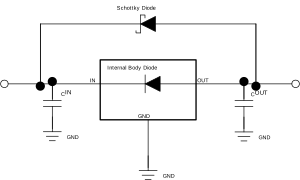
LP2992 Example Circuit
          for Reverse Current Protection Using a Schottky Diode Figure 7-1 Example Circuit for Reverse Current Protection Using a Schottky Diode