SPRAD58B September 2022 – February 2026 AM2631 , AM2631-Q1 , AM2632 , AM2632-Q1 , AM2634 , AM2634-Q1 , UCC14130-Q1 , UCC14131-Q1 , UCC14140-Q1 , UCC14141-Q1 , UCC14240-Q1 , UCC14241-Q1 , UCC14340-Q1 , UCC14341-Q1 , UCC15240-Q1 , UCC15241-Q1 , UCC5870-Q1 , UCC5871-Q1 , UCC5880-Q1 , UCC5881-Q1
- 1
- Abstract
- Trademarks
- 1 Introduction
- 2 Architectures and Trends
- 3 Key Technology to Enable Traction Inverters
- 4 Microcontroller and Power Management IC
- 5 Isolated Gate Drivers
- 6 Low Voltage Isolated Bias Supply
- 7 High Voltage Isolated Bias Supply
- 8 DC Link Active Discharge
- 9 Motor Position Sensing
- 10Isolated Voltage and Current Sensing
- 11System Engineering and Reference Designs
- 12Conclusion
- 13References
6 Low Voltage Isolated Bias Supply
In traction inverters, the low-voltage isolated bias supply connects to a low-voltage source, such as a 12V or 48V battery, to provide a bias supply on the secondary side for the gate driver. There are three main low-voltage isolated bias supply architectures, see Figure 6-1:
- Fully distributed: each gate driver connects to an individual bias supply. This system enables the easiest PCB routing and is the most fault tolerant, but is potentially more expensive.
- Centralized: A single converter with multiple outputs supplies all the gate drivers. Each gate driver can receive an individual isolated supply (demanding a 1:6 transformer). However, there is also the option for a single 1:4 transformer to supply the high side individually and the low side together. The PWM driver module remains the central IC in the supply controlling the transformer. This system potentially costs less but requires a larger transformer and complicates meeting the functional safety classification requirements due to the single-point failure.
- Semi-distributed: This is the trade-off between cost and fault redundancy. The low side gate drivers share a single bias supply, either from a 1:3 or a 1:1 transformer, while the high side gate drivers each get individual bias supplies.
 Figure 6-1 Low Voltage Bias Supply Architectures
TI provides various designs for the four most common topologies for isolated bias supplies. These include primary side regulated flyback converters, open-loop push-pull converters, open-loop inductor-inductor-capacitor (LLC) resonant converters, and fully integrated modules, see Figure 6-2. Controller options with both external field-effect transistor (FET) and external magnetics are also available instead of the converters.
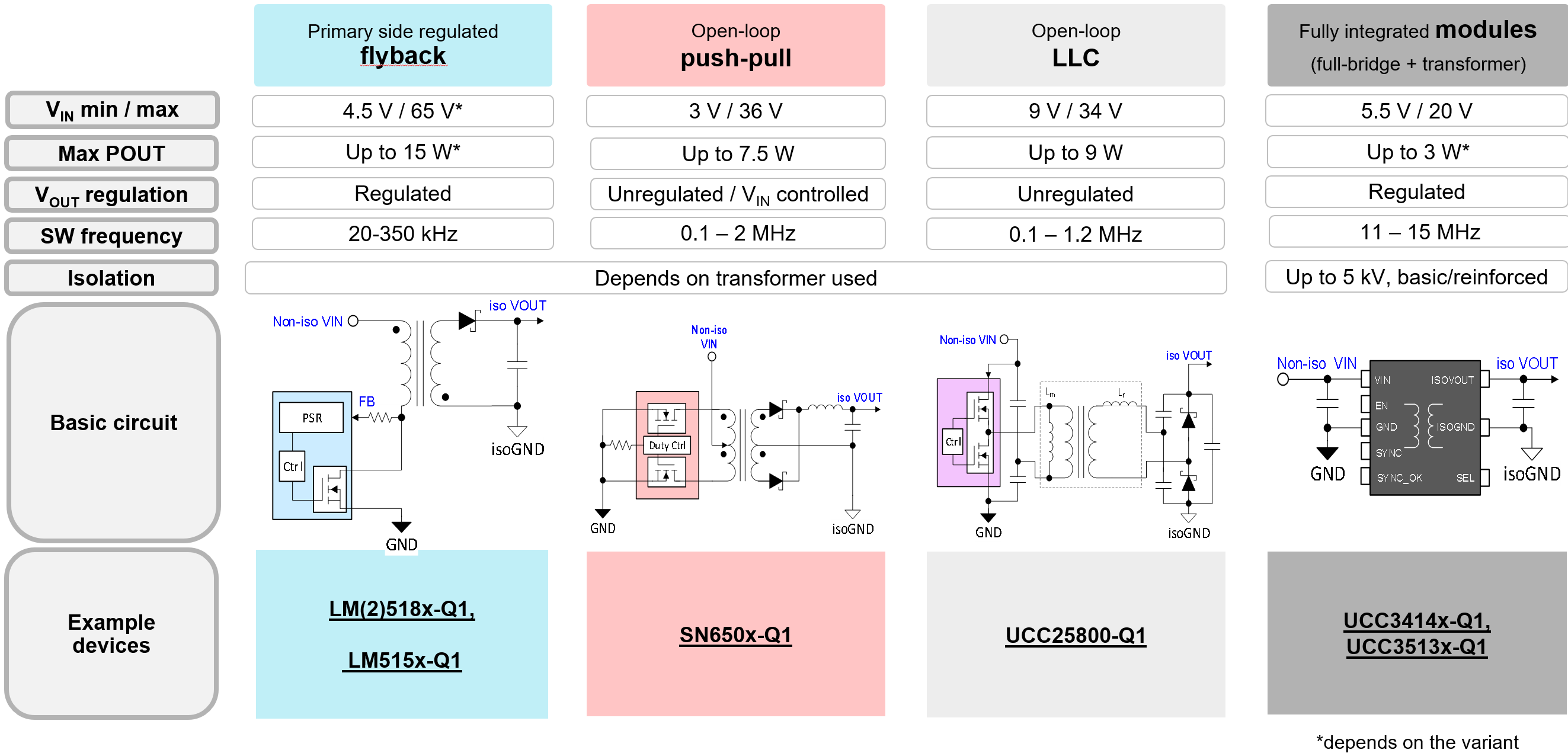 Figure 6-2 Common Topologies for Isolated Bias Supplies
The UCC34xxx-Q1 and UCC35xxx-Q1 family of isolated DC-DC converter modules features a wide input voltage range (5.5V – 28V). With the transformer integrated, a smaller BOM footprint can be enabled, which has potentially smaller costs than other designs. For a full inverter design, the UCC34xxx-Q1 device shrinks the system footprint by 77% and the number of components by 20% when compared to a semi-distributed flyback design, see Figure 6-3. The UCC34xxx-Q1 family of devices reaches an output power of 1.5W with an output voltage accuracy ≤1.5%, whereas the new generation of the UCC35xxx-Q1 family provides 2W of power.
 Figure 6-3 Size Comparison Between a Converter Module (Fully Distributed) Versus Flyback (Semi-Distributed) System Design
The UCC25800-Q1 device is an inductor-inductor-capacitor (LLC) resonant converter with ultra-low EMI emission. This device allows the design to utilize a transformer with higher leakage inductance but much smaller parasitic primary-to-secondary capacitance, and protection features such as adjustable overcurrent protection, input overvoltage protection, overtemperature protection, and protection from pin faults.
The SN6507-Q1 device is a high-frequency push-pull transformer driver with integrated MOSFETs and duty cycle control, which enables a wide input voltage range. The device integrates a controller and two 0.5A NMOS power switches that switch out of phase. This device also includes a programmable soft start, spread spectrum clocking, and pin-configurable slew rate control.
The LM2518x-Q1 family of devices are primary-side regulated (PSR) flyback converters with integrated power switches and the ability to operate over a wide input voltage range of 4.5V to 42V. The isolated output voltage is sampled from the primary-side flyback voltage, eliminating the need for an optocoupler, voltage reference, or third winding from the transformer for output voltage regulation. Boundary conduction mode (BCM) switching enables a compact magnetic design and better than ±1.5% load and line regulation performance.