ZHCSU65D February 2010 – June 2025 TPS73801
PRODUCTION DATA
- 1
- 1 特性
- 2 应用
- 3 说明
- 4 Pin Configuration and Functions
- 5 Specifications
- 6 Detailed Description
- 7 Application and Implementation
- 8 Device and Documentation Support
- 9 Revision History
- 10Mechanical, Packaging, and Orderable Information
4 Pin Configuration and Functions
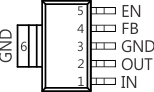 Figure 4-1 DCQ Package,6-Pin SOT-223(Top View)
Table 4-1 Pin Functions
| PIN | TYPE | DESCRIPTION | |
|---|---|---|---|
| NO. | NAME | ||
| 1 | IN | — | Input. Power is supplied to the device through the IN pin. A bypass capacitor is required on this pin if the device is more than six inches away from the main input filter capacitor. In general, the output impedance of a battery rises with frequency, so including a bypass capacitor in battery-powered circuits is advisable. A bypass capacitor (ceramic) in the range of 1 µF to 10 µF is sufficient. The TPS73801 regulators are designed to withstand reverse voltages on the IN pin with respect to ground and the OUT pin. In the case of a reverse input, which can happen if a battery is plugged in backwards, the device acts as if there is a diode in series with the input. There is no reverse current flow into the regulator, and no reverse voltage appears at the load. Both the device and the load are protected. |
| 2 | OUT | — | Output. The output supplies power to the load. A minimum output capacitor (ceramic) of 10 µF is required to prevent oscillations. Larger output capacitors are required for applications with large transient loads to limit peak voltage transients. |
| 3 | GND | — | Ground |
| 4 | FB | IN | Feedback. This pin is the input to the error amplifier. This pin is internally clamped to ±7 V. FB has a bias current of 3 μA that flows into the pin. The FB pin voltage is 1.21 V referenced to ground, and the output voltage range is 1.21 V to 20 V. |
| 5 | EN | IN | Enable. The EN pin is used to put the TPS73801 regulators into a low-power shutdown state. The output is off when the EN pin is pulled low. The EN pin can be driven either by 5-V logic or open-collector gate, normally several microamperes, and the EN pin current, typically 3 μA. If unused, the EN pin must be connected to the IN pin. The device is in the low-power shutdown state if the EN pin is not connected. |
| 6 | GND | — | Ground |