SLVSJB2 July 2025 SN74LV8T374
PRODUCTION DATA
- 1
- 1 Features
- 2 Applications
- 3 Description
- 4 Pin Configuration and Functions
- 5 Specifications
- 6 Parameter Measurement Information
- 7 Detailed Description
- 8 Application and Implementation
- 9 Device and Documentation Support
- 10Revision History
- 11Mechanical, Packaging, and Orderable Information
封装选项
机械数据 (封装 | 引脚)
散热焊盘机械数据 (封装 | 引脚)
- RKS|20
订购信息
5.9 Typical Characteristics
TA = 25°C (unless otherwise noted)
 Figure 5-1 Supply Current Across Input Voltage
1.8V and 2.5V Supply
Figure 5-1 Supply Current Across Input Voltage
1.8V and 2.5V Supply Figure 5-3 Supply Current Across Supply
Voltage
Figure 5-3 Supply Current Across Supply
Voltage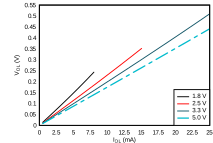 Figure 5-5 Output Voltage vs Current in LOW
State
Figure 5-5 Output Voltage vs Current in LOW
State Figure 5-7 Output Voltage vs Current in LOW
State; 5V Supply
Figure 5-7 Output Voltage vs Current in LOW
State; 5V Supply Figure 5-9 Output Voltage vs Current in LOW
State; 3.3V Supply
Figure 5-9 Output Voltage vs Current in LOW
State; 3.3V Supply Figure 5-11 Output Voltage vs Current in LOW
State; 2.5V Supply
Figure 5-11 Output Voltage vs Current in LOW
State; 2.5V Supply Figure 5-13 Output Voltage vs Current in LOW
State; 1.8V Supply
Figure 5-13 Output Voltage vs Current in LOW
State; 1.8V Supply Figure 5-2 Supply Current Across Input Voltage
3.3V and 5.0V Supply
Figure 5-2 Supply Current Across Input Voltage
3.3V and 5.0V Supply Figure 5-4 Output Voltage vs Current in HIGH
State
Figure 5-4 Output Voltage vs Current in HIGH
State Figure 5-6 Output Voltage vs Current in HIGH
State; 5V Supply
Figure 5-6 Output Voltage vs Current in HIGH
State; 5V Supply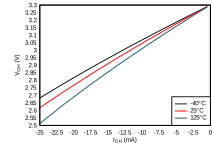 Figure 5-8 Output Voltage vs Current in HIGH
State; 3.3V Supply
Figure 5-8 Output Voltage vs Current in HIGH
State; 3.3V Supply Figure 5-10 Output Voltage vs Current in HIGH
State; 2.5V Supply
Figure 5-10 Output Voltage vs Current in HIGH
State; 2.5V Supply Figure 5-12 Output Voltage vs Current in HIGH
State; 1.8V Supply
Figure 5-12 Output Voltage vs Current in HIGH
State; 1.8V Supply