ZHCSJS5D March   2011  – May 2019 LM21215A

PRODUCTION DATA.  

  1. 特性
  2. 应用
    1.     2.5V、500kHz 时的效率
  3. 说明
    1.     典型应用电路
      1.      Device Images
  4. 修订历史记录
  5. Pin Configuration and Functions
    1.     Pin Functions
  6. Specifications
    1. 6.1 Absolute Maximum Ratings
    2. 6.2 ESD Ratings
    3. 6.3 Recommended Operating Conditions
    4. 6.4 Thermal Information
    5. 6.5 Electrical Characteristics
    6. 6.6 Typical Characteristics
  7. Detailed Description
    1. 7.1 Overview
    2. 7.2 Functional Block Diagram
    3. 7.3 Feature Description
      1. 7.3.1 Precision Enable
      2. 7.3.2 Input Voltage UVLO
      3. 7.3.3 Soft-Start Capability
      4. 7.3.4 PGOOD Indicator
      5. 7.3.5 Frequency Synchronization
      6. 7.3.6 Current Limit
      7. 7.3.7 Short Circuit Protection
    4. 7.4 Device Functional Modes
      1. 7.4.1 Light-Load Operation
      2. 7.4.2 Overvoltage and Undervoltage Handling
      3. 7.4.3 Thermal Shutdown
  8. Application and Implementation
    1. 8.1 Application Information
    2. 8.2 Typical Applications
      1. 8.2.1 Typical Application 1
        1. 8.2.1.1 Design Requirements
        2. 8.2.1.2 Detailed Design Procedure
          1. 8.2.1.2.1 Custom Design With WEBENCH® Tools
          2. 8.2.1.2.2 Output Voltage Setpoint
          3. 8.2.1.2.3 Precision Enable
          4. 8.2.1.2.4 Filter Inductor Selection
          5. 8.2.1.2.5 Output Capacitor Selection
          6. 8.2.1.2.6 Input Capacitor Selection
          7. 8.2.1.2.7 Control Loop Compensation
        3. 8.2.1.3 Application Curves
      2. 8.2.2 Typical Application 2
        1. 8.2.2.1 Design Requirements
        2. 8.2.2.2 Detailed Design Procedure
  9. Power Supply Recommendations
  10. 10Layout
    1. 10.1 Layout Guidelines
      1. 10.1.1 Compact PCB Layout for EMI Reduction
      2. 10.1.2 Thermal Design
      3. 10.1.3 Ground Plane Design
    2. 10.2 Layout Example
  11. 11器件和文档支持
    1. 11.1 器件支持
      1. 11.1.1 第三方产品免责声明
      2. 11.1.2 开发支持
        1. 11.1.2.1 使用 WEBENCH® 工具创建定制设计方案
    2. 11.2 文档支持
      1. 11.2.1 相关文档
    3. 11.3 社区资源
    4. 11.4 商标
    5. 11.5 静电放电警告
    6. 11.6 Glossary
  12. 12机械、封装和可订购信息

封装选项

机械数据 (封装 | 引脚)
散热焊盘机械数据 (封装 | 引脚)
订购信息

Filter Inductor Selection

The filter inductor, designated LF, chosen for the application influences the ripple current and the efficiency of the converter. The first selection criteria is to define the buck converter inductor ripple current ΔIL, typically selected between 20% to 40% of the maximum output current. Figure 31 shows the ripple current in a conventional buck converter operating in continuous conduction mode. Larger ripple current results in a lower inductance, which leads to lower inductor DC resistance (DCR) and improved efficiency. However, larger ripple current causes the LM21215A to operate in DCM at a higher average output current.
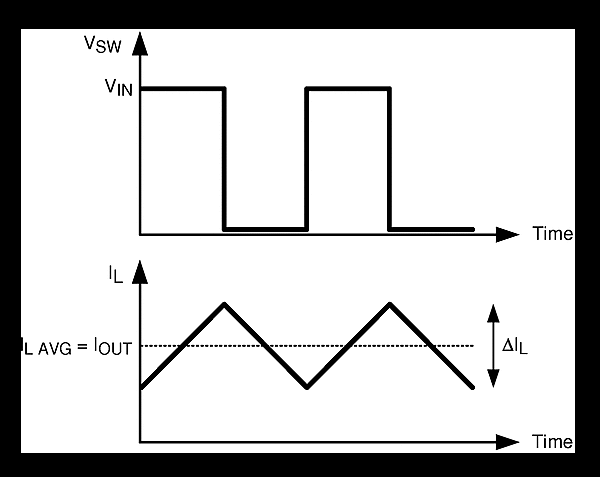
LM21215A 30152107.gifFigure 31. Switch (SW) Voltage and Inductor Current Waveforms

Once the ripple current has been determined, calculate the appropriate inductance using Equation 5.

Equation 5. LM21215A q_Lf_nosb87.gif

A 0.56-µH inductor with 1.8-mΩ DCR meets the application requirements here. The peak inductor current at full load corresponds to the maximum output current plus the ripple current, as shown by Equation 6.
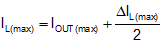
Equation 6. LM21215A q_LLmax_nvs639.gif

Choose an inductor with a saturation current rating at maximum operating temperature that is higher than the overcurrent protection limit. In general, lower inductance is desirable in switching converters because it equates to faster transient response, lower inductor DCR, and reduced size for more compact designs. However, too low of an inductance implies large inductor ripple current such that the overcurrent protection circuit is falsely triggered at the full load. Larger inductor ripple current also implies higher output voltage ripple.