ZHCSE69E November 2014 – May 2025 DLP9500UV
PRODUCTION DATA
- 1
- 1 特性
- 2 应用
- 3 说明
- 4 说明(续)
- 5 Pin Configuration and Functions
-
6 Specifications
- 6.1 Absolute Maximum Ratings
- 6.2 Storage Conditions
- 6.3 ESD Ratings
- 6.4 Recommended Operating Conditions
- 6.5 Thermal Information
- 6.6 Electrical Characteristics
- 6.7 LVDS Timing Requirements
- 6.8 LVDS Waveform Requirements
- 6.9 Serial Control Bus Timing Requirements
- 6.10 Systems Mounting Interface Loads
- 6.11 Micromirror Array Physical Characteristics
- 6.12 Micromirror Array Optical Characteristics
- 6.13 Chipset Component Usage Specification
-
7 Detailed Description
- 7.1 Overview
- 7.2 Functional Block Diagram
- 7.3
Feature Description
- 7.3.1 DLPC410—Digital Controller for DLP Discovery 4100 Chipset
- 7.3.2 DLPA200 - DMD Micromirror Drivers
- 7.3.3 DLPR410—PROM for DLP Discovery 4100 Chipset
- 7.3.4 DLP9500—DLP 0.95 1080p 2xLVDS UV Type-A DMD 1080p DMD
- 7.3.5 Measurement Conditions
- 7.4 Device Functional Modes
- 7.5 Window Characteristics and Optics
- 7.6 Micromirror Array Temperature Calculation
- 7.7 Micromirror Landed-On and Landed-Off Duty Cycle
- 8 Application and Implementation
- 9 Device and Documentation Support
- 10Revision History
- 11Mechanical, Packaging, and Orderable Information
8.1.1 DMD Reflectivity Characteristics
TI assumes no responsibility for end-equipment reflectivity performance. Achieving the desired end-equipment reflectivity performance involves making trade-offs between numerous component and system design parameters. Typical DMD reflectivity characteristics over UV exposure times are represented in Figure 8-1.
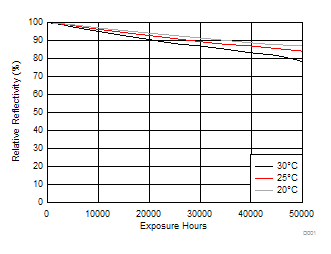
| 2.3 W/cm2, 363 to 400nm, 25°C |
DMD reflectivity includes micromirror surface reflectivity and window transmission. The DMD was characterized for DMD reflectivity using a broadband light source (200W metal-halide lamp). Data is based on a 2.3W/cm2 UV exposure at the DMD surface (365nm peak output) using a 363nm high-pass filter between the light source and the DMD. (Contact your local Texas Instruments representative for additional information about power density measurements and UV filter details.)