ZHCSCJ9B February 2013 – May 2015
PRODUCTION DATA.
- 1 特性
- 2 应用范围
- 3 说明
- 4 修订历史记录
- 5 说明 (续)
- 6 Pin Configuration and Functions
- 7 Specifications
-
8 Detailed Description
- 8.1 Overview
- 8.2 Functional Block Diagrams
- 8.3
Feature Description
- 8.3.1 Input Voltage Protection
- 8.3.2 Battery Protection
- 8.3.3 DEFAULT Mode
- 8.3.4 USB Friendly Power Up
- 8.3.5 Input Current Limiting at Power Up
- 8.3.6 Factory Mode
- 8.3.7 Spread Spectrum Mode
- 8.3.8 PWM Controller in Charge Mode
- 8.3.9 Battery Charging Process
- 8.3.10 Thermal Regulation and Protection
- 8.3.11 Charge Status Output, STAT Pin
- 8.3.12 Control Bits in Charge Mode
- 8.3.13 Control Pins in Charge Mode
- 8.3.14 Boost Mode Operation
- 8.3.15 High Impedance (Hi-Z) Mode
- 8.3.16 Serial Interface Description
- 8.4 Device Functional Modes
- 8.5 Register Maps
- 9 Application and Implementation
- 10Power Supply Recommendations
- 11Layout
- 12器件和文档支持
- 13机械、封装和可订购信息
11 Layout
11.1 Layout Guidelines
Give special attention to the PCB layout. The following list provides guidelines:
- To obtain optimal performance, the power input capacitors, connected from input to PGND, should be placed as close as possible to the pin. The output inductor should be placed close to the IC and the output capacitor connected between the inductor and PGND of the IC. The intent is to minimize the current path loop area from the SW pin through the LC filter and back to the PGND pin. To prevent high frequency oscillation problems, proper layout to minimize high frequency current path loop is critical (see Figure 37). The sense resistor should be adjacent to the junction of the inductor and output capacitor. Route the sense leads connected across the RSNS back to the IC, close to each other (minimize loop area) or on top of each other on adjacent layers (do not route the sense leads through a high-current path, see Figure 38).
- Place all decoupling capacitors close to their respective IC pins and close to PGND (do not place components such that routing interrupts power stage currents). All small control signals should be routed away from the high current paths.
- The PCB should have a ground plane (return) connected directly to the return of all components through vias (two vias per capacitor for power-stage capacitors, two vias for the IC PGND, and one via per capacitor for small-signal components). A star ground design approach is typically used to keep circuit block currents isolated (high-power/low-power small-signal), which reduces noise-coupling and ground-bounce issues. A single ground plane for this design gives good results. With this small layout and a single ground plane, there is no ground-bounce issue, and having the components segregated minimizes coupling between signals.
- The high-current charge paths into VBUS, PMID, and from the SW pins must be sized appropriately for the maximum charge current in order to avoid voltage drops in these traces. The PGND pins should be connected to the ground plane to return current through the internal low-side FET.
- Place 4.7-μF input capacitor as close to PMID pin and PGND pin as possible to make the high frequency current loop area as small as possible. Place 1-μF input capacitor as close to VBUS pin and PGND pin as possible to make high frequency current loop area as small as possible (see Figure 39).
11.2 Layout Example
 Figure 37. High Frequency Current Path
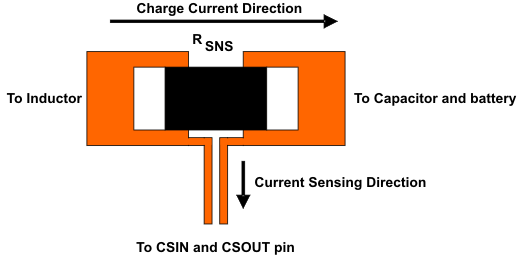 Figure 38. Sensing Resistor PCB Layout
 Figure 39. Input Capacitor Position and PCB Layout Example