ZHCSU12M March   2000  – June 2025 LP2982

PRODUCTION DATA  

  1.   1
  2. 特性
  3. 应用
  4. 说明
  5. Pin Configuration and Functions
  6. Specifications
    1. 5.1 Absolute Maximum Ratings
    2. 5.2 ESD Ratings
    3. 5.3 Recommended Operating Conditions
    4. 5.4 Thermal Information
    5. 5.5 Electrical Characteristics
    6. 5.6 Typical Characteristics
  7. Detailed Description
    1. 6.1 Overview
    2. 6.2 Functional Block Diagrams
    3. 6.3 Feature Description
      1. 6.3.1 Output Enable
      2. 6.3.2 Dropout Voltage
      3. 6.3.3 Current Limit
      4. 6.3.4 Undervoltage Lockout (UVLO)
      5. 6.3.5 Output Pulldown
      6. 6.3.6 Thermal Shutdown
    4. 6.4 Device Functional Modes
      1. 6.4.1 Device Functional Mode Comparison
      2. 6.4.2 Normal Operation
      3. 6.4.3 Dropout Operation
      4. 6.4.4 Disabled
  8. Application and Implementation
    1. 7.1 Application Information
      1. 7.1.1 Recommended Capacitor Types
        1. 7.1.1.1 Recommended Capacitors (Legacy Chip)
        2. 7.1.1.2 Recommended Capacitors (New Chip)
      2. 7.1.2 Input Capacitor Requirements
      3. 7.1.3 Output Capacitor Requirements
      4. 7.1.4 Noise Bypass Capacitor (CBYPASS)
      5. 7.1.5 Reverse Current
      6. 7.1.6 Power Dissipation (PD)
      7. 7.1.7 Estimating Junction Temperature
    2. 7.2 Typical Application
      1. 7.2.1 Design Requirements
      2. 7.2.2 Detailed Design Procedure
        1. 7.2.2.1 ON/ OFF Input Operation
      3. 7.2.3 Application Curves
    3. 7.3 Power Supply Recommendations
    4. 7.4 Layout
      1. 7.4.1 Layout Guidelines
      2. 7.4.2 Layout Example
  9. 器件和文档支持
    1. 8.1 器件命名规则
    2. 8.2 第三方产品免责声明
    3. 8.3 文档支持
      1. 8.3.1 相关文档
    4. 8.4 接收文档更新通知
    5. 8.5 支持资源
    6. 8.6 商标
    7. 8.7 静电放电警告
    8. 8.8 术语表
  10. Revision History
  11. 10Mechanical, Packaging, and Orderable Information

封装选项

机械数据 (封装 | 引脚)
散热焊盘机械数据 (封装 | 引脚)
订购信息

Application Curves

LP2982 5-V,
                        2.2-μF ESR Curves (Legacy chip)
VIN = 6 V
Figure 7-5 5-V, 2.2-μF ESR Curves (Legacy chip)
LP2982 Line
                        Transient Response (Legacy chip)
Figure 7-7 Line Transient Response (Legacy chip)
LP2982 Line Transient Response
                        (New Chip)
VOUT = 3.3 V, ΔVIN = 1 V, IOUT = 50 mA, dV/dt = 1 V/μs
Figure 7-9 Line Transient Response (New Chip)
LP2982 Load
                        Transient Response (Legacy chip)
Figure 7-11 Load Transient Response (Legacy chip)
LP2982 Load
                        Transient Response (Legacy chip)
Figure 7-13 Load Transient Response (Legacy chip)
LP2982 Turnon Waveform (Legacy chip)
Figure 7-15 Turnon Waveform (Legacy chip)
LP2982 Turnon Waveform (Legacy chip)
Figure 7-17 Turnon Waveform (Legacy chip)
LP2982 Turnon Waveform (New
                        chip)
Cbyp = 0.1 nF
Figure 7-19 Turnon Waveform (New chip)
LP2982 3-V, 4.7-μF ESR Curves (Legacy chip)
VIN = 4 V
Figure 7-6 3-V, 4.7-μF ESR Curves (Legacy chip)
LP2982 Line
                        Transient Response (Legacy chip)
Figure 7-8 Line Transient Response (Legacy chip)
LP2982 Load
                        Transient Response (Legacy chip)
Figure 7-10 Load Transient Response (Legacy chip)
LP2982 Load
                        Transient Response (Legacy chip)
Figure 7-12 Load Transient Response (Legacy chip)
LP2982 Load Transient Response
                        (New Chip)
dI/dt = 1 A/μs
Figure 7-14 Load Transient Response (New Chip)
LP2982 Turnon Waveform (Legacy chip)
Figure 7-16 Turnon Waveform (Legacy chip)
LP2982 Turnon Waveform (New
                        chip)
Cbyp = 0 nF
Figure 7-18 Turnon Waveform (New chip)
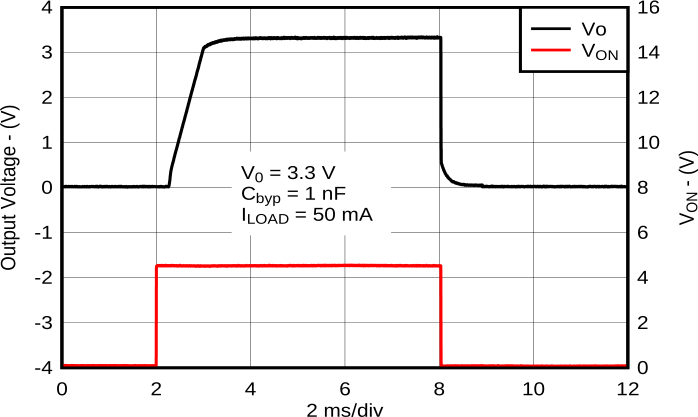
LP2982 Turnon Waveform (New
                        chip)
Cbyp = 1 nF
Figure 7-20 Turnon Waveform (New chip)