SLUP413A May 2024 – April 2026 TPS53689T
3 Magnetics
Because the TLVR topology achieves its transient benefits by allowing different effective inductance values in steady-state and transient conditions, it is helpful to explore the behavior of the coupled inductor structure that it uses. This concept is not entirely unique to the TLVR topology.
Figure 7 shows a traditional two-phase coupled inductor structure in which the windings for individual phases in the converter share a common magnetic core. Current in one winding directly induces current in the others, as the magnetic flux in the core is additive. During a load transient, a current change in one phase (one winding) directly causes a change in the same direction in the other phases. This behavior allows the total converter ISUM to ramp up or down to meet the load current demand more quickly than if the phases were uncoupled.
The coupling coefficient (K) between different windings of this structure will typically be between 0.4 and 0.7. This coupling is well controlled by the core design (in Figure 7, by the air gap in the middle leg). Very high coupling (K≅1.0) is not beneficial, as it increases the current ripple of the converter in steady state. Very low coupling simply reduces the transient benefits achievable.

Adoption of the traditional coupled inductor for high-phase-count designs (more than four phases) has been limited for several reasons. Extending it to higher phase counts requires a complex core geometry to maintain coupling symmetry. This structure also requires more customization of inductors for different designs, limiting scalability; for example, you would need a different inductor for two- and three-phase designs. Additionally, until recently, aggressive patent protection limited multisourcing options; no such limitation exists for the TLVR topology.
The TLVR topology relies on a similar principle but with a different magnetic structure, known as an indirect-coupled inductor, shown in Figure 8. Each phase inductor has its own physical core with two windings, so this structure is easily scalable to higher phase counts simply by adding more cores. The magnetizing inductance (LM) of each coupled inductor provides energy storage and filtering. The K between two windings on one core can be very high. Passing the same secondary-side current to all phases achieves coupling between cores (the phases), as they are connected in a loop.

Similar to a traditional coupled inductor, it is beneficial to have the coupling coefficient (α) between phases in the range of 0.4 to 0.7. The secondary loop controls this coupling. The inductance in the secondary loop may be very low, leading to high coupling (and thus a large steady-state current ripple) or simply not well-controlled, as a result of interconnect and physical construction tolerances.
To control the coupling between phases, the TLVR topology often uses a separate physical inductor on the secondary side, LC, shown in Figure 9. If the leakage inductance in the secondary-side loop is large enough compared to the magnetizing inductance of the individual coupled inductors, and can be well-controlled by manufacturing, a separate physical LC is not needed, especially in high-frequency designs switching at higher than 1 MHz per phase.
 Figure 9 Indirect-coupled two-phase
inductor with a physical compensating inductor.
Figure 9 Indirect-coupled two-phase
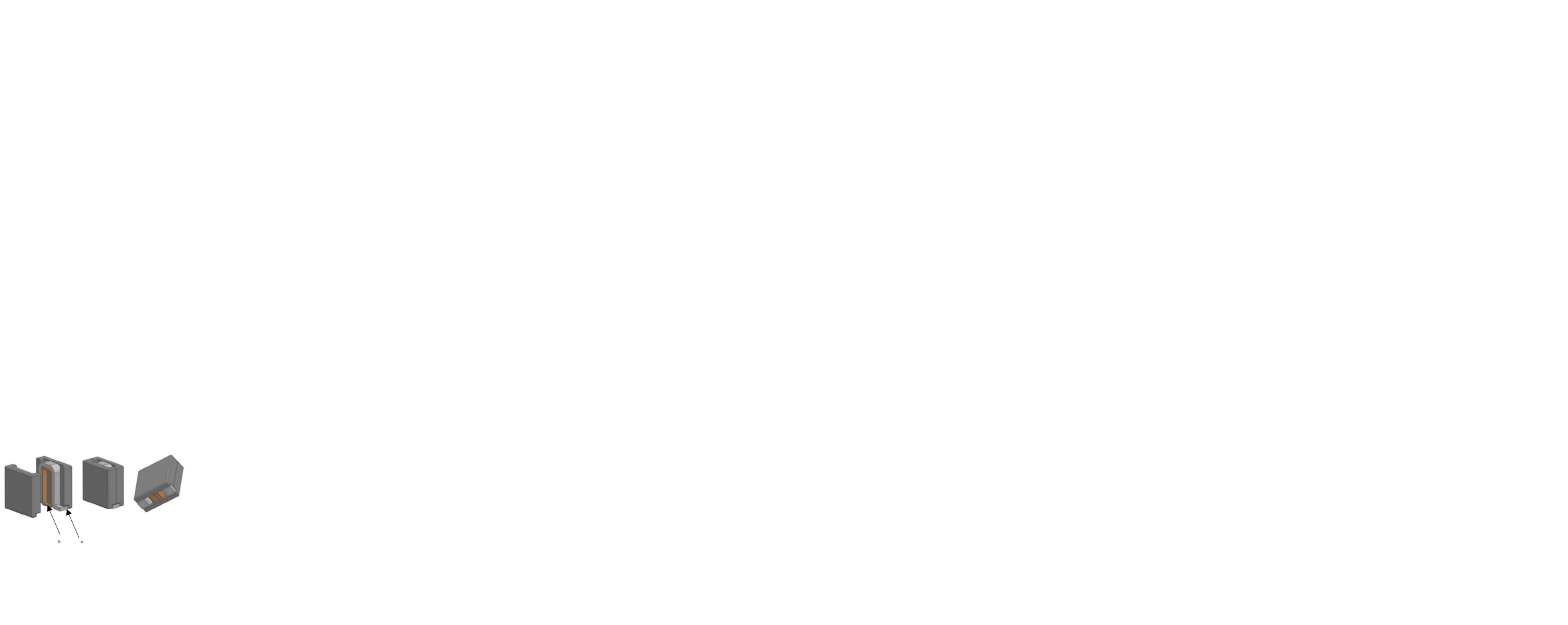
inductor with a physical compensating inductor.Figure 10 shows the typical construction of a TLVR inductor. The inductor size and shape are similar to traditional high-current ferrite core inductors for multiphase buck converters, with the secondary winding inside the primary winding. The land pattern on the bottom of the package enables co-layout with both TLVR and non-TLVR designs on the same physical printed circuit board (PCB).