ZHCS206A June 2011 – January 2017 TPS65053-Q1
PRODUCTION DATA.
- 1 特性
- 2 应用
- 3 说明
- 4 修订历史记录
- 5 Pin Configuration and Function
- 6 Specifications
- 7 Detailed Description
- 8 Application and Implementation
- 9 Power Supply Recommendations
- 10Layout
- 11器件和文档支持
- 12机械、封装和可订购信息
6 Specifications
6.1 Absolute Maximum Ratings
over operating free-air temperature range (unless otherwise noted)(1)| MIN | MAX | UNIT | |||
|---|---|---|---|---|---|
| VI | Input voltage | All pins except AGND, PGND, and EN_LDO1 pins with respect to AGND | –0.3 | 7 | V |
| EN_LDO1 pin with respect to AGND | –0.3 | VCC + 0.5 | |||
| VO | Output voltage for LDO1, LDO2 and LDO3 | –0.3 | 4 | V | |
| II | Current | VINDCDC1/2, L1, PGND1, L2, PGND2 | 1800 | mA | |
| All other pins | 1000 | ||||
| TA | Operating free-air temperature | –40 | 85 | °C | |
| Tstg | Storage temperature | –65 | 150 | °C | |
(1) Stresses beyond those listed under Absolute Maximum Ratings may cause permanent damage to the device. These are stress ratings only, which do not imply functional operation of the device at these or any other conditions beyond those indicated under Recommended Operating Conditions. Exposure to absolute-maximum-rated conditions for extended periods may affect device reliability.
6.2 ESD Ratings
| VALUE | UNIT | ||||
|---|---|---|---|---|---|
| V(ESD) | Electrostatic discharge | Human-body model (HBM), per AEC Q100-002(1) | ±2000 | V | |
| Charged-device model (CDM), per AEC Q100-011 | All pins | ±500 | |||
| Corner pins (1, 6, 7, 12, 13, 18, 19, and 24) | ±750 | ||||
(1) AEC Q100-002 indicates that HBM stressing shall be in accordance with the ANSI/ESDA/JEDEC JS-001 specification.
6.3 Recommended Operating Conditions
| MIN | NOM | MAX | UNIT | |||
|---|---|---|---|---|---|---|
| VINDCDC1/2 | Input voltage for step-down converters | 2.5 | 6 | V | ||
| VINLDO1, VINLDO2/3 | Input voltage range for LDOs | 1.5 | 6.5 | V | ||
| VDCDC1 | Output voltage range for externally adjustable VDCDC1 step-down converter | 0.6 | VINDCDC1 | V | ||
| VDCDC2 | Output voltage range for externally adjustable VDCDC2 step-down converter | 0.6 | VINDCDC2 | V | ||
| VLDO1-2 | Output voltage range for externally adjustable LDO1 and LDO2 | 1 | 3.6 | V | ||
| VLDO3 | Output voltage for LDO3 | 1.3 | V | |||
| IOUTDCDC1 | Output current at L1 | 1000 | mA | |||
| IOUTDCDC2 | Output current at L2 | 600 | mA | |||
| ILDO1 | Output current at VLDO1 | 400 | mA | |||
| ILDO2,3 | Output current at VLDO2 and VLDO3 | 200 | mA | |||
| CINDCDC1/2 | Input capacitor at VINDCDC1/2(1) | 22 | μF | |||
| CVCC | Input capacitor at VCC (1) | 1 | μF | |||
| Cin1-2 | Input capacitor at VINLDO1, VINLDO2/3 (1) | 2.2 | μF | |||
| COUTDCDC1 | Output capacitor at VDCDC1(1) | 10 | 22 | μF | ||
| COUTDCDC2 | Output capacitor at VDCDC2(1) | 10 | 22 | μF | ||
| COUT1 | Output capacitor at VLDO1 (1) | 4.7 | μF | |||
| COUT2-3 | Output capacitor at VLDO2-3 (1) | 2.2 | μF | |||
| L1 | Inductor at L1(1) | 1.5 | 2.2 | μH | ||
| L2 | Inductor at L2(1) | 1.5 | 2.2 | μH | ||
| RCC | Resistor from battery voltage to VCC used for filtering(2) | 1 | 10 | Ω | ||
| TA | Operating ambient temperature | –40 | 85 | °C | ||
| TJ | Operating junction temperature | –40 | 125 | °C | ||
(1) See the Application and Implementation section of this data sheet for more details.
(2) Up to 2 mA can flow into VCC when both converters are running in PWM, this resistor causes the UVLO threshold to be shifted accordingly.
6.4 Thermal Information
| THERMAL METRIC(1) | TPS65053-Q1 | UNIT | |
|---|---|---|---|
| RGE (VQFN) | |||
| 24 PINS | |||
| RθJA | Junction-to-ambient thermal resistance | 31.7 | °C/W |
| RθJC(top) | Junction-to-case (top) thermal resistance | 23.7 | °C/W |
| RθJB | Junction-to-board thermal resistance | 8.0 | °C/W |
| ψJT | Junction-to-top characterization parameter | 0.3 | °C/W |
| ψJB | Junction-to-board characterization parameter | 8.0 | °C/W |
| RθJC(bot) | Junction-to-case (bottom) thermal resistance | 2.2 | °C/W |
(1) For more information about traditional and new thermal metrics, see the Semiconductor and IC Package Thermal Metrics application report.
6.5 Electrical Characteristics
VCC = VINDCDC1/2 = 3.6 V, EN = VCC, MODE = GND, L = 2.2 μH, COUT = 22 μF, TA = –40°C to +85°C (unless otherwise noted).| PARAMETER | TEST CONDITIONS | MIN | TYP | MAX | UNIT | |
|---|---|---|---|---|---|---|
| SUPPLY CURRENT | ||||||
| VCC | Input voltage range | 2.5 | 6 | V | ||
| IQ | Operating quiescent current Total current into VCC, VINDCDC1/2, VINLDO1, VINLDO2/3 |
One converter, IOUT = 0 mA. PFM mode enabled (Mode = GND) device not switching, EN_DCDC1 = VIN OR EN_DCDC2 = VIN; EN_LDO1= EN_LDO2 = EN_LDO3 = GND | 30 | μA | ||
| One converter, IOUT = 0 mA. PFM mode enabled (Mode = GND) device not switching, EN_DCDC1 = VIN OR EN_DCDC2 = VIN; EN_LDO1= EN_LDO2 = EN_LDO3 = GND, TA = 25°C | 20 | |||||
| Two converters, IOUT = 0 mA, PFM mode enabled (Mode = 0) device not switching, EN_DCDC1 = VIN AND EN_DCDC2 = VIN; EN_LDO1 = EN_LDO2 = EN_LDO3 = GND |
40 | |||||
| Two converters, IOUT = 0 mA, PFM mode enabled (Mode = 0) device not switching, EN_DCDC1 = VIN AND EN_DCDC2 = VIN; EN_LDO1 = EN_LDO2 = EN_LDO3 = GND, TA = 25°C |
32 | |||||
| One converter, IOUT = 0 mA, PFM mode enabled (Mode = GND) device not switching, EN_DCDC1 = VIN OR EN_DCDC2 = VIN; EN_LDO1 = EN_LDO2 = EN_LDO3 = VIN | 210 | |||||
| One converter, IOUT = 0 mA, PFM mode enabled (Mode = GND) device not switching, EN_DCDC1 = VIN OR EN_DCDC2 = VIN; EN_LDO1 = EN_LDO2 = EN_LDO3 = VIN, TA = 25°C | 145 | |||||
| IQ | Operating quiescent current into VCC | One converter, IOUT = 0 mA, Switching with no load (Mode = VIN), PWM operation, EN_DCDC1 = VIN OR EN_DCDC2 = VIN; EN_LDO1 = EN_LDO2 = EN_LDO3 = GND, TA = 25°C | 0.85 | mA | ||
| Two converters, IOUT = 0 mA, Switching with no load (Mode = VIN), PWM operation, EN_DCDC1 = VIN AND EN_DCDC2 = VIN; EN_LDO1 = EN_LDO2 = EN_LDO3 = GND, TA = 25°C | 1.25 | mA | ||||
| I(SD) | Shutdown current | EN_DCDC1 = EN_DCDC2 = GND, EN_LDO1 = EN_LDO2 = EN_LDO3 = GND | 12 | μA | ||
| EN_DCDC1 = EN_DCDC2 = GND, EN_LDO1 = EN_LDO2 = EN_LDO3 = GND, TA = 25°C | 9 | |||||
| UVLO | Undervoltage lockout threshold for DC-DC converters and LDOs | Voltage at VCC | 2 | V | ||
| Voltage at VCC, TA = 25°C | 1.8 | |||||
| EN_DCDC1, EN_DCDC2, EN_LDO1, EN_LDO2, EN_LDO3, MODE | ||||||
| VIH | High-level input voltage | MODE, EN_DCDC1, EN_DCDC2, EN_LDO1, EN_LDO2, EN_LDO3 | 1.2 | VCC | V | |
| VIL | Low-level input voltage | MODE, EN_DCDC1, EN_DCDC2, EN_LDO1, EN_LDO2, EN_LDO3 | 0 | 0.4 | V | |
| IIN | Input bias current | MODE, EN_DCDC1, EN_DCDC2, EN_LDO1, EN_LDO2, EN_LDO3, MODE = GND or VIN, TA = 25°C | 0.01 | 1 | μA | |
| POWER SWITCH | ||||||
| rDS(on) | P-channel MOSFET on resistance, DCDC1, DCDC2 | VINDCDC1/2 = 3.6 V | 630 | mΩ | ||
| VINDCDC1/2 = 3.6 V, TA = 25°C | 280 | |||||
| VINDCDC1/2 = 2.5 V, TA = 25°C | 400 | |||||
| ILD_PMOS | P-channel leakage current | V(DS) = 6 V | 1 | μA | ||
| rDS(on) | N-channel MOSFET on resistance, DCDC1, DCDC2 | VINDCDC1/2 = 3.6 V | 450 | mΩ | ||
| VINDCDC1/2 = 3.6 V, TA = 25°C | 220 | |||||
| VINDCDC1/2 = 2.5 V, TA = 25°C | 320 | |||||
| ILK_NMOS | N-channel leakage current | V(DS) = 6 V | 10 | μA | ||
| V(DS) = 6 V, TA = 25°C | 7 | |||||
| I(LIMF) | Forward current limit PMOS (high side) and NMOS (low side) | DCDC1, 2.5 V ≤ VIN ≤ 6 V | 1.1 | 1.8 | A | |
| DCDC1, 2.5 V ≤ VIN ≤ 6 V, TA = 25°C | 1.4 | |||||
| DCDC2, 2.5 V ≤ VIN ≤ 6 V | 0.85 | 1.15 | ||||
| DCDC2, 2.5 V ≤ VIN ≤ 6 V, TA = 25°C | 1 | |||||
| TSD,DCDC | Thermal shutdown | Increasing junction temperature, TA = 25°C | 150 | °C | ||
| TSDhys,DCDC | Thermal shutdown hysteresis | Decreasing junction temperature below TSD,DCDC for resuming normal operation, TA = 25°C | 20 | °C | ||
| OSCILLATOR | ||||||
| fSW | Oscillator frequency | 2.025 | 2.475 | MHz | ||
| TA = 25°C | 2.25 | |||||
| OUTPUT | ||||||
| VOUT | Output voltage range | 0.6 | VIN | V | ||
| Vref | Reference voltage | TA = 25°C | 600 | mV | ||
| VOUT | DC output voltage accuracy | VIN = 2.5 V to 6 V, Mode = GND, PFM operation, 0 mA < IOUT < IOUTmax |
-2% | 0 | 2% | |
| VIN = 2.5 V to 6 V, Mode = VIN, PWM operation, 0 mA < IOUT < IOUTmax |
–1% | 0 | 1% | |||
| ΔVOUT | Power save mode ripple voltage(2) | IOUT = 1 mA, Mode = GND, VO = 1.3 V, Bandwidth = 20 MHz, TA = 25°C |
25 | mVPP | ||
| tStart | Start-up time | Time from active EN to start switching, TA = 25°C | 170 | μs | ||
| tRamp | VOUT ramp up time | Time to ramp from 5% to 95% of VOUT, TA = 25°C | 750 | μs | ||
| RESET delay time | Input voltage at threshold pin rising | 80 | 120 | ms | ||
| Input voltage at threshold pin rising, TA = 25°C | 100 | |||||
| VOL | RESET output low voltage | IOL = 1 mA, Vth < 1 V | 0.2 | V | ||
| RESET sink current | TA = 25°C | 1 | mA | |||
| RESET output leakage current | Vth > 1 V, TA = 25°C | 10 | nA | |||
| Vth | Threshold voltage | Falling voltage | 0.98 | 1.02 | V | |
| Falling voltage, TA = 25°C | 1 | |||||
| VLDO1, VLDO2, VLDO3 LOW DROPOUT REGULATORS | ||||||
| VINLDO | Input voltage range for LDO1, LDO2, LDO3 | 1.5 | 6.5 | V | ||
| VLDO1 | LDO1 output voltage range | 1 | 3.6 | V | ||
| VLDO2 | LDO2 output voltage range | 1 | 3.6 | V | ||
| VLDO3 | LDO3 output voltage | TA = 25°C | 1.3 | V | ||
| V(FB) | Feedback voltage for FB_LDO1, FB_LDO2 | TA = 25°C | 1 | V | ||
| IO | Maximum output current for LDO1 | 400 | mA | |||
| Maximum output current for LDO2, LDO3 | 200 | mA | ||||
| I(SC) | LDO1 short-circuit current limit | VLDO1 = GND | 850 | mA | ||
| LDO2 and LDO3 short-circuit current limit | VLDO2 = GND, VLDO3 = GND | 420 | mA | |||
| Dropout voltage at LDO1 | IO = 400 mA, VINLDO1 = 1.8 V | 280 | mV | |||
| Dropout voltage at LDO2, LDO3 | IO = 200 mA, VINLDO2/3 = 1.8 V | 280 | mV | |||
| Output voltage accuracy for LDO1, LDO2, LDO3(1) | IO = 10 mA | –2% | 1% | |||
| Line regulation for LDO1, LDO2, LDO3 | VINLDO1,2 = VLDO1,2 + 0.5 V (min. 2.5 V) to 6.5 V, IO = 10 mA | –1% | 1% | |||
| Load regulation for LDO1, LDO2, LDO3 | IO = 0 mA to 400 mA for LDO1, IO = 0 mA to 200 mA for LDO2, LDO3 | –1% | 1% | |||
| Regulation time for LDO1, LDO2, LDO3 | Load change from 10% to 90%, TA = 25°C | 25 | μs | |||
| R(DIS) | Internal discharge resistor at VLDO1, VLDO2, VLDO3 | Active when LDO is disabled, TA = 25°C | 350 | Ω | ||
| TSD,LDO | Thermal shutdown | Increasing junction temperature | 140 | °C | ||
| TSDhys,LDO | Thermal shutdown hysteresis | Decreasing junction temperature below TSD,LDO for resuming normal operation | 20 | °C | ||
(1) Output voltage specification does not include tolerance of external voltage programming resistors.
(2) In Power Save Mode, operation is typically entered at IPSM = VIN / 32 Ω.
6.6 Typical Characteristics
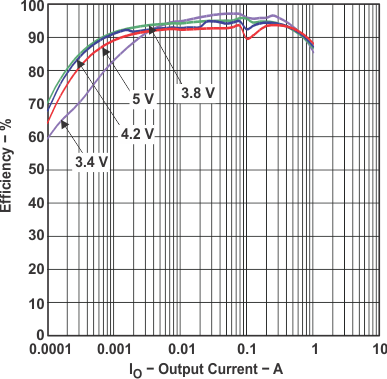
| VDCDC1 = 2.85 V | VINDCDC1/2 = 3.4, 3.8, 4.2, and 5 V |

| VDCDC2 = 1.8 V | VINDCDC1/2 = 3.4, 3.8, 4.2, and 5 |
 Figure 5. LDO1 Power-Supply Rejection Ratio

| VDCDC1 = 2.85 V | VINDCDC1/2 = 3.4, 3.8, 4.2, and 5 V |

| VDCDC2 = 1.8 V | VINDCDC1/2 = 3.4, 3.8, 4.2, and 5 V |