SLVSIL6 January   2026 INA151

ADVANCE INFORMATION  

  1.   1
  2. Features
  3. Applications
  4. Description
  5. Device Comparison Table
  6. Pin Configuration and Functions
  7. Specifications
    1. 6.1 Absolute Maximum Ratings
    2. 6.2 ESD Ratings
    3. 6.3 Recommended Operating Conditions
    4. 6.4 Thermal Information
    5. 6.5 Electrical Characteristics
    6. 6.6 Typical Characteristics
  8. Detailed Description
    1. 7.1 Overview
    2. 7.2 Functional Block Diagram
    3. 7.3 Feature Description
      1. 7.3.1 Input Common-Mode Voltage Range
      2. 7.3.2 Low Input Bias Current
    4. 7.4 Device Functional Modes
      1. 7.4.1 Output Enable and Disable
  9. Application and Implementation
    1. 8.1 Application Information
      1. 8.1.1 Reference Pin
    2. 8.2 Typical Applications
      1. 8.2.1 Battery Monitoring Using Difference Amplifier
        1. 8.2.1.1 Design Requirements
        2. 8.2.1.2 Detailed Design Procedure
        3. 8.2.1.3 Application Curves
    3. 8.3 Power Supply Recommendations
    4. 8.4 Layout
      1. 8.4.1 Layout Guidelines
      2. 8.4.2 Layout Example
  10. Device and Documentation Support
    1. 9.1 Device Support
      1. 9.1.1 Development Support
        1. 9.1.1.1 PSpice® for TI
    2. 9.2 Documentation Support
      1. 9.2.1 Related Documentation
    3. 9.3 Receiving Notification of Documentation Updates
    4. 9.4 Support Resources
    5. 9.5 Trademarks
    6. 9.6 Electrostatic Discharge Caution
    7. 9.7 Glossary
  11. 10Revision History
  12. 11Mechanical, Packaging, and Orderable Information

封装选项

机械数据 (封装 | 引脚)
散热焊盘机械数据 (封装 | 引脚)
订购信息

Typical Characteristics

at TA = 25°C, VS = ±5V, RL = 10kΩ, CL = 10pF, VREF = VS / 2, VCM = (VIN+ + VIN–) / 2 = VS / 2, and G = 1 (A) (unless otherwise noted)

INA151 Typical Distribution Offset Voltage (Input Referred) (G=2/3)
N=5 Mean=−73.1μV Std. Dev.=296μV
Figure 6-1 Typical Distribution Offset Voltage (Input Referred) (G=2/3)
INA151 Typical Distribution of Gain Error (G=2/3)
N=540 Mean=0.0025% Std. Dev. = 0.0031%
Figure 6-3 Typical Distribution of Gain Error (G=2/3)
INA151 Offset Voltage (Input referred) vs
                        Temperature
Figure 6-5 Offset Voltage (Input referred) vs Temperature
INA151 Gain Error vs Temperature
Figure 6-7 Gain Error vs Temperature
INA151 Offset Voltage (Input Referred) vs Input Common-Mode
                        Voltage
Normalized to 0mV at TA=25ºC
Figure 6-9 Offset Voltage (Input Referred) vs Input Common-Mode Voltage
INA151 Input Bias Current vs Input Differential
                        Voltage
Figure 6-11 Input Bias Current vs Input Differential Voltage
INA151 Non-Linearity vs Output Voltage (G=1)
Figure 6-13 Non-Linearity vs Output Voltage (G=1)
INA151 Non-Linearity vs Output Voltage (G=1/2)
Figure 6-15 Non-Linearity vs Output Voltage (G=1/2)
INA151 CMRR
                        (Referred to Input) vs Frequency
Figure 6-17 CMRR (Referred to Input) vs Frequency
INA151 AC
                        PSRR- (Referred to Input) vs Frequency
Figure 6-19 AC PSRR- (Referred to Input) vs Frequency
INA151 Input
                        Referred Voltage Noise Spectral Density Figure 6-21 Input Referred Voltage Noise Spectral Density
INA151 Input Referred 0.1Hz to 10Hz Voltage Noise in Time
                        Domain, G=2/3V/V

G = 2/3V/V

Figure 6-23 Input Referred 0.1Hz to 10Hz Voltage Noise in Time Domain, G=2/3V/V
INA151 Input Referred 0.1Hz to 10Hz Voltage Noise in Time
                        Domain, G=1/4V/V

G = 1/4V/V

Figure 6-25 Input Referred 0.1Hz to 10Hz Voltage Noise in Time Domain, G=1/4V/V
INA151 Small-Signal Step
                        Response
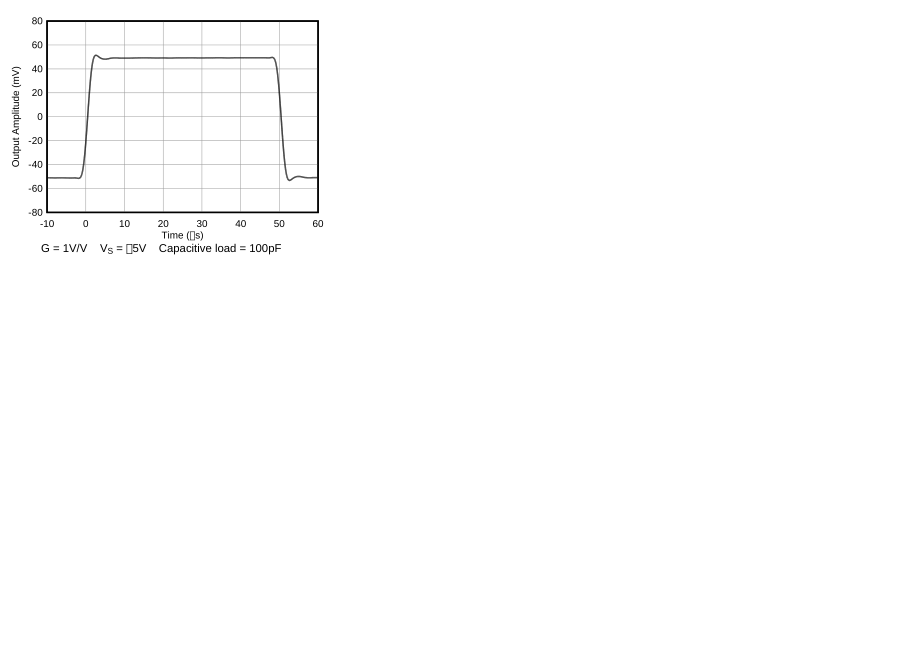
Figure 6-27 Small-Signal Step Response
INA151 Negative Output Voltage Swing vs Output Current
Figure 6-29 Negative Output Voltage Swing vs Output Current
INA151 Overload Recovery
Figure 6-31 Overload Recovery
INA151 Typical Distribution CMRR (G=2/3)
N=5 Mean=0.0845μV/V Std. Dev. = 0.179μV/V
Figure 6-2 Typical Distribution CMRR (G=2/3)
INA151 Typical Distribution of Gain Error Drift (G=2/3)
N=16 Mean=0.046ppm/ºC Std. Dev. = 0.015ppm/ºC
Figure 6-4 Typical Distribution of Gain Error Drift (G=2/3)
INA151 CMRR vs Temperature
Figure 6-6 CMRR vs Temperature
INA151 Input Bias Current vs Temperature
Figure 6-8 Input Bias Current vs Temperature
INA151 Input Bias Current vs Input Common-Mode
                        Voltage
Figure 6-10 Input Bias Current vs Input Common-Mode Voltage
INA151 Input Bias Current vs Reverse Input Common-Mode
                        Voltage
Figure 6-12 Input Bias Current vs Reverse Input Common-Mode Voltage
INA151 Non-Linearity vs Output Voltage (G=2/3)
Figure 6-14 Non-Linearity vs Output Voltage (G=2/3)
INA151 Non-Linearity vs Output Voltage (G=1/4)
Figure 6-16 Non-Linearity vs Output Voltage (G=1/4)
INA151 AC
                        PSRR+ (Referred to Input) vs Frequency
Figure 6-18 AC PSRR+ (Referred to Input) vs Frequency
INA151 Closed Loop Gain vs Frequency
Figure 6-20 Closed Loop Gain vs Frequency
INA151 Input
                        Referred 0.1Hz to 10Hz Voltage Noise in Time Domain, G=1V/V

G = 1V/V

Figure 6-22 Input Referred 0.1Hz to 10Hz Voltage Noise in Time Domain, G=1V/V
INA151 Input Referred 0.1Hz to 10Hz Voltage Noise in Time
                        Domain, G=1/2V/V

G = 1/2V/V

Figure 6-24 Input Referred 0.1Hz to 10Hz Voltage Noise in Time Domain, G=1/2V/V
INA151 Large
                        Signal Step Response
G=1V/V
Figure 6-26 Large Signal Step Response
INA151 Positive Output Voltage Swing vs Output
                        Current
Figure 6-28 Positive Output Voltage Swing vs Output Current
INA151 Short-Circuit Current vs Temperature
Figure 6-30 Short-Circuit Current vs Temperature
INA151 Quiescent Current vs Temperature, G=1
Figure 6-32 Quiescent Current vs Temperature, G=1