SLVS465C December 2003 – February 2016 TPS61043
PRODUCTION DATA.
- 1 Features
- 2 Applications
- 3 Description
- 4 Revision History
- 5 Pin Configuration and Functions
- 6 Specifications
- 7 Parameter Measurement Information
- 8 Detailed Description
- 9 Application and Implementation
- 10Power Supply Recommendations
- 11Layout
- 12Device and Documentation Support
- 13Mechanical, Packaging, and Orderable Information
封装选项
请参考 PDF 数据表获取器件具体的封装图。
机械数据 (封装 | 引脚)
- DRB|8
散热焊盘机械数据 (封装 | 引脚)
- DRB|8
订购信息
6 Specifications
6.1 Absolute Maximum Ratings
over operating free-air temperature range (unless otherwise noted)(1)| MIN | MAX | UNIT | |
|---|---|---|---|
| Supply Voltages, v(VIN) (2) | –0.3 | 7 | V |
| Voltages, V(Rs), V(CTRL), V(FB) | –0.3 | Vin + 0.3 | V |
| Voltages, V(SW), V(LED) (2) | 30 | V | |
| Voltage, V(OVP) | 30 | V | |
| Operating junction temperature | –40 | 150 | °C |
| Lead temperature (soldering, 10 sec) | 260 | 260 | °C |
| Storage temperature, Tstg | –65 | 150 | °C |
(1) Stresses beyond those listed under Absolute Maximum Ratings may cause permanent damage to the device. These are stress ratings only, which do not imply functional operation of the device at these or any other conditions beyond those indicated under Recommended Operating Conditions. Exposure to absolute-maximum-rated conditions for extended periods may affect device reliability.
(2) All voltage values are with respect to network ground terminal.
6.2 ESD Ratings
| VALUE | UNIT | |||
|---|---|---|---|---|
| V(ESD) | Electrostatic discharge | Human body model (HBM), per ANSI/ESDA/JEDEC JS-001(1) | ±2000 | V |
| Charged-device model (CDM), per JEDEC specification JESD22-C101(2) | ±750 | |||
(1) JEDEC document JEP155 states that 500-V HBM allows safe manufacturing with a standard ESD control process.
(2) JEDEC document JEP157 states that 250-V CDM allows safe manufacturing with a standard ESD control process.
6.3 Recommended Operating Conditions
| MIN | NOM | MAX | UNIT | ||
|---|---|---|---|---|---|
| VI | Input voltage | 1.8 | 6 | V | |
| TA | Operating ambient temperature | –40 | 85 | °C | |
| TJ | Operating junction temperature | –40 | 125 | °C | |
6.4 Thermal Information
| THERMAL METRIC(1) | TPS61043 | UNIT | |
|---|---|---|---|
| DRB (VSON) | |||
| 8 PINS | |||
| RθJA | Junction-to-ambient thermal resistance | 48.6 | °C/W |
| RθJC(top) | Junction-to-case (top) thermal resistance | 66.9 | °C/W |
| RθJB | Junction-to-board thermal resistance | 23.8 | °C/W |
| ψJT | Junction-to-top characterization parameter | 1.5 | °C/W |
| ψJB | Junction-to-board characterization parameter | 23.9 | °C/W |
| RθJC(bot) | Junction-to-case (bottom) thermal resistance | 5.2 | °C/W |
(1) For more information about traditional and new thermal metrics, see the IC Package Thermal Metrics application report, SPRA953.
6.5 Electrical Characteristics
VI = 3.6 V, CTRL= VI, TA = –40°C to + 85°C, typical values are at TA= 25°C (unless otherwise noted)| PARAMETER | TEST CONDITIONS | MIN | TYP | MAX | UNIT | |
|---|---|---|---|---|---|---|
| SUPPLY CURRENT | ||||||
| VI | Input voltage range | 1.8 | 6 | V | ||
| I(Q) | Operating quiescent current into VIN | IO = 0 mA, not switching | 38 | 65 | µA | |
| IO(sd) | Shutdown current | CTRL = GND | 0.1 | 1 | µA | |
| VUVLO | Under-voltage lockout threshold | VI falling | 1.5 | 1.7 | V | |
| CTRL | ||||||
| VIH | CTRL high level input voltage | 1.3 | V | |||
| VIL | CTRL low level input voltage | 0.3 | V | |||
| IIkg | CTRL input leakage current | CTRL = GND or VIN | 0.1 | µA | ||
| ton | Minimim CTRL pulse witdh to enable | CTRL = low to high | 500 | us | ||
| toff | Minimum CTRL pulse width to disable | CTRL = high to low | 10 | 32 | ms | |
| f(CTRL) | PWM switching frequency applied to CTRL | 0.1 | 50 | kHz | ||
| D(CTRL) | PWM duty cycle applied to CTRL | 1% | 100% | |||
| POWER SWITCH AND CURRENT LIMIT (SW) | ||||||
| VS | Maximum switch voltage | 30 | V | |||
| rds(ON) | MOSFET ON-resistance | V I = 3.6 V; I(SW) = 200 mA | 300 | 600 | mΩ | |
| Ilkg | MOSFET leakage current | V(SW) = 28 V | 0.1 | 10 | µA | |
| ILIM | MOFSET current limit | 320 | 400 | 480 | mA | |
| TON | Power switch maximum on-time | VO = 15 V | 4.5 | µs | ||
| TOFF | Power switch minimum off-time | 400 | ns | |||
| LED SWITCH AND CURRENT LIMIT (LED) | ||||||
| VS | Maximum switch voltage | 30 | V | |||
| I (LED) | Maximum LED switch current | 60 | mA | |||
| rds(ON) | MOSFET ON-resistance | VI = 3.6 V; ISW = 20 mA | 1 | 2 | Ω | |
| Ilkg | MOSFET leakage current | V(LED)= 28 V | 0.1 | 10 | µA | |
| OUTPUT | ||||||
| VO | Output voltage range | OVP connected | VI | 16.9 | V | |
| I(FB) | Feedback input bias current(1) | V(FB) = 0.252 V | 100 | nA | ||
| VFB | Feedback trip point voltage | 1.8 V ≤ VI ≤ 6.0 V | 244 | 252 | 260 | mV |
| V(OVP) | Output overvoltage protection | VO rising | 17 | 18 | 19 | V |
| Vhys(OVP) | Output overvoltage protection hysteresis | 3.65 | V | |||
| I(OVP) | OVP input current | VO = 15 V | 17 | 23 | µA | |
(1) The feedback input is high-impedance MOSFET Gate input.
6.6 Typical Characteristics
Table 1. Table of Graphs
| FIGURE | |||
|---|---|---|---|
| V(FB) | Feedback voltage | vs Temperature | Figure 1 |
| I(FB) | Feedback current | vs Temperature | Figure 2 |
| rds(on) | Main switch Q1 | vs Temperature | Figure 3 |
| vs Input voltage | Figure 4 | ||
| LED switch Q2 | vs Temperature | Figure 5 | |
| vs Input voltage | Figure 6 | ||
| ILED | Average LED current | vs PWM duty cycle on CTRL pin | Figure 7 |
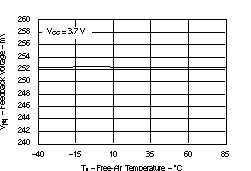 Figure 1. Feedback Voltage vs Temperature
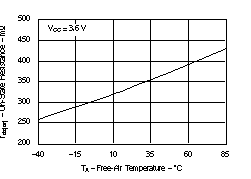 Figure 3. rds(on) Main Switch (Q1) vs Temperature
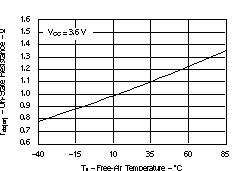 Figure 5. rds(on) LED Switch (Q2) vs Temperature
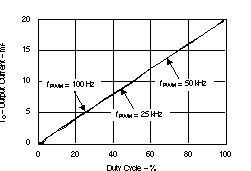 Figure 7. Average LED Current vs PWM Duty Cycle on CTRL Pin
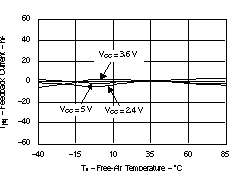 Figure 2. Feedback Current vs Temperature
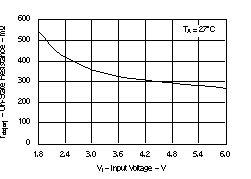 Figure 4. rds(ON) Main Switch (Q1) vs Input Voltage
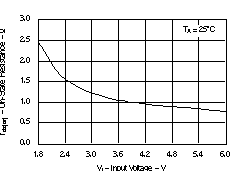 Figure 6. rds(on) LED Switch (Q2) vs Input Voltage