SLOS180D February   1997  – April 2026 TL031 , TL032 , TL032A , TL034 , TL034A

PRODUCTION DATA  

  1.   1
  2. Features
  3. Applications
  4. Description
  5. Pin Configuration and Functions
  6. Specifications
    1. 5.1  Absolute Maximum Ratings
    2. 5.2  Thermal Information
    3. 5.3  Recommended Operating Conditions
    4. 5.4  TL031C and TL031AC Electrical Characteristics
    5. 5.5  TL031C and TL031AC Operating Characteristics
    6. 5.6  TL031I and TL031AI Electrical Characteristics
    7. 5.7  TL031I and TL031AI Operating Characteristics
    8. 5.8  TL032C and TL032AC Electrical Characteristics
    9. 5.9  TL032C and TL032AC Operating Characteristics
    10. 5.10 TL032I and TL032AI Electrical Characteristics
    11. 5.11 TL032I and TL032AI Operating Characteristics
    12. 5.12 TL034C and TL034AC Electrical Characteristics
    13. 5.13 TL034C and TL034AC Operating Characteristics
    14. 5.14 TL034I and TL034AI Electrical Characteristics
    15. 5.15 TL034I and TL034AI Operating Characteristics
    16. 5.16 Typical Characteristics
  7. Parameter Measurement Information
    1. 6.1 Typical Values
    2. 6.2 Input Bias and Offset Current
    3. 6.3 Noise
  8. Application and Implementation
    1. 7.1 Application Information
      1. 7.1.1 Input Characteristics
      2. 7.1.2 Output Characteristics
      3. 7.1.3 Transimpedance Amplifier
      4. 7.1.4 4mA to 20mA Current Loops
      5. 7.1.5 Instrumentation Amplifier with Linear Gain Adjust
  9. Device and Documentation Support
    1. 8.1 Receiving Notification of Documentation Updates
    2. 8.2 Support Resources
    3. 8.3 Trademarks
    4. 8.4 Electrostatic Discharge Caution
    5. 8.5 Glossary
  10. Revision History
  11. 10Mechanical, Packaging, and Orderable Information

封装选项

请参考 PDF 数据表获取器件具体的封装图。

机械数据 (封装 | 引脚)
  • D|8
  • P|8
  • PS|8
散热焊盘机械数据 (封装 | 引脚)
订购信息

Typical Characteristics

TL031 TL031A TL032 TL032A TL034 TL034A Input
                        Bias Current vs Common-Mode Voltage
VCC=±15V

TA= 25°C

Figure 5-1 Input Bias Current vs Common-Mode Voltage

Data at high and low temperatures are applicable only within the recommended operating free-air temperature ranges of the various devices.

TL031 TL031A TL032 TL032A TL034 TL034A Maximum Peak-to-peak
                        Output Voltage† vs FrequencyFigure 5-3 Maximum Peak-to-peak Output Voltage vs Frequency
TL031 TL031A TL032 TL032A TL034 TL034A Open-Loop Output Impedance vs FrequencyFigure 5-5 Open-Loop Output Impedance vs Frequency
TL031 TL031A TL032 TL032A TL034 TL034A Short-Circuit Current vs Temperature
 
Figure 5-7 Short-Circuit Current vs Temperature
TL031 TL031A TL032 TL032A TL034 TL034A Quiescent Current vs Supply Voltage
VCM = V–
Figure 5-9 Quiescent Current vs Supply Voltage
TL031 TL031A TL032 TL032A TL034 TL034A Small-Signal Overshoot vs Capacitive Load
G = 1, 10mV output step
Figure 5-11 Small-Signal Overshoot vs Capacitive Load
TL031 TL031A TL032 TL032A TL034 TL034A Small-Signal Step Response
CL = 20pF, G = 1, 20mV step response
Figure 5-13 Small-Signal Step Response
TL031 TL031A TL032 TL032A TL034 TL034A Input
                        Bias Current vs TemperatureFigure 5-2 Input Bias Current vs Temperature
TL031 TL031A TL032 TL032A TL034 TL034A Open-Loop Gain and Phase vs Frequency
CL = 20pF
Figure 5-4 Open-Loop Gain and Phase vs Frequency
TL031 TL031A TL032 TL032A TL034 TL034A PSRR
                        vs Temperature (dB)
f = 0Hz
Figure 5-6 PSRR vs Temperature (dB)
TL031 TL031A TL032 TL032A TL034 TL034A Input
                        Voltage Noise Spectral Density vs FrequencyFigure 5-8 Input Voltage Noise Spectral Density vs Frequency
TL031 TL031A TL032 TL032A TL034 TL034A Quiescent Current vs Temperature
 
Figure 5-10 Quiescent Current vs Temperature
TL031 TL031A TL032 TL032A TL034 TL034A Phase
                        Margin vs Capacitive Load
 
Figure 5-12 Phase Margin vs Capacitive Load
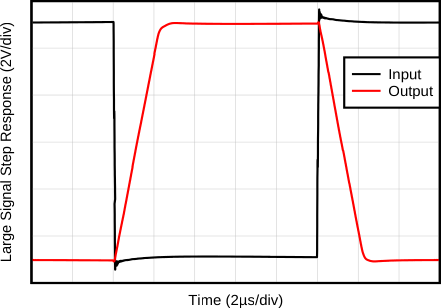
TL031 TL031A TL032 TL032A TL034 TL034A Large-Signal Step Response
CL = 20pF, G = –1
Figure 5-14 Large-Signal Step Response