ZHCSF17E April 2008 – May 2016 LM2758
PRODUCTION DATA.
6 Specifications
6.1 Absolute Maximum Ratings
over operating free-air temperature range (unless otherwise noted)(1)(2)(3)| MIN | MAX | UNIT | ||
|---|---|---|---|---|
| VIN, CPOUT pins: voltage to GND | –0.3 | 6 | V | |
| EN1, EN2 pins: Voltage to GND | –0.3 | (VIN + 0.3) w/ 6 V maximum | V | |
| Continuous power dissipation | ||||
| Junction temperature, TJ-MAX | 150 | °C | ||
| Maximum lead temperature (soldering) | See(4) | |||
| Storage temperature, Tstg | –65°C | 150 | °C | |
(1) Stresses beyond those listed under Absolute Maximum Ratings may cause permanent damage to the device. These are stress ratings only, which do not imply functional operation of the device at these or any other conditions beyond those indicated under Recommended Operating Conditions. Exposure to absolute-maximum-rated conditions for extended periods may affect device reliability.
(2) If Military/Aerospace specified devices are required, contact the Texas Instruments Sales Office/ Distributors for availability and specifications.
(3) All voltages are with respect to the potential to the GND pin.
(4) For detailed soldering specifications and information, see AN-1112 DSBGA Wafer Level Chip Scale Package (SNVA009).
6.2 ESD Ratings
| VALUE | UNIT | |||
|---|---|---|---|---|
| V(ESD) | Electrostatic discharge | Human-body model (HBM), per ANSI/ESDA/JEDEC JS-001(1) | ±2000 | V |
| Charged-device model (CDM), per JEDEC specification JESD22-C101(2) | ±200 | |||
(1) JEDEC document JEP155 states that 500-V HBM allows safe manufacturing with a standard ESD control process.
(2) JEDEC document JEP157 states that 250-V CDM allows safe manufacturing with a standard ESD control process.
6.3 Recommended Operating Conditions
over operating free-air temperature range (unless otherwise noted)(1)| MIN | MAX | UNIT | ||
|---|---|---|---|---|
| Input voltage | 2.7 | 5.5 | V | |
| Junction temperature, TJ | –40 | 125 | °C | |
| Ambient temperature, TA (2) | –40 | 85 | °C | |
(1) All voltages are with respect to the potential at the GND pin.
(2) In applications where high power dissipation and/or poor package thermal resistance is present, the maximum ambient temperature may have to be derated. Maximum ambient temperature (TA-MAX) is dependent on the maximum operation junction temperature (TJ-MAX-OP = 125°C), the maximum power dissipation of the device in the application (PD-MAX), and the junction-to ambient thermal resistance of the part/package in the application (RθJA), as given by the following equation: TA-MAX = TJ-MAX-OP – (RθJA × PD-MAX).
6.4 Thermal Information
| THERMAL METRIC(1) | LM2758 | UNIT | |
|---|---|---|---|
| YZR (DSBGA) | |||
| 12 PINS | |||
| RθJA | Junction-to-ambient thermal resistance | 93.6 | °C/W |
| RθJC(top) | Junction-to-case (top) thermal resistance | 0.7 | °C/W |
| RθJB | Junction-to-board thermal resistance | 16.1 | °C/W |
| ψJT | Junction-to-top characterization parameter | 2.9 | °C/W |
| ψJB | Junction-to-board characterization parameter | 16.0 | °C/W |
(1) For more information about traditional and new thermal metrics, see the Semiconductor and IC Package Thermal Metrics application report, SPRA953.
6.5 Electrical Characteristics
Unless otherwise specified, aspecifications apply to the Figure 8 with VIN = 3.6 V, VEN1 = VIN, VEN2 = 0 V,C1 = C2 = 1 µF, CIN = COUT = 2.2 µF, RSET = 20 kΩ, TJ = 25°C.(1)(2)(3)
| PARAMETER | TEST CONDITIONS | MIN | TYP | MAX | UNIT | |
|---|---|---|---|---|---|---|
| ILED | LED current accuracy | ILED = 500 mA, flash mode | 500 | |||
| ILED = 500 mA, flash mode –40°C ≤ TJ ≤ 125°C |
450 | 550 | mA | |||
| VSET | ISET pin voltage | 1.3 | V | |||
| ID/ISET | LED current to set current ratio | Flash mode | 7650 | |||
| Torch mode | 1639 | |||||
| ILED-IND | Indicator current level | Indicator mode 32-kHZ PWM mode |
1/32 × ILED-TORCH | mA | ||
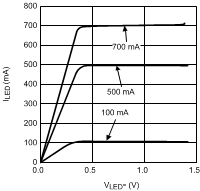
| VGDX | 1× to 1.5× gain transition voltage threshold on VLED– | IOUT = 500 mA | 300 | mV | ||
| VOUT | Output voltage | 1× mode, IOUT = 0 mA | VIN | V | ||
| 1.5× mode, IOUT = 0 mA(4) | 4.8 | |||||
| 1.5× mode, IOUT = 0 mA –40°C ≤ TJ ≤ 125°C(4) |
5.3 | |||||
| ROUT | 1× mode output impedance | IOUT = 200 mA, VIN = 3.3 V –40°C ≤ TJ ≤ 125°C |
0.33 | Ω | ||
| IOUT = 200 mA, VIN = 3.3 V(5) | 0.53 | |||||
| 1.5× mode output impedance | IOUT = 500 mA, VIN = 3.3 V(5) | 1.5 | 2.0 | |||
| FSW | Switching frequency | 1.25 | MHz | |||
| –40°C ≤ TJ ≤ 125°C | 0.8 | 1.5 | ||||
| IQ | Quiescent current | IOUT = 0 mA 1× mode, –40°C ≤ TJ ≤ 125°C | 0.7 | mA | ||
| IOUT = 0 mA 1x mode | 0.8 | |||||
| IOUT = 0 mA 1.5× mode | 4 | |||||
| IOUT = 0 mA 1.5× mode, –40°C ≤ TJ ≤ 125°C | 5 | |||||
| ISD | Shutdown current | Device disabled(6) | 0.01 | µA | ||
| Device disabled, –40°C ≤ TJ ≤ 125°C(6) | 1 | |||||
| TOUT | Timeout duration | –40°C ≤ TJ ≤ 125°C, see(7) | 814 | msec | ||
| See(7) | 640 | 1000 | ||||
| VIH | Input logic high | Pins: EN1, EN2, –40°C ≤ TJ ≤ 125°C | 1.2 | V | ||
| VIL | Input logic low | Pins: EN1, EN2, –40°C ≤ TJ ≤ 125°C | 0.4 | V | ||
(1) All voltages are with respect to the potential at the GND pin.
(2) Minimum (MIN) and maximum (MAX) limits are specified by design, test, or statistical analysis. Typical (TYP) numbers are not ensured, but do represent the most likely norm. Unless otherwise specified, conditions for TTYP specifications are: VIN = 3.6 V and TA = 25°C.
(3) CIN, COUT, C1, C2: Low-ESR surface-mount ceramic capacitors (MLCCs) used in setting electrical characteristics.
(4) Output voltage is internally limited not to exceed maximum specified value.
(5) These table entries are specified by design. These parameters are not ensured by production testing. The temperature limits for test are (–40°C ≤ TA ≤ +85°C).
(6) The temperature limits for ISD (shutdown current) test are -40°C ≤ TA ≤ +85°C, as in shutdown mode ambient temperature is equal to junction temperature.
(7) The timeout specifications are calculated values based on the switching frequency spread.
6.6 Typical Characteristics
Unless otherwise specified: TA = 25°C, VIN = 3.6 V, CIN = COUT = 2.2 µF, C1 = C2 = 1 µF. Capacitors are low-ESR multi-layer ceramic capacitors (MLCCs). Luxeon PWF1 Flash LED.