SN75LVDS32

AKTIV

Vierfach-Highspeed-Differenzialempfänger

Produktdetails

Function Receiver Protocols LVDS Number of transmitters 0 Number of receivers 4 Signaling rate (Mbps) 155 Input signal LVDS Output signal LVTTL Rating Catalog Operating temperature range (°C) 0 to 70
SOIC (D) 16 59.4 mm² (9.9 mm × 6 mm)
  • Meets or Exceeds the Requirements of ANSI TIA/EIA-644 Standard
  • Operates With a Single 3.3-V Supply
  • Designed for Signaling Rate of up to 155 Mbps
  • Differential Input Thresholds ±100 mV Max
  • Low-Voltage TTL (LVTTL) Logic Output Levels
  • Open-Circuit Fail Safe
  • Characterized For Operation From 0&dg;C to 70°C

  • Meets or Exceeds the Requirements of ANSI TIA/EIA-644 Standard
  • Operates With a Single 3.3-V Supply
  • Designed for Signaling Rate of up to 155 Mbps
  • Differential Input Thresholds ±100 mV Max
  • Low-Voltage TTL (LVTTL) Logic Output Levels
  • Open-Circuit Fail Safe
  • Characterized For Operation From 0&dg;C to 70°C

The SN75LVDS32 and SN75LVDS9637 are differential line receivers that implement the electrical characteristics of low-voltage differential signaling (LVDS). This signaling technique lowers the output voltage levels of 5-V differential standard levels (such as EIA/TIA-422B) to reduce the power, increase the switching speeds, and allow operation with a 3.3-V supply rail. Any of the four differential receivers provides a valid logical output state with a ±100 mV allow operation with a differential input voltage within the input common-mode voltage range. The input common-mode voltage range allows 1 V of ground potential difference between two LVDS nodes.

The intended application of these devices and signaling technique is both point-to-point and multidrop (one driver and multiple receivers) data transmission over controlled impedance media of approximately 100 . The transmission media may be printed-circuit board traces, backplanes, or cables. The ultimate rate and distance of data transfer is dependent upon the attenuation characteristics of the media and the noise coupling to the environment.

The SN75LVDS32 and SN75LVDS9637 are characterized for operation from 0°C to 70°C.
The SN75LVDS32 and SN75LVDS9637 are differential line receivers that implement the electrical characteristics of low-voltage differential signaling (LVDS). This signaling technique lowers the output voltage levels of 5-V differential standard levels (such as EIA/TIA-422B) to reduce the power, increase the switching speeds, and allow operation with a 3.3-V supply rail. Any of the four differential receivers provides a valid logical output state with a ±100 mV allow operation with a differential input voltage within the input common-mode voltage range. The input common-mode voltage range allows 1 V of ground potential difference between two LVDS nodes.

The intended application of these devices and signaling technique is both point-to-point and multidrop (one driver and multiple receivers) data transmission over controlled impedance media of approximately 100 . The transmission media may be printed-circuit board traces, backplanes, or cables. The ultimate rate and distance of data transfer is dependent upon the attenuation characteristics of the media and the noise coupling to the environment.

The SN75LVDS32 and SN75LVDS9637 are characterized for operation from 0°C to 70°C.

Herunterladen Video mit Transkript ansehen Video

Ähnliche Produkte, die für Sie interessant sein könnten

Ähnliche Funktionalität wie der verglichene Baustein.
SN75LVDS31 AKTIV Vierfach-Highspeed-Differenztreiber Driver variant

Technische Dokumentation

Keine Ergebnisse gefunden. Bitte geben Sie einen anderen Begriff ein und versuchen Sie es erneut.
Alle anzeigen 5
Top-Dokumentation Typ Titel Format-Optionen Neueste englische Version herunterladen Datum
* Datenblatt High-Speed Differential Line Receivers datasheet (Rev. B) 22.06.2001
Application brief LVDS to Improve EMC in Motor Drives 27.09.2018
Application brief How Far, How Fast Can You Operate LVDS Drivers and Receivers? 03.08.2018
Application brief How to Terminate LVDS Connections with DC and AC Coupling 16.05.2018
Anwendungshinweis An Overview of LVDS Technology 05.10.1998

Design und Entwicklung

Weitere Bedingungen oder erforderliche Ressourcen enthält gegebenenfalls die Detailseite, die Sie durch Klicken auf einen der unten stehenden Titel erreichen.

Evaluierungsplatine

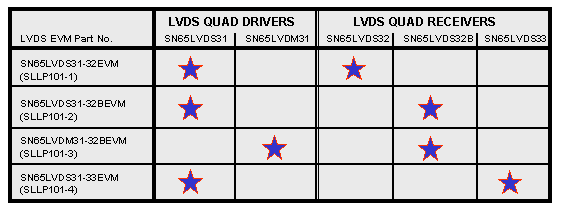
SN65LVDS31-32BEVM — SN65LVDS31-32BEVM-Evaluierungsmodul für LVDS31 und LVDS32B

TI offers a series of low-voltage differential signaling (LVDS) evaluation modules (EVMs) designed for analysis of the electrical characteristics of LVDS drivers and receivers. Four unique EVMs are available to evaluate the different classes of LVDS devices offered by TI.

Combination Table

As seen (...)

Unterstützte Produkte und Hardware
Vorrätig
Limit:
??asset.out-of-stock-ti_de_DE??
Nicht verfügbar
Evaluierungsplatine

SN65LVDS31-32EVM — SN65LVDS31-32EVM-Evaluierungsmodul für SNx5LVDS31 und SNx5LVDS32

The SN65LVDS31-32EVM evaluation moduel (EVM) includes the SV65LVDS31 quad driver and the SN65LVDS32 quad receiver. The SN65LVDS31 device is a TIA/EIA-644 standard-compliant LVDS driver. The SN65LVDS32 device is a TIA/EIA-644 standard-compliant receiver that has a passive open-circuit failsafe (...)

Unterstützte Produkte und Hardware
Vorrätig
Limit:
??asset.out-of-stock-ti_de_DE??
Nicht verfügbar
Simulationsmodell

SN65LVDS32 IBIS Model (Rev. A)

SLLC011 (4 KB) - IBIS-Modell
Unterstützte Produkte und Hardware
Gehäuse Pins CAD-Symbole, Footprints und 3D-Modelle
SOIC (D) 16 Ultra Librarian

Bestellen & Qualität

Support und Schulungen

TI E2E™-Foren mit technischem Support von TI-Ingenieuren

Inhalte werden ohne Gewähr von TI und der Community bereitgestellt. Sie stellen keine Spezifikationen von TI dar. Siehe Nutzungsbedingungen.

Bei Fragen zu den Themen Qualität, Gehäuse oder Bestellung von TI-Produkten siehe TI-Support. ​​​​​​​​​​​​​​

Videos