SLVS941G April 2009 – August 2016 TPS62230
PRODUCTION DATA.
- 1 Features
- 2 Applications
- 3 Description
- 4 Revision History
- 5 Device Comparison Table
- 6 Pin Configuration and Functions
- 7 Specifications
- 8 Detailed Description
-
9 Application and Implementation
- 9.1 Application Information
- 9.2
Typical Application
- 9.2.1 Design Requirements
- 9.2.2 Detailed Design Procedure
- 9.2.3
Application Curves
- 9.2.3.1 VOUT = 1.1 V - TPS622311
- 9.2.3.2 VOUT = 1.2 V - TPS62232/TPS62235
- 9.2.3.3 VOUT = 1.8 V - TPS62231
- 9.2.3.4 VOUT = 1.85 V - TPS62236
- 9.2.3.5 VOUT = 2.5 V - TPS62230
- 9.2.3.6 VOUT = 3.0 V - TPS62233
- 9.2.3.7 Start-Up
- 9.2.3.8 PFM / PWM Operation
- 9.2.3.9 Peak-to-Peak Output Ripple Voltage
- 9.2.3.10 Power-Supply Rejection
- 9.2.3.11 Spurious Output Noise
- 9.2.3.12 Line Transient Response
- 9.2.3.13 Mode Transition
- 9.2.3.14 AC-Load Regulation
- 9.2.3.15 Load Transient Response
- 9.3 System Examples
- 10Power Supply Recommendations
- 11Layout
- 12Device and Documentation Support
- 13Mechanical, Packaging, and Orderable Information
9 Application and Implementation
NOTE
Information in the following applications sections is not part of the TI component specification, and TI does not warrant its accuracy or completeness. TI’s customers are responsible for determining suitability of components for their purposes. Customers should validate and test their design implementation to confirm system functionality.
9.1 Application Information
The TPS6223x device family are high-frequency, synchronous, step-down DC-DC converters providing switch frequencies up to 3.8 MHz. Different fixed output voltage versions are available from 1.0 V to 3.3 V.
9.2 Typical Application
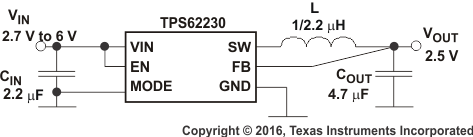 Figure 5. TPS62230 2.5-V Output
9.2.1 Design Requirements
The device operates over an input voltage range from 2.05 V to 6 V. The device family offers a broad range of internally fixed output voltage options from 1 V to 3.3 V. The TPS6223x is easy to use and needs just three external components; however, the selection of external components and PCB layout must comply with the design guidelines to achieve specified performance.
9.2.2 Detailed Design Procedure
9.2.2.1 Output Filter Design (Inductor and Output Capacitor)
The TPS6223x is optimized to operate with effective inductance values in the range of 0.7 μH to 4.3 μH and with effective output capacitance in the range of 2.0 μF to 15 μF. The internal compensation is optimized to operate with an output filter of L = 1.0 μH/2.2 μH and COUT = 4.7 μF. Larger or smaller inductor/capacitor values can be used to optimize the performance of the device for specific operation conditions. For more details, see the Checking Loop Stability section.
9.2.2.2 Inductor Selection
The inductor value affects its peak-to-peak ripple current, the PWM-to-PFM transition point, the output voltage ripple and the efficiency. The selected inductor has to be rated for its DC resistance and saturation current. The inductor ripple current (ΔIL) decreases with higher inductance and increases with higher VIN or VOUT . Equation 5 calculates the maximum inductor current under static load conditions. The saturation current of the inductor must be rated higher than the maximum inductor current as calculated with Equation 6. This is recommended because during heavy load transient the inductor current will rise above the calculated value.
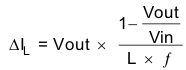
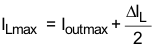
where
- f = Switching frequency
- L = Inductor value
- ΔIL= Peak-to-peak inductor ripple current
- ILmax = Maximum inductor current
In high-frequency converter applications, the efficiency is essentially affected by the inductor AC resistance (that is, quality factor) and to a smaller extent by the inductor DCR value. To achieve high-efficiency operation, take care in selecting inductors featuring a quality factor above 25 at the switching frequency. Increasing the inductor value produces lower RMS currents, but degrades transient response. For a given physical inductor size, increased inductance usually results in an inductor with lower saturation current.
The total losses of the coil consist of both the losses in the DC resistance, R(DC), and the following frequency-dependent components:
- The losses in the core material (magnetic hysteresis loss, especially at high switching frequencies)
- Additional losses in the conductor from the skin effect (current displacement at high frequencies)
- Magnetic field losses of the neighboring windings (proximity effect)
- Radiation losses
The following inductor series from different suppliers have been used with the TPS6223x converters.
Table 1. List of Inductors
| INDUCTANCE (μH) |
DIMENSIONS (mm3) |
INDUCTOR TYPE | SUPPLIER(1) |
|---|---|---|---|
| 1.0 / 2.2 | 2.5 × 2.0 × 1.2 | LQM2HPN1R0MJ0 | Murata |
| 2.2 | 2.0 × 1.2 × 0.55 | LQM21PN2R2 | Murata |
| 1.0 / 2.2 | 2.0 × 1.2 × 1.0 | MIPSZ2012 | FDK |
| 1.0 / 2.2 | 2.0 × 2.5 × 1.2 | MIPSA2520 | FDK |
| 1.0 / 2.2 | 2.0 × 1.2 × 1.0 | KSLI2012 series | Hitachi Metal |
9.2.2.3 Output Capacitor Selection
The unique hysteretic PWM control scheme of the TPS62230 allows the use of tiny ceramic capacitors. Ceramic capacitors with low ESR values have the lowest output voltage ripple and are recommended. The output capacitor requires either an X7R or X5R dielectric. Y5V and Z5U dielectric capacitors, aside from their wide variation in capacitance over temperature, become resistive at high frequencies.
At light load currents, the converter operate in power save mode and the output voltage ripple is dependent on the output capacitor value and the PFM peak inductor current. Higher output capacitor values minimize the voltage ripple in PFM mode and tighten DC output accuracy in PFM mode.
9.2.2.4 Input Capacitor Selection
Because of the nature of the buck converter having a pulsating input current, a low-ESR input capacitor is required for best input voltage filtering and minimizing the interference with other circuits caused by high input voltage spikes. For most applications a 2.2-μF to 4.7-μF ceramic capacitor is recommended. The input capacitor can be increased without any limit for better input voltage filtering. Because ceramic capacitor loses up to 80% of its initial capacitance at 5 V, TI recommends using 4.7 μF input capacitors for input voltages > 4.5 V.
Take care when using only small ceramic input capacitors. When a ceramic capacitor is used at the input and the power is being supplied through long wires, such as from a wall adapter, a load step at the output or VIN step on the input can induce ringing at the VIN pin. This ringing can couple to the output and be mistaken as loop instability or could even damage the part by exceeding the maximum ratings.
Table 2 shows a list of tested input and output capacitors.
Table 2. List of Capacitors
| CAPACITANCE [μF] | SIZE | CAPACITOR TYPE | SUPPLIER(1) |
|---|---|---|---|
| 2.2 | 0402 | GRM155R60J225 | Murata |
| 4.7 | 0402 | AMK105BJ475MV | Taiyo Yuden |
| 4.7 | 0402 | GRM155R60J475 | Murata |
| 4.7 | 0402 | CL05A475MQ5NRNC | Samsung |
| 4.7 | 0603 | GRM188R60J475 | Murata |
9.2.2.5 Checking Loop Stability
The first step of circuit and stability evaluation is to look from a steady-state perspective at the following signals:
- Switching node, SW
- Inductor current, IL
- Output ripple voltage, VOUT(AC)
These are the basic signals that need to be measured when evaluating a switching converter. When the switching waveform shows large duty cycle jitter or the output voltage or inductor current shows oscillations, the regulation loop may be unstable. This is often a result of board layout and/or L-C combination.
As a next step in the evaluation of the regulation loop, the load transient response is tested. The time between the application of the load transient and the turn on of the P-channel MOSFET, the output capacitor must supply all of the current required by the load. VOUT immediately shifts by an amount equal to ΔI(LOAD) x ESR, where ESR is the effective series resistance of COUT. ΔI(LOAD) begins to charge or discharge CO generating a feedback error signal used by the regulator to return VOUT to its steady-state value. The results are most easily interpreted when the device operates in PWM mode.
During this recovery time, VOUT can be monitored for settling time, overshoot or ringing that helps judge the converter’s stability. Without any ringing, the loop has usually more than 45° of phase margin.
Because the damping factor of the circuitry is directly related to several resistive parameters (for example, MOSFET rDS(on)) that are temperature dependant, the loop stability analysis has to be done over the input voltage range, load current range, and temperature range.
9.2.3 Application Curves
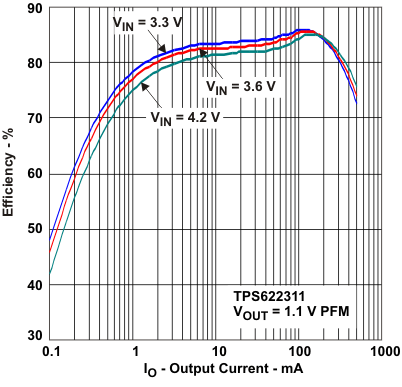
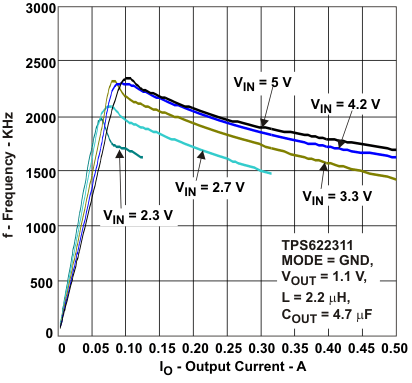
9.2.3.1 VOUT = 1.1 V – TPS622311
9.2.3.2 VOUT = 1.2 V – TPS62232/TPS62235
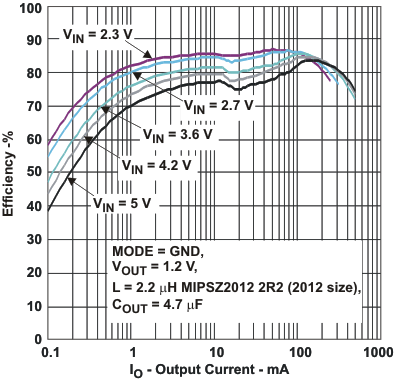 Figure 8. Efficiency PFM / PWM Mode, 1.2-V Output Voltage – TPS62232
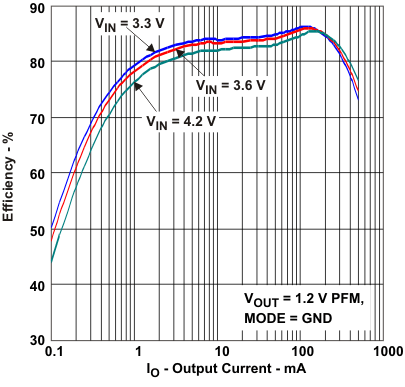 Figure 10. Efficiency vs IOUT, PFM / PWM Mode – TPS62235
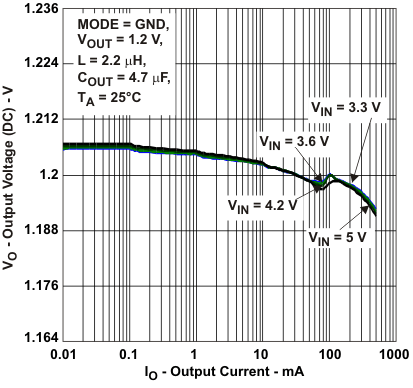 Figure 12. 1.2-V Output Voltage Accuracy PFM/PWM Mode – TPS62232
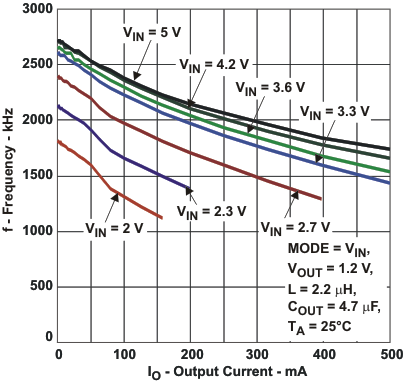 Figure 14. Switching Frequency vs Output Current, 1.2-V Output Voltage, Forced PWM Mode – TPS62232
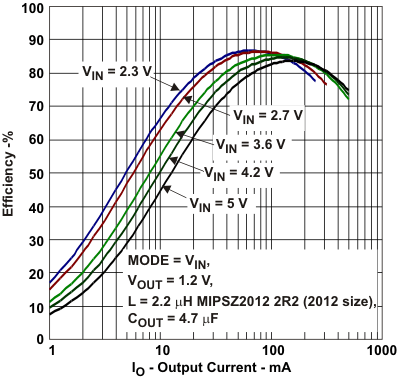 Figure 9. Efficiency Forced PWM Mode, 1.2-V Output Voltage – TPS62232
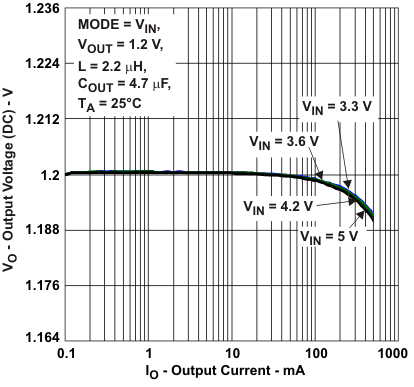 Figure 11. 1.2-V Output Voltage Accuracy Forced PWM Mode – TPS62232
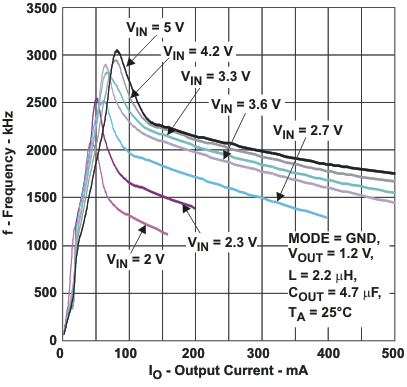 Figure 13. Switching Frequency vs Output Current, 1.2-V Output Voltage, PFM/PWM Mode – TPS62232
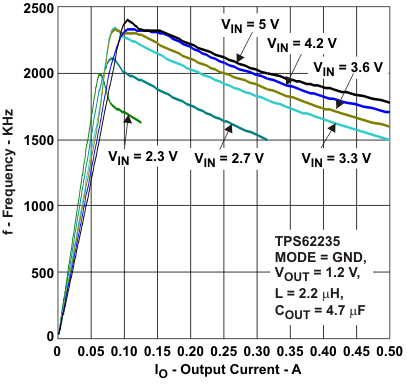
9.2.3.3 VOUT = 1.8 V – TPS62231
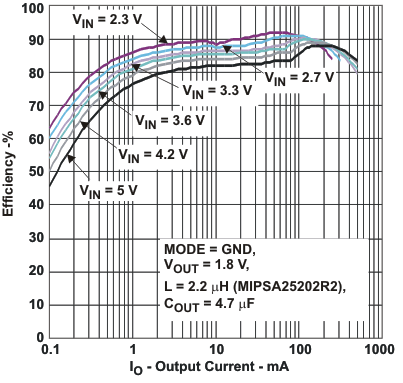 Figure 16. Efficiency PFM/PWM Mode, 1.8-V Output Voltage – TPS62231
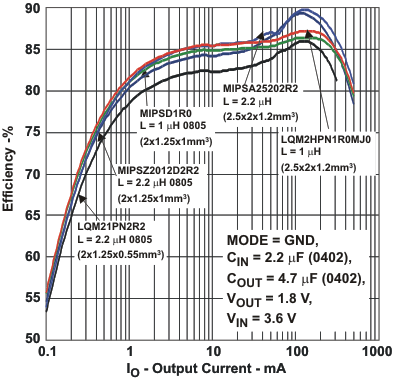 Figure 18. Comparison Efficiency vs Inductor Value and Size – TPS62231
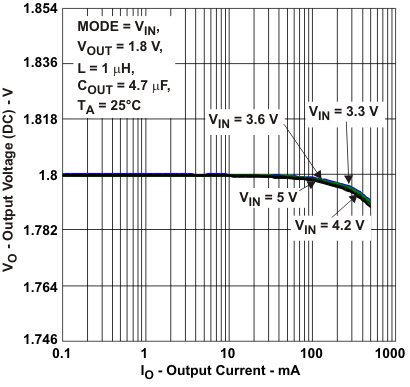 Figure 20. 1.8-V Output Voltage Accuracy Forced PWM Mode – TPS62231
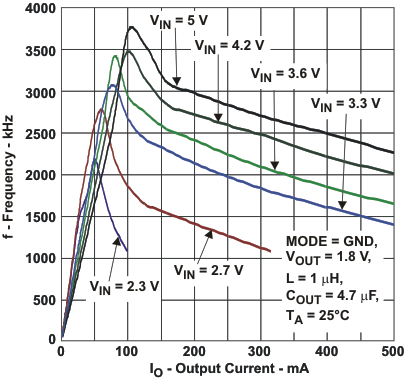 Figure 22. Switching Frequency vs Output Current, 1.8-V Output Voltage, PFM/PWM Mode – TPS62231
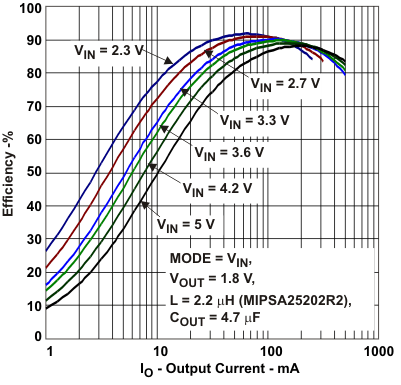 Figure 17. Efficiency Forced PWM Mode, 1.8-V Output Voltage – TPS62231
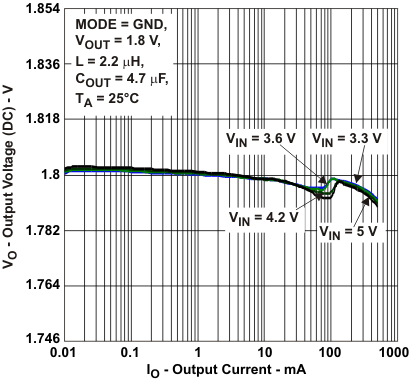 Figure 19. 1.8-V Output Voltage Accuracy PFM / PWM Mode – TPS62231
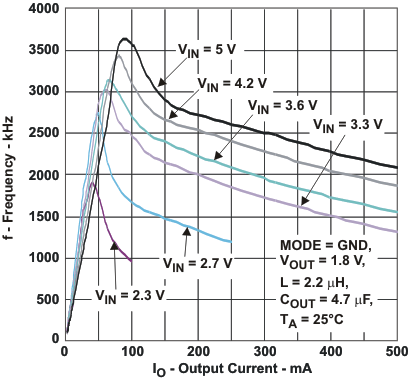 Figure 21. Switching Frequency vs Output Current, 1.8-V Output Voltage, PFM/PWM Mode – TPS62231
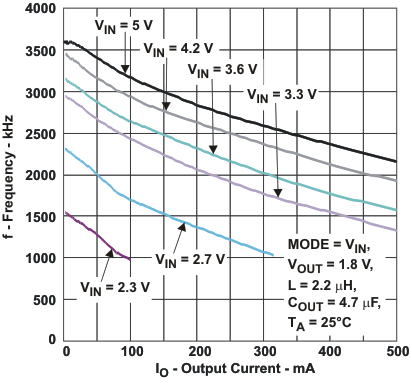 Figure 23. Switching Frequency vs Output Current, 1.8-V Output Voltage, Forced PWM Mode – TPS62231
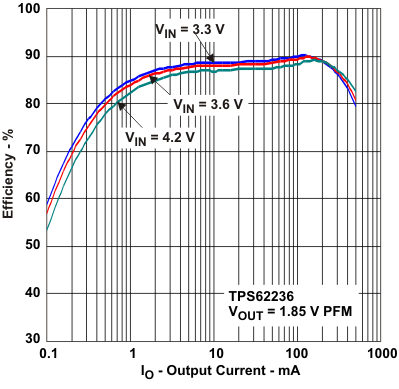
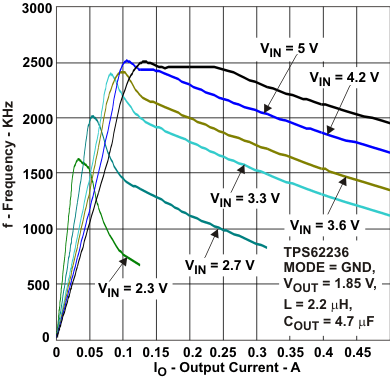
9.2.3.4 VOUT = 1.85 V – TPS62236
9.2.3.5 VOUT = 2.5 V – TPS62230
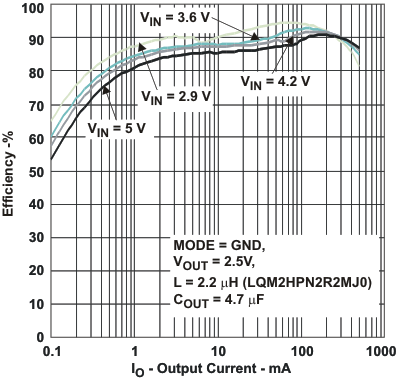 Figure 26. Efficiency PFM/PWM Mode, 2.5-V Output Voltage – TPS62230
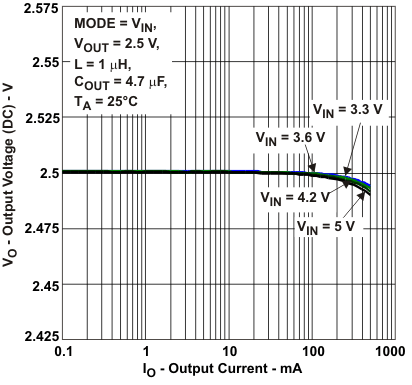 Figure 28. 2.5V Output Voltage Accuracy Forced PWM Mode – TPS62230
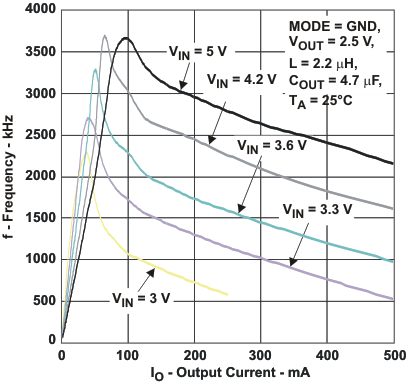 Figure 30. Switching Frequency vs Output Current, 2.5-V Output Voltage, PFM/PWM Mode – TPS62230
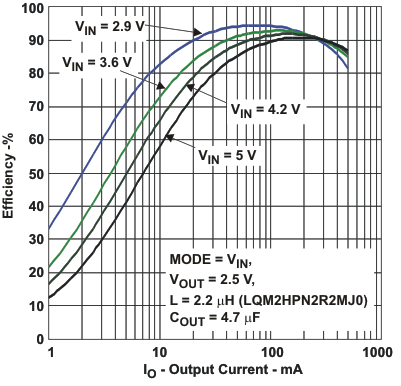 Figure 27. Efficiency Forced PWM Mode, 2.5-V Output Voltage – TPS62230
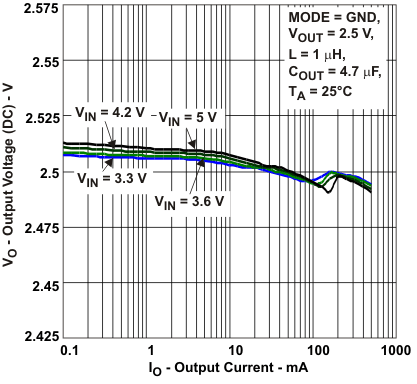 Figure 29. 2.5-V Output Voltage Accuracy PFM/PWM Mode – TPS62230
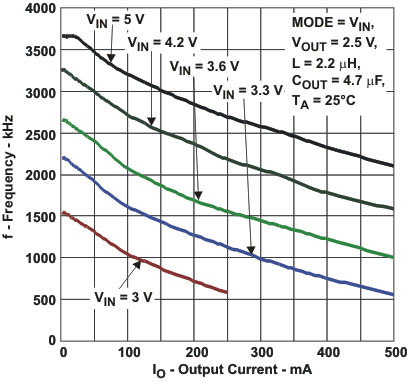 Figure 31. Switching Frequency vs Output Current, 2.5-V Output Voltage, Forced PWM Mode – TPS62230
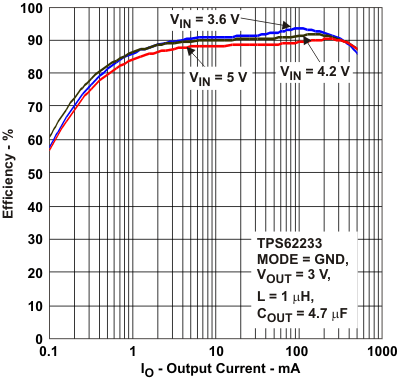
9.2.3.7 Start-Up
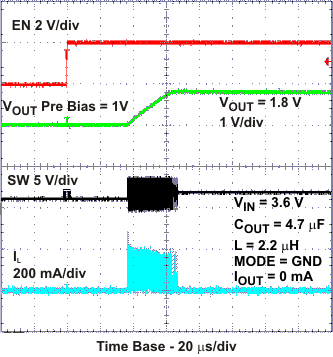 Figure 33. Start-Up in 1-V Prebiased Output – TPS62231
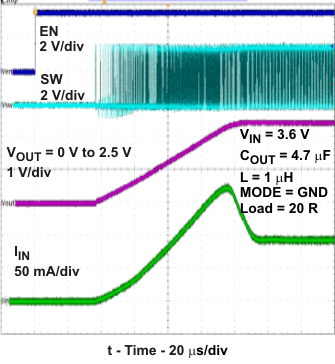 Figure 34. Start-Up into 20 Ω Load, VOUT 2.5 V – TPS62230
9.2.3.8 PFM / PWM Operation
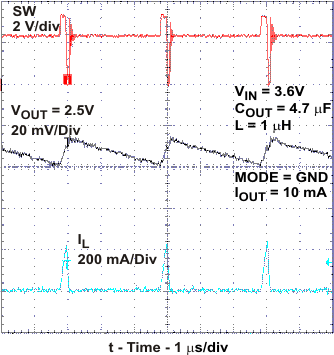 Figure 35. PFM Mode Operation, L = 1.0 µH,
IOUT = 10 mA – TPS62230
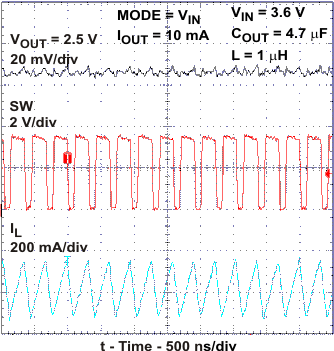 Figure 37. Forced PWM Mode Operation IOUT = 10 mA – TPS62230
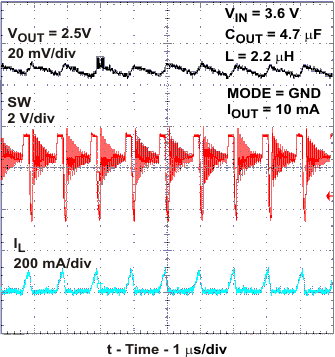 Figure 36. PFM Mode Operation, L = 2.2 µH,
 IOUT = 10 mA – TPS62230
9.2.3.9 Peak-to-Peak Output Ripple Voltage
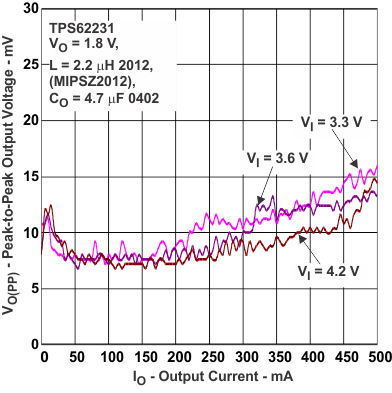 Figure 38. Output Voltage, Peak-to-Peak vs Output Current – TPS62231
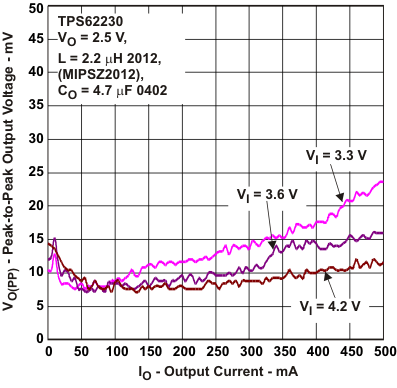 Figure 39. Output Voltage, Peak-to-Peak vs Output Current – TPS62230
9.2.3.10 Power-Supply Rejection
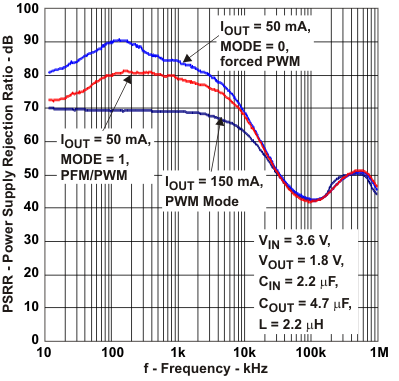 Figure 40. 1.8-V Power-Supply Rejection Ratio – TPS62231
9.2.3.11 Spurious Output Noise
9.2.3.12 Line Transient Response
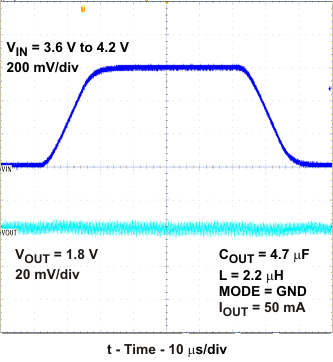 Figure 43. Line Transient Response, PFM Mode – TPS62231
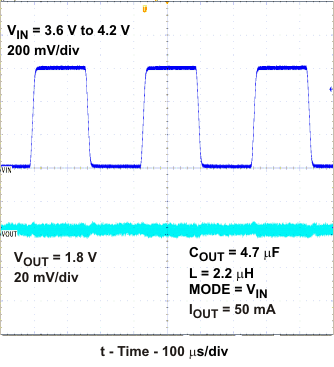 Figure 44. Line Transient Response, PWM Mode – TPS62231
9.2.3.13 Mode Transition
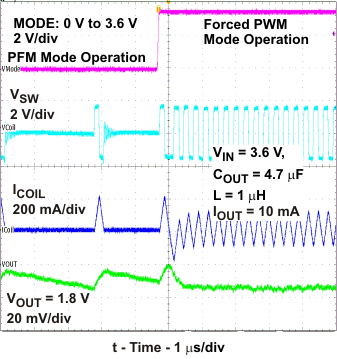 Figure 45. Mode Transition PFM / Forced PWM Mode – TPS62231
9.2.3.14 AC-Load Regulation
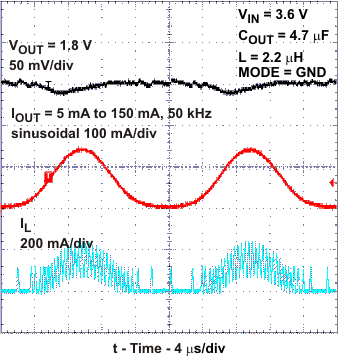 Figure 46. AC – Load Regulation Performance 1.8-V VOUT, PFM Mode – TPS62231
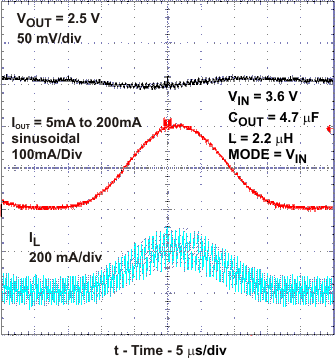 Figure 48. AC – Load Regulation Performance 2.5-V VOUT, PWM Mode – TPS62230
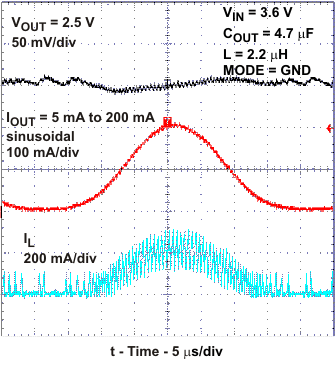 Figure 47. AC – Load Regulation Performance 2.5-V VOUT, PFM Mode – TPS62230
9.2.3.15 Load Transient Response
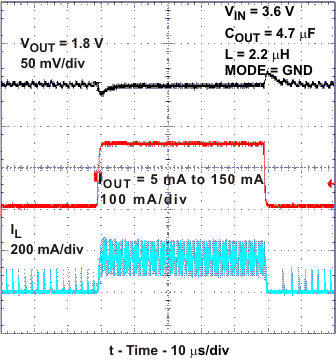 Figure 49. Load Transient Response 5 mA to 150 mA, PFM to PWM Mode, VOUT 1.8 V – TPS62231
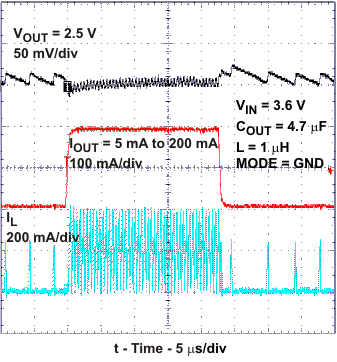 Figure 51. Load Transient Response 5 mA to 200 mA, PFM to PWM Mode, VOUT 2.5 V – TPS62230
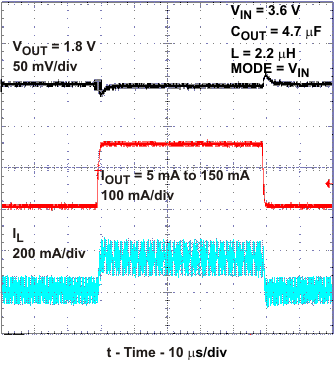 Figure 50. Load Transient Response 5 mA to 150 mA, Forced PWM Mode, VOUT 1.8 V – TPS62231
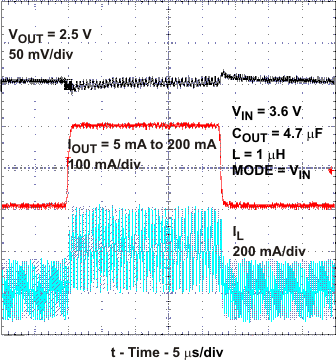 Figure 52. Load Transient Response 5 mA to 200 mA, Forced PWM Mode, VOUT 2.5 V – TPS62230
9.3 System Examples
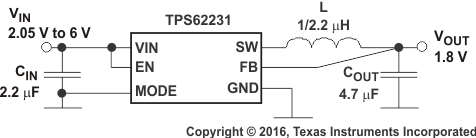 Figure 53. TPS62231 1.8-V Output
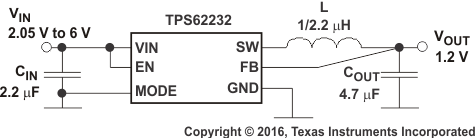 Figure 54. TPS62232 1.2-V Output