This section provides a failure mode
analysis (FMA) for the pins of the TPSI3050M. The
failure modes covered in this document include the typical pin-by-pin failure
scenarios for three-wire mode and two-wire mode:
Table 4-2 through Table 4-9 also indicate how these pin conditions can affect the device as per the failure
effects classification in Table 4-2.
Table 4-1 TI Classification of Failure
Effects
| Class |
Failure Effects |
| A |
Potential device damage that affects
functionality. |
| B |
No device damage, but loss of functionality. |
| C |
No device damage, but performance degradation. |
| D |
No device damage, no impact to functionality or
performance. |
Figure 4-1 shows the TPSI3050M pin diagram. For a detailed
description of the device pins please refer to the Pin Configuration and
Functions section in the TPSI3050M data
sheet.
The TPSI3050M is normally operated in one of two modes of operation for a
given application: three-wire mode or two-wire mode. The pin FMA was performed
individually for each of these modes of operation in the following sections.
Three-Wire Mode
Following are the assumptions of use
and the device configuration assumed for the pin FMA in this
section:
- Device configured and operating
in three-wire mode
- Device in normal operation prior
to any open or short condition being applied to the respective pin
- EN set to a static logic low or
high (VDRV asserted low or high respectively)
- Opens or shorts occur relative to
primary and secondary sides of the device and is a static event
Table 4-2 Three-Wire Mode: Pin FMA for
Device Pins Short-Circuited to VSSP or VSSS
| Pin Name |
Pin No. |
Ground |
Description of Potential Failure Effects |
Failure Effect Class |
| EN |
1 |
VSSP |
VDRV asserts
low. |
B |
| PXFR |
2 |
VSSP |
Subsequent power cycles
result in RPXFR selection to 7.32kΩ, which can result in
longer start-up and recovery times if a different RPXFR
selection from 7.32kΩ is used in the application. |
C |
| VDDP |
3 |
VSSP |
No power transfer. VDDH
and VDDM rails collapse. VDRV asserts low with active clamp enabled.
If EN static is high, additional leakage current into the EN pin is
observed on the order of 25mA. |
B |
| VDRV |
8 |
VSSS |
If VDRV is high, VDDH
and VDDM rails collapse. VDRV asserts low with an active clamp
enabled. If VDRV is low, no effect. |
B |
| VDDH |
7 |
VSSS |
VDDH and VDDM rails
collapse. VDRV asserts low with an active clamp enabled. |
B |
| VDDM |
6 |
VSSS |
VDDH and VDDM rails
collapse. VDRV asserts low with an active clamp enabled. |
B |
Table 4-3 Three-Wire Mode: Pin FMA for
Device Pins Open-Circuited
| Pin Name |
Pin No. |
Description of Potential Failure Effects |
Failure Effect Class |
| EN |
1 |
VDRV asserts low. The EN
pin has an internal resistive pulldown to VSSP. |
B |
| PXFR |
2 |
Subsequent power cycles
result in RPXFR selection to 7.32kΩ, which can result in
longer start-up and recovery times if a different RPXFR
selection from 7.32kΩ is used in the application. |
C |
| VDDP |
3 |
No power transfer. VDDH
and VDDM rails collapse. VDRV asserts low with an active clamp
enabled. |
B |
| VSSP |
4 |
No power transfer. VDDH
and VDDM rails collapse. VDRV asserts low with an active clamp
enabled. |
B |
| VDRV |
8 |
No drive to the external
switch. The external switch gate control can float dependent upon
application circuitry. |
B |
| VDDH |
7 |
VDDH can collapse under
loading or switching events. |
B |
| VDDM |
6 |
VDDH and VDDM can
collapse under loading or switching events. |
B |
| VSSS |
5 |
Normal power transfer.
VDDH and VDDM rails remain charged. VDRV follows the state of EN
logic level. Since VSSS is a floating ground, VSSS cannot drive the
external switch. |
B |
Table 4-4 Three-Wire Mode: Pin FMA for
Device Pins Short-Circuited to Adjacent Pin
| Pin Name |
Pin No. |
Shorted to |
Description of Potential Failure Effects |
Failure Effect Class |
| VDDH |
7 |
VDDM |
VDDH and VDDM rails collapse. VDRV
asserts low with an active clamp enabled. |
B |
| VDRV |
8 |
VDDH |
If VDRV is low, VDDH and VDDM rails
collapse. VDRV remains low with an active clamp enabled. If VDRV is
high, no effect. |
B |
| EN |
1 |
PXFR |
Subsequent power cycles result in
RPXFR selection to 7.32kΩ, which can result in longer
start-up and recovery times if a different RPXFR
selection from 7.32kΩ is used in the application. |
C |
Table 4-5 Three-Wire Mode: Pin FMA for
Device Pins Short-Circuited to
VDDP
| Pin Name |
Pin No. |
Description of Potential Failure Effects |
Failure Effect Class |
| EN |
1 |
VDRV asserts
high. |
B |
| PXFR |
2 |
Subsequent power cycles result in
RPXFR selection to 7.32kΩ, which can result in longer
start-up and recovery times if a different RPXFR
selection from 7.32kΩ is used in the application. |
C |
Two-Wire Mode
Following are the assumptions of use and the device configuration assumed for the pin
FMA in this
section:
- Device configured and operating
in two-wire mode
- Device in normal operation prior
to any open or short condition being applied to the respective pin
- EN set to a static high (VDRV
asserted high)
- Opens or shorts occur relative to
primary and secondary sides of the device and is a static event
Table 4-6 Two-Wire Mode: Pin FMA for
Device Pins Short-Circuited to VSSP or VSSS
| Pin Name |
Pin No. |
Ground |
Description of Potential Failure Effects |
Failure Effect Class |
| EN |
1 |
VSSP |
No power transfer. VDDH
and VDDM rails collapse. VDRV asserts low with an active clamp
enabled. |
B |
| PXFR |
2 |
VSSP |
Subsequent power cycles
result in RPXFR selection to 7.32kΩ, which can result in
longer start-up and recovery times if a different RPXFR
selection from 7.32kΩ is used in the application. |
C |
| VDDP |
3 |
VSSP |
No power transfer. VDDH
and VDDM rails collapse. VDRV asserts low with an active clamp
enabled. Additional leakage current into the EN pin is observed on
the order of 25mA. |
B |
| VDRV |
8 |
VSSS |
VDDH and VDDM rails
collapse. VDRV asserts low with an active clamp enabled. |
B |
| VDDH |
7 |
VSSS |
VDDH and VDDM rails
collapse. VDRV asserts low with an active clamp enabled. |
B |
| VDDM |
6 |
VSSS |
VDDH and VDDM rails
collapse. VDRV asserts low with an active clamp enabled. |
B |
Table 4-7 Two-Wire Mode: Pin FMA for Device Pins Open-Circuited
| Pin Name |
Pin No. |
Description of Potential Failure Effects |
Failure Effect Class |
| EN |
1 |
No power transfer. VDDH
and VDDM rails collapse. VDRV asserts low with an active clamp
enabled. The EN pin has an internal resistive pulldown to
VSSP. |
B |
| PXFR |
2 |
Subsequent power cycles
result in RPXFR selection to 7.32kΩ, which can result in
longer start-up and recovery times if a different RPXFR
selection from 7.32kΩ is used in the application. |
C |
| VDDP |
3 |
No power transfer. VDDH
and VDDM rails collapse. VDRV asserts low with an active clamp
enabled. |
B |
| VSSP |
4 |
No power transfer. VDDH
and VDDM rails collapse. VDRV asserts low with an active clamp
enabled. |
B |
| VDRV |
8 |
No drive to the external
switch. The external switch gate control can float dependent upon
application circuitry. |
B |
| VDDH |
7 |
VDDH can collapse under
loading or switching events. |
B |
| VDDM |
6 |
VDDH and VDDM can
collapse under loading or switching events. |
B |
| VSSS |
5 |
Normal power transfer.
VDDH and VDDM rails remain charged. VDRV follows the state of EN
logic level. Since VSSS is a floating ground, VSSS cannot drive the
external switch. |
B |
Table 4-8 Two-Wire Mode: Pin FMA for Device Pins Short-Circuited to Adjacent
Pin
| Pin Name |
Pin No. |
Shorted to |
Description of Potential Failure Effects |
Failure Effect Class |
| VDDH |
7 |
VDDM |
VDDH and VDDM rails collapse. VDRV
asserts low with an active clamp enabled. |
B |
| VDRV |
8 |
VDDH |
VDRV remains high. |
B |
| EN |
1 |
PXFR |
Subsequent power cycles result in
RPXFR selection to 7.32kΩ, which can result in longer
start-up and recovery times if a different RPXFR
selection from 7.32kΩ is used in the application. |
C |
Table 4-9 Two-Wire Mode: Pin FMA for Device Pins Short-Circuited to
VDDP
| Pin Name |
Pin No. |
Description of Potential Failure Effects |
Failure Effect Class |
| EN |
1 |
If EN voltage exceeds the absolute
maximum of VDDP, potential damage of device can occur. |
A |
| PXFR |
2 |
Subsequent power cycles result in
RPXFR selection to 7.32kΩ, which can result in longer
start-up and recovery times if a different RPXFR
selection from 7.32kΩ is used in the application. |
C |
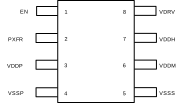 Figure 4-1 Pin Diagram