SFFS988 September 2024 LM5109B-Q1
4 Pin Failure Mode Analysis (Pin FMA)
This section provides a failure mode analysis (FMA) for the pins of the LM5109B-Q1. The failure modes covered in this document include the typical pin-by-pin failure scenarios:
- Pin short-circuited to ground (see Table 4-2)
- Pin open-circuited (see Table 4-3)
- Pin short-circuited to an adjacent pin (see Table 4-4)
- Pin short-circuited to supply (see Table 4-5)
Table 4-2 through Table 4-5 also indicate how these pin conditions can affect the device as per the failure effects classification in Table 4-1.
| Class | Failure Effects |
|---|---|
| A | Potential device damage that affects functionality. |
| B | No device damage, but loss of functionality. |
| C | No device damage, but performance degradation. |
| D | No device damage, no impact to functionality or performance. |
Figure 4-1 shows the LM5109B-Q1 pin diagram. For a detailed description of the device pins, see the Pin Configuration and Functions section in the LM5109B-Q1 data sheet.
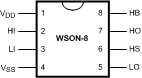 Figure 4-1 Pin Diagram
Following are the assumptions of use and the device configuration assumed for the pin FMA in this section:
- Short between VDD and HB is not considered.
- Short between VSS and LO is not considered.
| Pin Name | Pin No. | Description of Potential Failure Effects | Failure Effect Class |
|---|---|---|---|
| VDD | 1 | The device is not powered. | C |
| HI | 2 | HO is pulled low (sinking is on). HI is stuck low. | C |
| LI | 3 | LO is pulled low (sinking is on). LI is stuck low. | C |
| VSS | 4 | No impact. Short to same potential. | D |
| LO | 5 | LO is stuck low. | A |
| HS | 6 | HS is stuck low. Power FET short circuit HV and HS when HI = H is commanded. | D |
| HO | 7 | HO is stuck low. Device damage is possible when HI = H is commanded. | A |
| HB | 8 | HO is stuck low. Boot diode damage is possible. | D |
| Pin Name | Pin No. | Description of Potential Failure Effects | Failure Effect Class |
|---|---|---|---|
| VDD | 1 | The device is not powered. | D |
| HI | 2 | HI is pulled down by the internal pulldown resistor. HO is pulled down (sinking is on). | C |
| LI | 3 | LI is pulled down by the internal pulldown resistor. LO is pulled down (sinking is on). | C |
| VSS | 4 | HI and LI float to VDD level. HO and LO float to VDD level. | C |
| LO | 5 | LO is disconnected from the gate of the power FET. | D |
| HS | 6 | Low side output has no supply. LO is pulled down (sinking is on). | C |
| HO | 7 | HO is disconnected from the gate of the power FET. | D |
| HB | 8 | High-side output has no supply. HO is pulled down (sinking is on). | C |
| Pin Name | Pin No. | Shorted to | Description of Potential Failure Effects | Failure Effect Class |
|---|---|---|---|---|
| VDD | 1 | HI | HI is stuck high. HO is pulled up (sourcing is on). | C |
| HI | 2 | LI | HI and LI are undefined. | C |
| LI | 3 | VSS | LI is stuck low. | C |
| VSS | 4 | N/A | N/A | N/A |
| LO | 5 | HS | LO is in an overvoltage condition and potentially exposed to VIN level when HI = H is commanded. | A |
| HS | 6 | HO | High-side HO output level is 0 (HO-HS). High-side power FET is off (VGS is stuck low). | A |
| HO | 7 | HB | HO is stuck high. HO is pulled up to VDD level. Power FET damage is possible when LI = H is commanded. | A |
| HB | 8 | N/A | N/A | N/A |
| Pin Name | Pin No. | Description of Potential Failure Effects | Failure Effect Class |
|---|---|---|---|
| VDD | 1 | No impact. Short to same potential. | D |
| HI | 2 | HI is stuck high. HO is pulled up (sourcing is on). | C |
| LI | 3 | LI is stuck high. LO is pulled up (sourcing is on). | C |
| VSS | 4 | VDD short to VSS The device is not powered. | C |
| LO | 5 | LO is stuck high and device damage is possible. Power FET damage is possible when HI = H is commanded. | A |
| HS | 6 | HO (and HS) is pulled to VDD level. | C |
| HO | 7 | HO is stuck high and device damage is possible. Power FET damage is possible when LI = H is commanded. | A |
| HB | 8 | HO output voltage (sourcing on) is lower than the specified range. | C |