SDAA460 July 2026 ISOUSB211
5.1 Operation Without External 1.8V Supply
The device can run without any external 1.8V supply. In this configuration, the internal LDOs generate both 1.8V rails from the VCC pins, so a dedicated 1.8V source is not required. Figure 5-1 shows this configuration.
The trade-off is thermal: relying on the internal 1.8V LDOs adds power dissipation inside the package, which lowers the maximum supported ambient temperature to approximately 107°C. When the 1.8V rails are supplied externally, the supported ambient temperature is approximately 128°C. Whenever an external 1.8V supply is available, supply the rails externally to keep the device cooler. Operation With External 1.8V Supply shows a design using an external supply.
For detailed thermal calculation of operation without the external 1.8V supply, see the Example Configuration 1 section in the ISOUSB211: 480Mbps High-Speed Reinforced USB Isolator datasheet.
 Figure 5-1 Using ISOUSB211 Without External 1.8V
Supply
Figure 5-1 Using ISOUSB211 Without External 1.8V
SupplyA simple trick to improve thermals without external 1.8V supply: Figure 5-2 shows a smart configuration, which helps in extending the ambient temperature by 10°C from 107°C (in Figure 5-1) to 117°C, without using external 1.8V supply. Extend the ambient temperature by adding a series 5Ω (50mW) resistor for external 3.3V connection to 1.8V LDO (V1P8V2) and 20Ω (250mW) resistor for external 5V connection to internal 1.8V LDO (V1P8V1). When choosing the resistor value, remember that the VCCx voltage can be as low as 2.4V. In that case, an additional 1μF capacitors is needed on VCCx pins.
The external resistors drop voltage and dissipate power, which helps reduce the power dissipation within ISOUSB211 and the corresponding temperature rise. Figure 5-1 shows a net change in internal power dissipation from 960mW to 728mW. This technique saves system cost by replacing two external DC-DC and LDOs with just two resistors and is useful in applications that prioritize cost over maximizing power dissipation and temperature range.
For detailed thermal calculation of operation without the external 1.8V supply and series resistors to VCCx pin, see the Example Configuration 3 section of the ISOUSB211: 480Mbps High-Speed Reinforced USB Isolator datasheet.
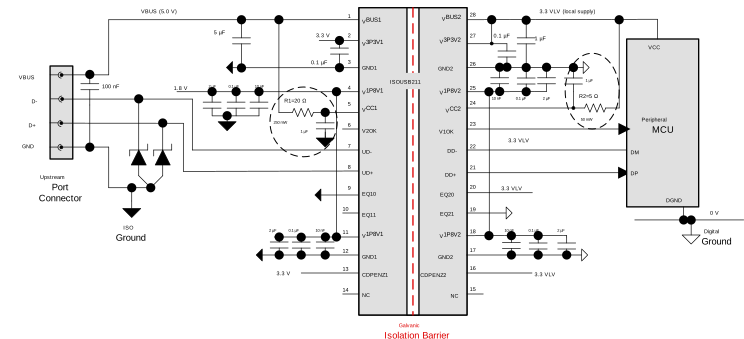 Figure 5-2 Using ISOUSB211 Without External 1.8V
Supply - With Resistors in Series With VCCx Pins
Figure 5-2 Using ISOUSB211 Without External 1.8V
Supply - With Resistors in Series With VCCx Pins