SLVSFW1 December   2025 TPS1HC120-Q1

PRODUCTION DATA  

  1.   1
  2. Features
  3. Applications
  4. Description
  5. Device Comparison Table
  6. Pin Configuration and Functions
  7. Specifications
    1. 6.1 Absolute Maximum Ratings
    2. 6.2 ESD Ratings
    3. 6.3 Recommended Operating Conditions
    4. 6.4 Thermal Information
    5. 6.5 Electrical Characteristics
    6. 6.6 Switching Characteristics
    7. 6.7 Typical Characteristics
  8. Detailed Description
    1. 7.1 Overview
    2. 7.2 Functional Block Diagram
    3. 7.3 Feature Description
      1. 7.3.1 ORing of EN and EN_AUX
      2. 7.3.2 Inductive-Load Switching-Off Clamp
      3. 7.3.3 Full Protections and Diagnostics
        1. 7.3.3.1  Programmable Current Limit
        2. 7.3.3.2  Short-Circuit and Overload Protection
          1. 7.3.3.2.1 Capacitive Charging
        3. 7.3.3.3  On-state Open-Load Detection
        4. 7.3.3.4  Reverse-Polarity and Reverse Battery Protection
        5. 7.3.3.5  Thermal Protection Behavior
        6. 7.3.3.6  UVLO Protection
        7. 7.3.3.7  Loss of GND Protection
        8. 7.3.3.8  Loss of Power Supply Protection
        9. 7.3.3.9  Reverse Current Protection
        10. 7.3.3.10 Protection for MCU I/Os
    4. 7.4 Device Functional Modes
      1. 7.4.1 Working Mode
  9. Application and Implementation
    1. 8.1 Application Information
    2. 8.2 Typical Application
      1. 8.2.1 Detailed Design Procedure
        1. 8.2.1.1 Dynamically Changing Current Limit
        2. 8.2.1.2 AEC Q100-012 Test Grade A Certification
        3. 8.2.1.3 EMC Transient Disturbances Test
      2. 8.2.2 Power Dissipation Calculation
      3. 8.2.3 Application Curves
    3. 8.3 Power Supply Recommendations
    4. 8.4 Layout
      1. 8.4.1 Layout Guidelines
      2. 8.4.2 Layout Examples
        1. 8.4.2.1 Without a GND Network
        2. 8.4.2.2 With a GND Network
  10. Device and Documentation Support
    1. 9.1 Third-Party Products Disclaimer
    2. 9.2 Receiving Notification of Documentation Updates
    3. 9.3 Support Resources
    4. 9.4 Trademarks
    5. 9.5 Electrostatic Discharge Caution
    6. 9.6 Glossary
  11. 10Revision History
  12. 11Mechanical, Packaging, and Orderable Information

封装选项

请参考 PDF 数据表获取器件具体的封装图。

机械数据 (封装 | 引脚)
  • DYC|8
散热焊盘机械数据 (封装 | 引脚)
订购信息

Short-Circuit and Overload Protection

The TPS1HC120-Q1 provides output short-circuit protection to ensure that the device will prevent current flow in the event of a low impedance path to GND, removing the risk of damage or significant supply droop. The device is guaranteed to protect against short-circuit events up to 28V supply.

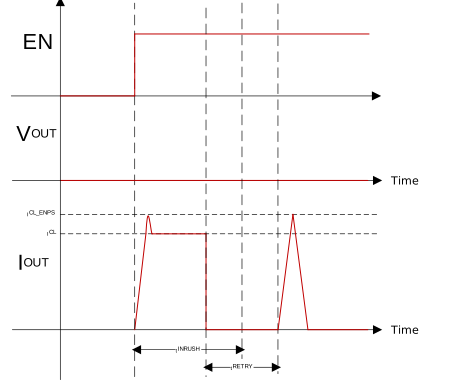
Figure 7-4 shows the behavior of the TPS1HC120-Q1 when the device is enabled into a short-circuit.

TPS1HC120-Q1 Enable Into Permanent
                    Short Figure 7-4 Enable Into Permanent Short

Once the device is enabled, due to the low impedance path, the output current will rapidly increase until it hits the current limit threshold (ICL). Due to the response time of the current limiting circuit, the measured maximum current may temporarily exceed the ICL value defined as ICL_ENPS, however, it will settle to the current limit regulation value. In this state, high power is dissipated in the FET, so eventually the internal thermal protection temperature for the FET is reached and the device safely shuts down. After thermal shutdown,

  • The device will retry after tRETRY duration if the inrush period (tINRUSH) has not expired. The inrush period starts from the EN rising edge.
  • After the inrush period expires, output voltage (VOUT) is sensed every time thermal shutdown is hit.
    • If VOUT is less than 3V, as is the case for strong output short to ground, the device will be latched off until EN inputs toggle.
    • If VOUT is higher than 3V, for example, for an overload scenario, the device will retry.

Figure 7-5 shows the behavior of the TPS1HC120-Q1 when a short-circuit occurs while the device is in the on-state and already delivering current. When the internal pass FET is fully enabled, the current limiting response time is slower. So to ensure that the current overshoot is limited, the device implements a fast trip at a level IOVCR. When this fast trip threshold is hit, the device immediately shuts off for a short period of time before quickly re-enabling and clamping the current to ICL level after a brief transient overshoot to the higher peak current (ICL_ENPS) level. The device will then keep the current clamped at the regulation current limit until the thermal shutdown temperature is hit and the device will safely shut-off. Once thermal shutdown is hit, the device will latch off till the enable inputs toggle if the output voltage is less than 3V, and will retry if the output voltage is more than 3V.

Once the device re-enables due to enable input toggling, if the output short still exists, the scenario is identical to the enable into permanent short scenario.

TPS1HC120-Q1 On-State Short-Circuit
                    Behavior Figure 7-5 On-State Short-Circuit Behavior

Figure 7-6 shows the behavior of the TPS1HC120-Q1 when there is a small change in impedance that sends the load current above the ICL threshold. The current rises to ICL_LINPK above the regulation level. Then the current limit regulation loop kicks in and the current drops to the ICL value.

TPS1HC120-Q1 Overload Behavior Figure 7-6 Overload Behavior

In all of these cases, the internal thermal shutdown is safe to hit repetitively. There is no device risk or lifetime reliability concerns from repeatedly hitting this thermal shutdown level.