SLOS498B September 2006 – September 2015 TPA2006D1
PRODUCTION DATA.
- 1 Features
- 2 Applications
- 3 Description
- 4 Revision History
- 5 Device Comparison Table
- 6 Pin Configuration and Functions
- 7 Specifications
- 8 Parameter Measurement Information
- 9 Detailed Description
- 10Application and Implementation
- 11Power Supply Recommendations
- 12Layout
- 13Device and Documentation Support
- 14Mechanical, Packaging, and Orderable Information
10 Application and Implementation
NOTE
Information in the following applications sections is not part of the TI component specification, and TI does not warrant its accuracy or completeness. TI’s customers are responsible for determining suitability of components for their purposes. Customers should validate and test their design implementation to confirm system functionality.
10.1 Application Information
These typical connection diagrams highlight the required external components and system level connections for proper operation of the device in several popular use cases. Each of these configurations can be realized using the evaluation modules (EVMs) for the device. These flexible modules allow full evaluation of the device in the most common modes of operation. Any design variation can be supported by TI through schematic and layout reviews. Visit http://e2e.ti.com for design assistance and join the audio amplifier discussion forum for additional information.
10.2 Typical Application
Figure 35 details the recommended component selection and board configurations for the TPA2006D1 device (see also System Examples).
 Figure 35. Typical TPA2006D1 Device Application Schematic With Differential Input for a Wireless Phone
10.2.1 Design Requirements
For typical mono filter-free Class-D audio power amplifier applications, use the parameters listed in Table 1.
Table 1. Design Parameters
| PARAMETER | EXAMPLE |
|---|---|
| Power supply | 5 V |
| Shutdown input | High > 1.3 V |
| Low < 0.35 V | |
| Speaker | 8 Ω |
10.2.2 Detailed Design Procedure
10.2.2.1 Component Selection
Figure 35 shows the TPA2006D1 device typical schematic with differential inputs and Figure 38 shows the TPA2006D1 device with differential inputs and input capacitors, and Figure 39 shows the TPA2006D1 device with single-ended inputs. Differential inputs should be used whenever possible because the single-ended inputs are much more susceptible to noise.
Table 2. Typical Component Values
| REF DES | VALUE | EIA SIZE | MANUFACTURER | PART NUMBER |
|---|---|---|---|---|
| RI | 150 kΩ (±0.5%) | 0402 | Panasonic | ERJ2RHD154V |
| CS | 1 μF (+22%, -80%) | 0402 | Murata | GRP155F50J105Z |
| CI (1) | 3.3 nF (±10%) | 0201 | Murata | GRP033B10J332K |
10.2.2.2 Input Resistors (RI)
The input resistors (RI) set the gain of the amplifier according to Equation 20.

Resistor matching is important in fully differential amplifiers. The balance of the output on the reference voltage depends on matched ratios of the resistors. CMRR, PSRR, and cancellation of the second harmonic distortion diminish if resistor mismatch occurs. Therefore, it is recommended to use 1% tolerance resistors or better to keep the performance optimized. Matching is more important than overall tolerance. Resistor arrays with 1% matching can be used with a tolerance greater than 1%.
Place the input resistors close to the TPA2006D1 device to limit noise injection on the high-impedance nodes.
For optimal performance the gain must be set to 2 V/V or lower. Lower gain allows the TPA2006D1 device to operate at its best and keeps a high voltage at the input making the inputs less susceptible to noise.
10.2.2.3 Decoupling Capacitor (CS)
The TPA2006D1 device is a high-performance class-D audio amplifier that requires adequate power supply decoupling to ensure the efficiency is high and total harmonic distortion (THD) is low. For higher frequency transients, spikes, or digital hash on the line, a good low equivalent-series-resistance (ESR) ceramic capacitor, typically 1 μF, placed as close as possible to the device VDD lead works best. Placing this decoupling capacitor close to the device is important for the efficiency of the class-D amplifier, because any resistance or inductance in the trace between the device and the capacitor can cause a loss in efficiency. For filtering lower-frequency noise signals, a 10-μF or greater capacitor placed near the audio power amplifier would also help, but it is not required in most applications because of the high PSRR of this device.
10.2.2.4 Input Capacitors (CI)
The TPA2006D1 device does not require input coupling capacitors if the design uses a differential source that is biased from 0.5 V to VDD – 0.8 V (shown in Figure 35). If the input signal is not biased within the recommended common-mode input range, if needing to use the input as a high pass filter (shown in Figure 38), or if using a single-ended source (shown in Figure 39), input coupling capacitors are required.
The input capacitors and input resistors form a high-pass filter with the corner frequency, fc, determined in Equation 21.

The value of the input capacitor is important to consider as it directly affects the bass (low frequency) performance of the circuit. Speakers in wireless phones cannot usually respond well to low frequencies, so the corner frequency can be set to block low frequencies in this application.
Equation 22 is reconfigured to solve for the input coupling capacitance.

If the corner frequency is within the audio band, the capacitors must have a tolerance of ±10% or better, because any mismatch in capacitance causes an impedance mismatch at the corner frequency and below, and causes pop. Any capacitor in the audio path should have a rating of X7R or better.
For a flat low-frequency response, use large input coupling capacitors (1 μF). However, in a GSM phone the ground signal is fluctuating at 217 Hz, but the signal from the codec does not have the same 217-Hz fluctuation. The difference between the two signals is amplified, sent to the speaker, and heard as a 217-Hz hum.
10.3 System Examples
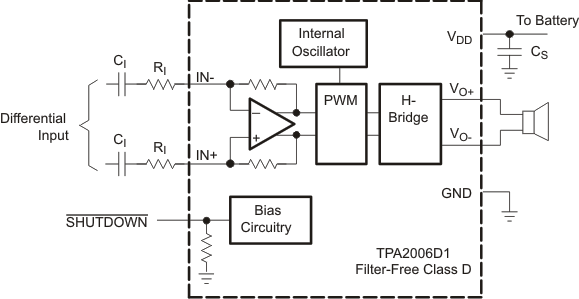 Figure 38. TPA2006D1 Device Application Schematic With Differential Input and Input Capacitors
 Figure 39. TPA2006D1 Device Application Schematic With Single-Ended Input