SBAS451B October 2008 – August 2015 PCM1789
PRODUCTION DATA.
- 1 Features
- 2 Applications
- 3 Description
- 4 Revision History
- 5 Pin Configuration and Functions
-
6 Specifications
- 6.1 Absolute Maximum Ratings
- 6.2 ESD Ratings
- 6.3 Recommended Operating Conditions
- 6.4 Thermal Information
- 6.5 Electrical Characteristics: Digital Input/Output
- 6.6 Electrical Characteristics: DAC
- 6.7 Electrical Characteristics: Power-Supply Requirements
- 6.8 System Clock Timing Requirements
- 6.9 Audio Interface Timing Requirements
- 6.10 Three-Wire Timing Requirements
- 6.11 SCL and SDA Timing Requirements
- 6.12 Typical Characteristics
-
7 Detailed Description
- 7.1 Overview
- 7.2 Functional Block Diagram
- 7.3
Feature Description
- 7.3.1 Analog Outputs
- 7.3.2 Voltage Reference VCOM
- 7.3.3 System Clock Input
- 7.3.4 Reset Operation
- 7.3.5 ZERO Flag
- 7.3.6 AMUTE Control
- 7.3.7 Three-Wire (SPI) Serial Control
- 7.3.8 Control Data Word Format
- 7.3.9 Register Write Operation
- 7.3.10 Timing Requirements
- 7.3.11 Two-wire (I2C) Serial Control
- 7.3.12 Packet Protocol
- 7.3.13 Write Operation
- 7.3.14 Read Operation
- 7.4 Device Functional Modes
- 7.5 Register Maps
- 8 Application and Implementation
- 9 Power Supply Recommendations
- 10Layout
- 11Device and Documentation Support
- 12Mechanical, Packaging, and Orderable Information
6 Specifications
6.1 Absolute Maximum Ratings
over operating free-air temperature range (unless otherwise noted)(1)| MIN | MAX | UNIT | ||
|---|---|---|---|---|
| Supply voltage | VCC1, VCC2 | –0.3 | 6.5 | V |
| VDD | –0.3 | 4.0 | ||
| Ground voltage differences | AGND1, AGND2, DGND | ±0.1 | V | |
| Supply voltage differences | VCC1, VCC2 | 0.1 | V | |
| Digital input voltage | RST, ADR5, MS, MC, MD, SCKI, AMUTEI | –0.3 | 6.5 | V |
| BCK, LRCK, DIN, MODE, ZERO1, ZERO2 | –0.3 | (VDD + 0.3) < +4.0 | ||
| Analog input voltage | VCOM, VOUTL±, VOUTR± | –0.3 | (VCC + 0.3) < +6.5 | V |
| Input current (all pins except supplies) | ±10 | mA | ||
| Ambient temperature under bias | –40 | 125 | °C | |
| Junction temperature | 150 | °C | ||
| Package temperature (IR reflow, peak) | 260 | °C | ||
| Storage temperature, Tstg | –55 | 150 | °C | |
(1) Stresses beyond those listed under Absolute Maximum Ratings may cause permanent damage to the device. These are stress ratings only, which do not imply functional operation of the device at these or any other conditions beyond those indicated under Recommended Operating Conditions. Exposure to absolute-maximum-rated conditions for extended periods may affect device reliability.
6.2 ESD Ratings
| VALUE | UNIT | |||
|---|---|---|---|---|
| V(ESD) | Electrostatic discharge | Human-body model (HBM), per ANSI/ESDA/JEDEC JS-001(1) | ±1000 | V |
| Charged-device model (CDM), per JEDEC specification JESD22-C101(2) | ±250 | |||
(1) JEDEC document JEP155 states that 500-V HBM allows safe manufacturing with a standard ESD control process.
(2) JEDEC document JEP157 states that 250-V CDM allows safe manufacturing with a standard ESD control process.
6.3 Recommended Operating Conditions
over operating free-air temperature range (unless otherwise noted)| MIN | NOM | MAX | UNIT | ||
|---|---|---|---|---|---|
| Analog supply voltage, VCC | 4.5 | 5.0 | 5.5 | V | |
| Digital supply voltage, VDD | 3.0 | 3.3 | 3.6 | V | |
| Digital Interface | LVTTL-compatible | ||||
| Digital input clock frequency | Sampling frequency, LRCK | 8 | 192 | kHz | |
| System clock frequency, SCKI | 2.048 | 36.864 | MHz | ||
| Analog output voltage | Differential | 8 | VPP | ||
| Analog output load resistance | To ac-coupled GND | 5 | kΩ | ||
| To dc-coupled GND | 15 | ||||
| Analog output load capacitance | 50 | pF | |||
| Digital output load capacitance | 20 | pF | |||
| Operating free-air temperature | PCM1789 consumer grade | –40 | 25 | 85 | °C |
6.4 Thermal Information
| THERMAL METRIC(1) | PCM1789 | UNIT | |
|---|---|---|---|
| PW (TSSOP) | |||
| 24 PINS | |||
| RθJA | Junction-to-ambient thermal resistance | 87.8 | °C/W |
| RθJC(top) | Junction-to-case (top) thermal resistance | 19.3 | °C/W |
| RθJB | Junction-to-board thermal resistance | 42.6 | °C/W |
| ψJT | Junction-to-top characterization parameter | 0.5 | °C/W |
| ψJB | Junction-to-board characterization parameter | 42.1 | °C/W |
| RθJC(bot) | Junction-to-case (bottom) thermal resistance | n/a | °C/W |
(1) For more information about traditional and new thermal metrics, see the Semiconductor and IC Package Thermal Metrics application report, SPRA953.
6.5 Electrical Characteristics: Digital Input/Output
All specifications at TA = +25°C, VCC1 = VCC2 = 5 V, VDD = 3.3 V, fS = 48 kHz, SCKI = 512 fS, 24-bit data, and Sampling mode = Auto, unless otherwise noted.| PARAMETER | TEST CONDITIONS | MIN | TYP | MAX | UNIT | |
|---|---|---|---|---|---|---|
| DATA FORMAT | ||||||
| fS | Sampling frequency | 8 | 48 | 192 | kHz | |
| System clock frequency | 128 fS, 192 fS, 256 fS, 384 fS, 512 fS, 768 fS, 1152 fS |
2.048 | 36.864 | MHz | ||
| INPUT LOGIC | ||||||
| LOGIC FAMILY | ||||||
| VIH | Input logic level, high (BCK, LRCK, and DIN) | 2.0 | VDD | VDC | ||
| VIL | Input logic level, low (BCK, LRCK, and DIN) | 0.8 | VDC | |||
| VIH | Input logic current, high (SCKI, ADR5/ADR1/RSV, MC/SCL/FMT, MD/SDA?DEMP, and AMUTEI) | 2.0 | 5.5 | VDC | ||
| VIL | Input logic current, low (SCKI, ADR5/ADR1/RSV, MC/SCL/FMT, MD/SDA/DEMP, and AMUTEI) | 0.8 | VDC | |||
| IIH | Input logic current, high (DIN, SCKI, ADR5/ADR1/RSV, MC/SCL/FMT, MD/SDA/DEMP, and AMUTEI) | VIN = VDD | ±10 | μA | ||
| IIL | Input logic current, low (DIN, SCKI, ADR5/ADR1/RSV, MC/SCL/FMT, MD/SDA/DEMP, and AMUTEI) | VIN = 0 V | ±10 | μA | ||
| IIH | Input logic current, high (BCK, LRCK, RST, MS/ADR0/RSV) | VIN = VDD | +65 | +100 | μA | |
| Input logic current, low (BCK, LRCK, RST, MS/ADR0/RSV) | VIN = 0 V | ±10 | μA | |||
| OUTPUT LOGIC | ||||||
| VOH | Output logic level, high (ZERO1 and ZERO2) | IOUT = –4 mA | 2.4 | VDC | ||
| VOL | Output logic level, high (ZERO1 and ZERO2) | IOUT = +4 mA | 0.4 | VDC | ||
| REFERENCE OUTPUT | ||||||
| VCOM output voltage | 0.5 × VCC1 | V | ||||
| VCOM output impedance | 7.5 | kΩ | ||||
| Allowable VCOM output source/sink current | 1 | μA | ||||
6.6 Electrical Characteristics: DAC
All specifications at TA = +25°C, VCC1 = VCC2 = 5 V, VDD = 3.3 V, fS = 48 kHz, SCKI = 512 fS, 24-bit data, and Sampling mode = Auto, unless otherwise noted.| PARAMETER | TEST CONDITIONS | MIN | TYP | MAX | UNIT | ||
|---|---|---|---|---|---|---|---|
| RESOLUTION | 16 | 24 | Bits | ||||
| DC ACCURACY | |||||||
| Gain mismatch channel-to-channel | x | ±2.0 | ±6.0 | % of FSR | |||
| Gain error | ±2.0 | ±6.0 | % of FSR | ||||
| Bipolar zero error | ±1.0 | % of FSR | |||||
| DYNAMIC PERFORMANCE(1)(2) | |||||||
| THD+N | Total harmonic distortion + noise | VOUT = 0 dB | fS = 48 kHz | –94 | –88 | dB | |
| fS = 96 kHz | –94 | dB | |||||
| fS = 192 kHz | –94 | dB | |||||
| Dynamic range | fS = 48 kHz, EIAJ, A-weighted | 106 | 113 | dB | |||
| fS = 96 kHz, EIAJ, A-weighted | 113 | dB | |||||
| fS = 192 kHz, EIAJ, A-weighted | 113 | dB | |||||
| SNR | Signal-to-noise ratio | fS = 48 kHz, EIAJ, A-weighted | 106 | 113 | dB | ||
| fS = 96 kHz, EIAJ, A-weighted | 113 | dB | |||||
| fS = 192 kHz, EIAJ, A-weighted | 113 | dB | |||||
| Channel separation | fS = 48 kHz | 103 | 109 | dB | |||
| fS = 96 kHz | 109 | dB | |||||
| fS = 192 kHz | 108 | dB | |||||
| ANALOG OUTPUT | |||||||
| Output voltage | Differential | 1.6 × VCC1 | VPP | ||||
| Center voltage | 0.5 × VCC1 | V | |||||
| Load impedance | To ac-coupled GND(3) | 5 | kΩ | ||||
| To dc-coupled GND(3) | 15 | kΩ | |||||
| LPF frequency response | f = 20 kHz | –0.04 | dB | ||||
| f = 44 kHz | –0.18 | dB | |||||
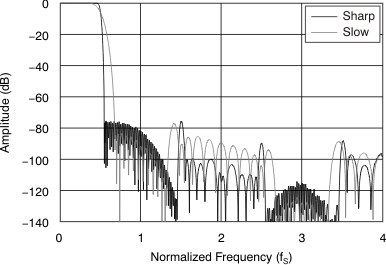
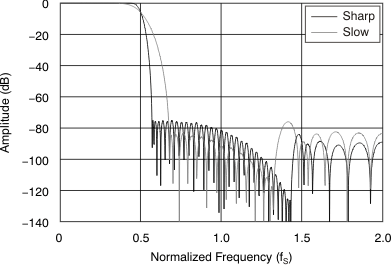
| DIGITAL FILTER PERFORMANCE WITH SHARP ROLL-OFF | |||||||
| Passband (single, dual) | Except SCKI = 128 fS and 192 fS | 0.454 × fS | Hz | ||||
| SCKI = 128 fS and 192 fS | 0.432 × fS | Hz | |||||
| Passband (quad) | 0.432 × fS | Hz | |||||
| Stop band (single, dual) | Except SCKI = 128 fS and 192 fS | 0.546 × fS | Hz | ||||
| SCKI = 128 fS and 192 fS | 0.569 × fS | Hz | |||||
| Stop band (quad) | 0.569 × fS | Hz | |||||
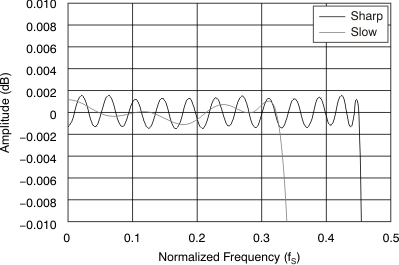
| Passband ripple | < 0.454 × fS, 0.432 × fS | ±0.0018 | dB | ||||
| Stop band attenuation | > 0.546 × fS, 0.569 × fS | –75 | dB | ||||
| DIGITAL FILTER PERFORMANCE WITH SLOW ROLL-OFF | |||||||
| Passband | 0.328 × fS | Hz | |||||
| Stop band | 0.673 × fS | Hz | |||||
| Passband ripple | < 0.328 × fS | ±0.0013 | dB | ||||
| Stop band attenuation | > 0.673 × fS | –75 | dB | ||||
| DIGITAL FILTER PERFORMANCE | |||||||
| Group delay time (single, dual) | Except SCKI = 128 fS and 192 fS | 28/fS | sec | ||||
| SCKI = 128 fS and 192 fS | 19/fS | sec | |||||
| Group delay time (quad) | 19/fS | sec | |||||
| De-emphasis error | ±0.1 | dB | |||||
(1) In differential mode at VOUTx± pin, fOUT = 1 kHz, using Audio Precision System II, Average mode with 20-kHz LPF and 400-Hz HPF.
(2) fS = 48 kHz: SCKI = 512 fS (single), fS = 96 kHz : SCKI = 256 fS (dual), fS = 192 kHz : SCKI = 128 fS (quad).
6.7 Electrical Characteristics: Power-Supply Requirements
All specifications at TA = +25°C, VCC1 = VCC2 = 5 V, VDD = 3.3 V, fS = 48 kHz, SCKI = 512 fS, 24-bit data, and Sampling mode = Auto, unless otherwise noted.| PARAMETER | TEST CONDITIONS | MIN | TYP | MAX | UNIT | |
|---|---|---|---|---|---|---|
| POWER-SUPPLY REQUIREMENTS | ||||||
| VCC1/2 | Voltage range | 4.5 | 5.0 | 5.5 | VDC | |
| VDD | 3.0 | 3.3 | 3.6 | VDC | ||
| ICC | Supply current | fS = 48 kHz | 19 | 28 | mA | |
| fS = 192 kHz | 19 | mA | ||||
| Full power-down(1) | 170 | μA | ||||
| IDD | fS = 48 kHz | 18 | 30 | mA | ||
| fS = 192 kHz | 22 | mA | ||||
| Full power-down(1) | 60 | μA | ||||
| Power dissipation | fS = 48 kHz | 154 | 239 | mW | ||
| fS = 192 kHz | 168 | mW | ||||
| Full power-down(1) | 1.05 | mW | ||||
| TEMPERATURE RANGE | ||||||
| Operating temperature | PCM1789 consumer grade | –40 | +85 | °C | ||
| θJA | Thermal resistance | TSSOP-24 | 115 | °C/W | ||
(1) SCKI, BCK, and LRCK stopped.
6.8 System Clock Timing Requirements
(see Figure 19)| MIN | NOM | MAX | UNIT | ||
|---|---|---|---|---|---|
| tSCY | System clock cycle tiime | 27 | ns | ||
| tSCH | Syst4em clock width high | 10 | ns | ||
| tSCL | System clock width low | 10 | ns | ||
| — | System clock duty cycle | 40% | 60% | ||
6.9 Audio Interface Timing Requirements
(see Figure 35)| MIN | NOM | MAX | UNIT | ||
|---|---|---|---|---|---|
| tBCY | BCK cycle time | 75 | ns | ||
| tBCH | BCK pulse width high | 35 | ns | ||
| tBCL | BCK pulse width low | 35 | ns | ||
| tLRW | LRCK pulse width high (LJ, RJ and I2S formats) | 1/(2 × fS) | 1/(2 × fS) | s | |
| LRCK pulse width high (DSP format) | tBCY | tBCY | s | ||
| tLRS | LRCK setup time to BCK rising edge | 10 | ns | ||
| tLRH | LRCK hold time to BCK rising edge | 10 | ns | ||
| tDIS | DIN setup time to BCK rising edge | 10 | ns | ||
| tDIH | DIN hold time to BCK rising edge | 10 | ns | ||
6.10 Three-Wire Timing Requirements
(See Figure 24)| MIN | NOM | MAX | UNIT | ||
|---|---|---|---|---|---|
| tMCY | MC pulse cycle time | 100 | ns | ||
| tMCL | MC low-level time | 40 | ns | ||
| tMCH | MC high-level time | 40 | ns | ||
| tHCH | MS high-level time | tMCY | ns | ||
| tMSS | MS falling edge to MC rising edge | 30 | ns | ||
| tMHS | MS rising edge from MC rising edge for LSB | 15 | ns | ||
| tMDH | MS hold time | 15 | ns | ||
| tMDS | MD setup time | 15 | ns | ||
6.11 SCL and SDA Timing Requirements
(See Figure 1)| STANDARD MODE | FAST MODE | UNIT | ||||
|---|---|---|---|---|---|---|
| MIN | MAX | MIN | MAX | |||
| fSCL | SCL clock frequency | 100 | 400 | kHz | ||
| tBUF | Bus free time between STOP and START condition | 4.7 | 1.3 | μs | ||
| tLOW | Low period of the SCL clock | 4.7 | 1.3 | μs | ||
| tHI | High period of the SCL clock | 4.0 | 0.6 | μs | ||
| tS-SU | Setup time for START/Repeated START condition | 4.7 | 0.6 | μs | ||
| tS-HD | Hold time for START/Repeated START condition | 4.0 | 0.6 | μs | ||
| tD-SU | Data setup time | 250 | 100 | ns | ||
| tD-HD | Data hold time | 0 | 3450 | 0 | 900 | ns |
| tSCL-R | Rise time of SCL signal | 1000 | 20 + 0.1 CB | 300 | ns | |
| tSCL-F | Fall time of SCL signal | 1000 | 20 + 0.1 CB | 300 | ns | |
| tSDA-R | Rise time of SDA signal | 1000 | 20 + 0.1 CB | 300 | ns | |
| tSDA-F | Fall time of SDA signal | 1000 | 20 + 0.1 CB | 300 | ns | |
| tP-SU | Setup time for STOP condition | 4.0 | 0.6 | μs | ||
| tGW | Allowable glitch width | N/A | 50 | ns | ||
| CB | Capacitive load for SDA and SCL line | 400 | 100 | pF | ||
| VNH | Noise margin at high level for each connected device(including hysteresis) | 0.2 × VDD | 0.2 × VDD | V | ||
| VNL | Noise margin at low level for each connected device (including hysteresis) | 0.1 × VDD | 0.1 × VDD | V | ||
| VHYS | Hysteresis of Schmitt trigger input | N/A | 0.05 × VDD | V | ||
 Figure 1. SCL and SDA Control Interface Timing
6.12 Typical Characteristics
6.12.1 Digital Filter
All specifications at TA = 25°C, VCC1 = VCC2 = 5 V, VDD = 3.3 V, fS = 48 kHz, SCKI = 512 fS, 24-bit data, and Sampling mode = Auto, unless otherwise noted.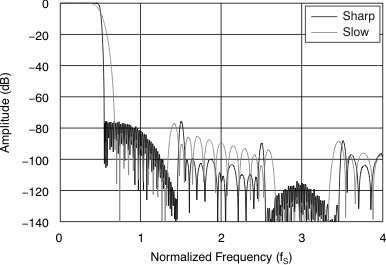
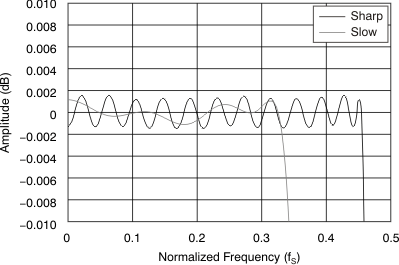

6.12.2 Digital De-Emphasis Filter
All specifications at TA = +25°C, VCC1 = VCC2 = 5 V, VDD = 3.3 V, fS = 48 kHz, SCKI = 512 fS, 24-bit data, and Sampling mode = Auto, unless otherwise noted.
| fS = 48 kHz |

| fS = 32 kHz |
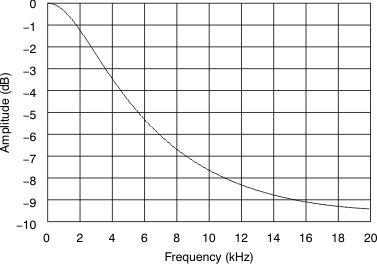
| fS = 44.1 kHz |
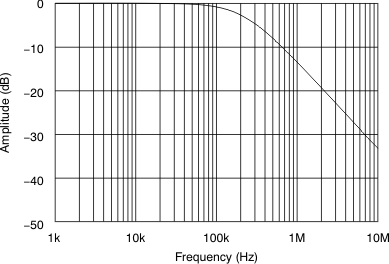
6.12.3 Dynamic Performance
All specifications at TA = +25°C, VCC1 = VCC2 = 5 V, VDD = 3.3 V, fS = 48 kHz, SCKI = 512 fS, 24-bit data, and Sampling mode = Auto, unless otherwise noted.
vs Temperature
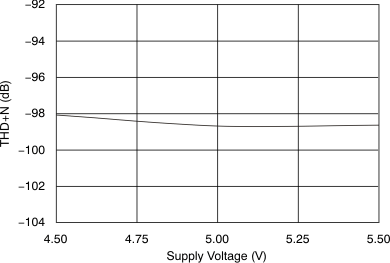
vs Supply Voltage

vs Temperature
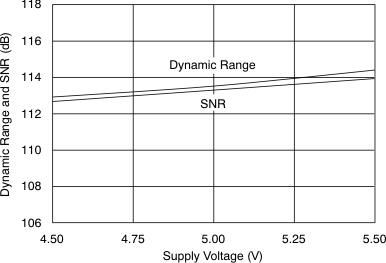
vs Supply Voltage
6.12.4 Output Spectrum
All specifications at TA = +25°C, VCC1 = VCC2 = 5 V, VDD = 3.3 V, fS = 48 kHz, SCKI = 512 fS, 24-bit data, and Sampling mode = Auto, unless otherwise noted.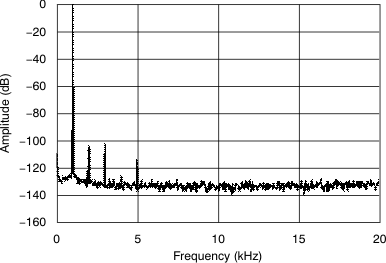
| 0 dB, N = 32768 |
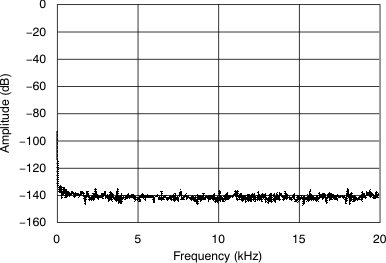
| BPZ, N = 32768 |
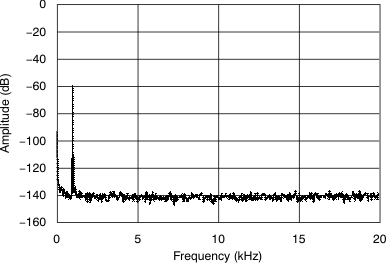
| –60 dB, N = 32768 |