ZHCSEC1A APRIL 2013 – October 2015 DS125RT410
PRODUCTION DATA.
- 1 特性
- 2 应用
- 3 说明
- 4 修订历史记录
- 5 Pin Configuration and Functions
- 6 Specifications
-
7 Detailed Description
- 7.1 Overview
- 7.2 Functional Block Diagram
- 7.3 Feature Description
- 7.4
Device Functional Modes
- 7.4.1 SMBus Master Mode and SMBus Slave Mode
- 7.4.2 Address Lines <ADDR_[3:0]>
- 7.4.3 SDA and SDC
- 7.4.4
Standards-Based Modes
- 7.4.4.1 Ref_mode 3 Mode (Reference Clock Required)
- 7.4.4.2 False Lock Detector Setting
- 7.4.4.3 Reference Clock In
- 7.4.4.4 Reference Clock Out
- 7.4.4.5 Driver Output Voltage
- 7.4.4.6 Driver Output De-Emphasis
- 7.4.4.7 Driver Output Rise and Fall Time
- 7.4.4.8 INT
- 7.4.4.9 LOCK_3, LOCK_2, LOCK_1, and LOCK_0
- 7.5
Programming
- 7.5.1 SMBus Strap Observation
- 7.5.2 Device Revision and Device ID
- 7.5.3 Control/Shared Register Reset
- 7.5.4 Interrupt Channel Flag Bits
- 7.5.5 SMBus Master Mode Control Bits
- 7.5.6 Resetting Individual Channels of the Retimer
- 7.5.7 Interrupt Status
- 7.5.8 Overriding the CTLE Boost Setting
- 7.5.9 Overriding the VCO Search Values
- 7.5.10 Overriding the Output Multiplexer
- 7.5.11 Overriding the VCO Divider Selection
- 7.5.12 Using the PRBS Generator
- 7.5.13 Using the Internal Eye Opening Monitor
- 7.5.14 Enabling Slow Rise and Fall Time on the Output Driver
- 7.5.15 Inverting the Output Polarity
- 7.5.16 Overriding the Figure of Merit for Adaptation
- 7.5.17 Setting the Rate and Subrate for Lock Acquisition
- 7.5.18 Setting the Adaptation/Lock Mode
- 7.5.19 Initiating Adaptation
- 7.5.20 Setting the Reference Enable Mode
- 7.5.21 Overriding the CTLE Settings Used for CTLE Adaptation
- 7.5.22 Setting the Output Differential Voltage
- 7.5.23 Setting the Output De-Emphasis Setting
- 7.6 Register Maps
- 8 Application and Implementation
- 9 Power Supply Recommendations
- 10Layout
- 11器件和文档支持
- 12机械、封装和可订购信息
6 Specifications
6.1 Absolute Maximum Ratings
See (1)(2)(1) Absolute Maximum Ratings indicate limits beyond which damage to the device may occur, including inoperability and degradation of device reliability and/or performance. Functional operation of the device and/or non-degradation at the Absolute Maximum Ratings or other conditions beyond those indicated in the Recommended Operating Conditions is not implied. The Recommended Operating Conditions indicate conditions at which the device is functional and the device should not be operated outside these conditions.
(2) For soldering specifications: see SNOA549.
6.2 ESD Ratings
| VALUE | UNIT | |||
|---|---|---|---|---|
| V(ESD) | Electrostatic discharge | Human body model (HBM), per ANSI/ESDA/JEDEC JS-001, all pins(1) | ±6000 | V |
| Charged device model (CDM), per JEDEC specification JESD22-C101, all pins(2) | ±1250 | |||
| Machine model, STD - JESD22-A115-A | ±250 | |||
(1) JEDEC document JEP155 states that 500-V HBM allows safe manufacturing with a standard ESD control process.
(2) JEDEC document JEP157 states that 250-V CDM allows safe manufacturing with a standard ESD control process.
6.3 Recommended Operating Conditions
| MIN | NOM | MAX | UNIT | ||
|---|---|---|---|---|---|
| Supply voltage | VDD to GND | 2.375 | 2.5 | 2.625 | V |
| Ambient temperature | –40 | 25 | 85 | °C | |
6.4 Thermal Information
| THERMAL METRIC(1) | DS125RT410 | UNIT | |
|---|---|---|---|
| RHS (WQFN) | |||
| 48 PINS | |||
| RθJA | Junction-to-ambient thermal resistance | 29.2 | °C/W |
| RθJC(top) | Junction-to-case (top) thermal resistance | 10.2 | °C/W |
| RθJB | Junction-to-board thermal resistance | 6.1 | °C/W |
| ψJT | Junction-to-top characterization parameter | 0.1 | °C/W |
| ψJB | Junction-to-board characterization parameter | 6.1 | °C/W |
| RθJC(bot) | Junction-to-case (bottom) thermal resistance | 2.0 | °C/W |
(1) For more information about traditional and new thermal metrics, see the IC Package Thermal Metrics application report, SPRA953.
6.5 Electrical Characteristics
over recommended operating supply and temperature ranges with default register settings unless otherwise specified(1)| PARAMETER | TEST CONDITIONS | MIN | TYP | MAX | UNIT | |
|---|---|---|---|---|---|---|
| POWER | ||||||
| PD | Power supply consumption | Average power consumption(2) | 660 | mW | ||
| Max transient power supply current(3) | 500 | 610 | mA | |||
| NTPS | Supply noise tolerance(4) | 50 Hz to 100 Hz | 100 | mVP-P | ||
| 100 Hz to 10 MHz | 40 | mVP-P | ||||
| 10 MHz to 5.0 GHz | 10 | mVP-P | ||||
| 2.5-V LVCMOS DC SPECIFICATIONS | ||||||
| VIH | High level input voltage | 1.75 | VDD | V | ||
| High level (ADDR[3:0] pins) | 2.28 | VDD | V | |||
| VIL | Low level input voltage | GND | 0.7 | V | ||
| Low level input voltage (ADDR[3:0] pins) | GND | 0.335 | V | |||
| VOH | High level output voltage | IOH = –3 mA | 2.0 | V | ||
| VOL | Low level output voltage | IOL = 3 mA | 0.4 | V | ||
| IIN | Input leakage current | VIN = VDD | 10 | μA | ||
| VIN = GND | –10 | μA | ||||
| IIH | Input high current (EN_SMB pin) | VIN = VDD | 55 | μA | ||
| IIL | Input low current (EN_SMB pin) | VIN = GND | –110 | μA | ||
| 3.3-V LVCMOS DC SPECIFICATIONS (SDA, SDC, INT) | ||||||
| VIH | High level input voltage | VDD = 2.5 V | 1.75 | 3.6 | V | |
| VIL | Low level input voltage | VDD = 2.5 V | GND | 0.7 | V | |
| VOL | Low level output voltage | IPULLUP = 3 mA | 0.4 | V | ||
| IIH | Input high current | VIN = 3.6 V, VDD = 2.5 V | 20 | 40 | μA | |
| IIL | Input low current | VIN = GND, VDD = 2.5 V | –10 | 10 | μA | |
| fSDC | SMBus clock rate | Slave Mode | 100 | 400 | kHz | |
| Master Mode(5) | 400 | kHz | ||||
| DATA BIT RATES | ||||||
| RB | Bit rate range | 9.8 | 12.5 | Gbps | ||
| SIGNAL DETECT | ||||||
| SDH | Signal detect ON threshold level | Default input signal level to assert signal detect, 10.3125 Gbps, PRBS-31 |
70 | mVp-p | ||
| SDL | Signal detect OFF threshold level | Default input signal level to de-assert signal detect, 10.3125 Gbps, PRBS-31 | 10 | mVp-p | ||
| RECEIVER INPUTS (RXPn, RXNn) | ||||||
| VTX2, min | Minimum source transmit launch signal level (IN, diff) | See (6) | 600 | mVP-P | ||
| VTX2, max | 1000 | mVP-P | ||||
| VTX1, max | See (7) | 1200 | mVP-P | |||
| VTX0, max | See (8) | 1600 | mVP-P | |||
| LRI | Maximum differential input return loss - |SDD11| | 100 MHz to 6 GHz | –15 | dB | ||
| ZD | Differential input impedance | 100 MHz to 6 GHz | 100 | Ω | ||
| ZS | Single-ended input impedance | 100 MHz to 6 GHz | 50 | Ω | ||
| DRIVER OUTPUTS (TXPn, TXNn) | ||||||
| VOD0 | Differential output voltage | Differential measurement with OUT+ and OUT– terminated by 50 Ω to GND, AC-Coupled, SMBus register VOD control (Register 0x2d bits 2:0) set to 0, minimum VOD De-emphasis control set to minimum (0 dB) |
400 | 675 | mVP-P | |
| VOD7 | Differential output voltage | Differential measurement with OUT+ and OUT- terminated by 50 Ω to GND, AC-Coupled SMBus register VOD control (Register 0x2d bits 2:0) set to 7, maximum VOD De-emphasis control set to minimum (0 dB) |
1000 | mVP-P | ||
| VOD_DE | De-emphasis level(10) | Differential measurement with OUT+ and OUT- terminated by 50 Ω to GND, AC-Coupled Set by SMBus register control to maximum de-emphasis setting Relative to the nominal 0 dB de-emphasis level set at the minimum de-emphasis setting |
–15 | dB | ||
| tR, tF | Transition time (rise and fall times)(10) (11) | Transition time control = Full slew rate | 39 | ps | ||
| Transition time control = Limited slew rate | 50 | ps | ||||
| LRO | Maximum differential output return loss - |SDD22| | 100 MHz to 6 GHz(9) | –15 | dB | ||
| tDP | Propagation delay | Retimed data | 300 | ps | ||
| TDE | De-emphasis pulse duration(12) | Measured at VOD = 1000 mVP-P, de-emphasis setting = –12 dB |
75 | ps | ||
| TJ | Output total jitter | Measured at BER = 10–12(13) | 10 | ps | ||
| TSKEW | Intra pair skew | Difference in 50% crossing between TXPn and TXNn for any output | 3 | ps | ||
| Channel-to-channel skew | 7 | ps | ||||
| CLOCK AND DATA RECOVERY | ||||||
| BWPLL | PLL bandwidth, –3 dB | Measured at 10.3125 Gbps | 5 | MHz | ||
| JTOL | Input sinusoidal jitter tolerance 10-kHz to 250-MHz sinusoidal jitter frequency |
Measured at BER = 10-15 | 0.6 | UI | ||
| JTRANS | Jitter transfer sinusoidal jitter at 10 MHz jitter frequency | Measured at BER = 10-15 | –6 | dB | ||
| TLOCK | CDR lock time, Ref_mode 3, Fixed data rate (for example, 10.3125 Gbps) |
Fixed (manual setting) of CTLE, HEO/VEO lock monitor disabled (register 0x3e, bit 7 set to 0) | 2 | ms | ||
| Fixed (manual setting) of CTLE, HEO/VEO lock monitor enabled (register 0x3e, bit 7 set to 1 - default) | 12 | ms | ||||
| Medium (20 inch) channel loss with CTLE adaption, HEO/VEO lock monitor must be enabled (14) | 74 | ms | ||||
| RECOMMENDED REFERENCE CLOCK SPECIFICATIONS | ||||||
| REFf | Input reference clock frequency | 24.9975 | 25 | 25.0025 | MHz | |
| REFCLK _INPW |
Minimum REFCLK_IN pulse width | At REFCLK_IN pin | 4 | ns | ||
| REFCLK _OUTDCD |
REFCLK_OUT duty cycle distortion | CL = 5 pF | 0.55 | ns | ||
| REFVIH | Reference clock input min high threshold | 1.75 | V | |||
| REFVIL | Reference clock input max low threshold | 0.7 | V | |||
(1) Typical values represent most likely parametric norms at VDD = 2.5 V, TA = 25°C, and at the Recommended Operation Conditions at the time of product characterization.
(2) VDD = 2.5 V, TA = 25°C. All four channels active and locked.
(3) Max momentary power supply current lasting less than 1s. The retimer may consume more power than the maximum average power rating during the time required to acquire CDR lock.
(4) Allowed supply noise (mVP-P sine wave) under typical conditions.
(5) EEPROM device used for Master mode programming must support fSDC greater than 400 kHz.
(6) Differential signal amplitude at the transmitter output providing < 1 x 10–12 bit error rate. Measured at 10.3125 Gbps with a PRBS-31 data pattern. Input transmission channel is 40-inch long FR-4 stripline, 4-mil trace width.
(7) Differential signal amplitude at the transmitter output providing < 1 x 10–12 bit error rate. Measured at 10.3125 Gbps with a PRBS-31 data pattern. Input transmission channel is 30-inch long FR-4 stripline, 4-mil trace width.
(8) Differential signal amplitude at the transmitter output providing < 1 x 10–12 bit error rate. Measured at 10.3125 Gbps with a PRBS-31 data pattern. No input transmission channel.
(9) Measured with 10-MHz clock pattern output.
(10) Measured with clock-like {11111 00000} pattern.
(11) Slew rate is controlled by SMBus register settings.
(12) De-emphasis pulse width varies with VOD and de-emphasis settings.
(13) Typical with no output de-emphasis, minimum output transmission channel.
(14) The CDR lock time is when the input has a valid signal to when the output sends retimed data. The CDR lock time is after the CTLE adaption is completed.
6.6 Typical Characteristics
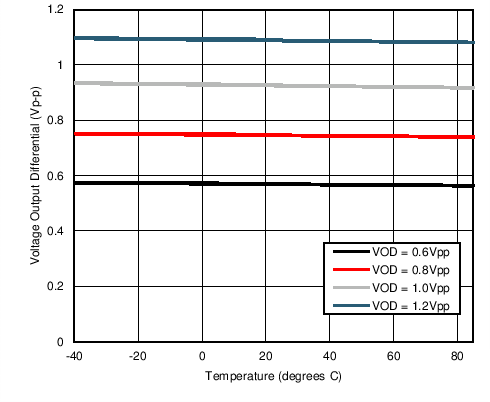 Figure 1. Typical VOD vs VDD
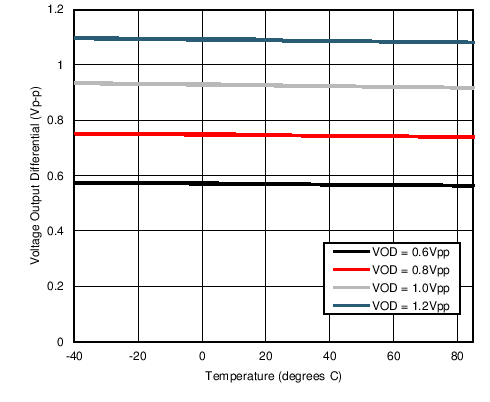 Figure 2. Typical VOD vs Temperature