SN75LVDS32
- Meets or Exceeds the Requirements of ANSI TIA/EIA-644 Standard
- Operates With a Single 3.3-V Supply
- Designed for Signaling Rate of up to 155 Mbps
- Differential Input Thresholds ±100 mV Max
- Low-Voltage TTL (LVTTL) Logic Output Levels
- Open-Circuit Fail Safe
- Characterized For Operation From 0&dg;C to 70°C
The SN75LVDS32 and SN75LVDS9637 are differential line receivers that implement the electrical characteristics of low-voltage differential signaling (LVDS). This signaling technique lowers the output voltage levels of 5-V differential standard levels (such as EIA/TIA-422B) to reduce the power, increase the switching speeds, and allow operation with a 3.3-V supply rail. Any of the four differential receivers provides a valid logical output state with a ±100 mV allow operation with a differential input voltage within the input common-mode voltage range. The input common-mode voltage range allows 1 V of ground potential difference between two LVDS nodes.
The intended application of these devices and signaling technique is both point-to-point and multidrop (one
driver and multiple receivers) data transmission over controlled impedance media of approximately 100  . The
transmission media may be printed-circuit board traces, backplanes, or cables. The ultimate rate and distance
of data transfer is dependent upon the attenuation characteristics of the media and the noise coupling to the
environment.
. The
transmission media may be printed-circuit board traces, backplanes, or cables. The ultimate rate and distance
of data transfer is dependent upon the attenuation characteristics of the media and the noise coupling to the
environment.
The SN75LVDS32 and SN75LVDS9637 are characterized for operation from 0°C to 70°C.
您可能會感興趣的類似產品
功能相似於所比較的產品。
技術文件
| 重要文件 | 類型 | 標題 | 格式選項 | 下載最新的英文版本 | 日期 | |
|---|---|---|---|---|---|---|
| * | 資料表 | High-Speed Differential Line Receivers datasheet (Rev. B) | 2001/6/22 | |||
| Application brief | LVDS to Improve EMC in Motor Drives | 2018/9/27 | ||||
| Application brief | How Far, How Fast Can You Operate LVDS Drivers and Receivers? | 2018/8/3 | ||||
| Application brief | How to Terminate LVDS Connections with DC and AC Coupling | 2018/5/16 | ||||
| 應用說明 | An Overview of LVDS Technology | 1998/10/5 |
設計與開發
如需其他條款或必要資源,請按一下下方的任何標題以檢視詳細頁面 (如有)。
SN65LVDS31-32BEVM — 適用 LVDS31 和 LVDS32B 的 SN65LVDS31-32B 低電壓差動訊號評估模組
TI offers a series of low-voltage differential signaling (LVDS) evaluation modules (EVMs) designed for analysis of the electrical characteristics of LVDS drivers and receivers. Four unique EVMs are available to evaluate the different classes of LVDS devices offered by TI.
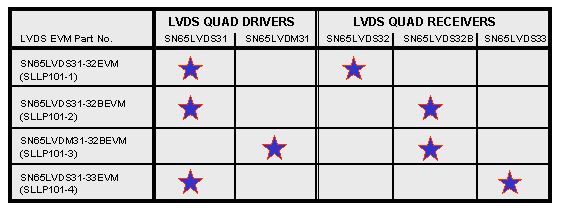
As seen (...)
SN65LVDS31-32EVM — 適用 SNx5LVDS31 和 SNx5LVDS32 的 SN65LVDS31-32EVM 評估模組
The SN65LVDS31-32EVM evaluation moduel (EVM) includes the SV65LVDS31 quad driver and the SN65LVDS32 quad receiver. The SN65LVDS31 device is a TIA/EIA-644 standard-compliant LVDS driver. The SN65LVDS32 device is a TIA/EIA-644 standard-compliant receiver that has a passive open-circuit failsafe (...)
| 封裝 | 針腳 | CAD 符號、佔位空間與 3D 模型 |
|---|---|---|
| SOIC (D) | 16 | Ultra Librarian |