SNVSD24 August 2025 LP5814I
PRODUCTION DATA
- 1
- 1 Features
- 2 Applications
- 3 Description
- 4 Device Comparison
- 5 Pin Configuration and Functions
- 6 Specifications
- 7 Detailed Description
- 8 Application and Implementation
- 9 Device and Documentation Support
- 10Revision History
- 11Mechanical, Packaging, and Orderable Information
7.3.4.3 Animation Control
The LP5814I has individual engine busy flag for each output channel, OUT0_ENGINE_BUSY, OUT1_ENGINE_BUSY, OUT2_ENGINE_BUSY and OUT3_ENGINE_BUSY, to indicate whether the engine selected by the output channel is under running or not. Besides the individule output busy flag there is a global engine busy flag, ENGINE_BUSY, to indicate if there is engine under running or not.
When the ENGINE_BUSY is set as 1, the engine configure registers and pattern configure registers shown in Table 7-4 are locked for modification protection. These engine busy lock registers can only be modified when ENGINE_BUSY = 0.
| Description | Register Address | Register Acronym |
|---|---|---|
| Engine configure registers | 0x06 to 0x0C | ENGINE_CONFIG0 to ENGINE_CONFIG6 |
| Pattern configure registers | 0x1C to 0x3F |
x = 0, 1, 2, 3 |
The LP5814I has 4 internal engine busy flags, ENGINE0_BUSY, ENGINE1_BUSY, ENGINE2_BUSY and ENGINE3_BUSY, as shown in Figure 7-7. The ENGINEy_BUSY is set as 1 after Start_command is received with all the below conditions.
- The engine has been selected by at least one channel, for example OUTx, and there is at least one engine order enabled in this engine
- The autonomous enable bit is set as 1 of the OUTx
The internal ENGINEy_BUSY flag keeps as 1 until the engine has completed or there is Stop_command received.
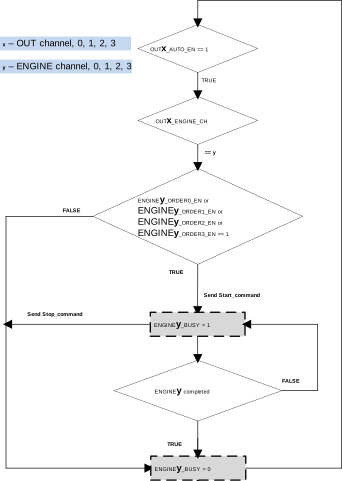
Figure 7-7 Internal Engine Busy Status
Any one of the internal engine busy flag, ENGINEx_BUSY, set to 1 leads to the global engine busy flag, ENGINE_BUSY, being 1, as shown in Figure 7-8.
The individual engine busy flag, OUTx_ENGINE_BUSY, is dependent on the internal engine busy flag selected by the correpsonding engine channel register value.
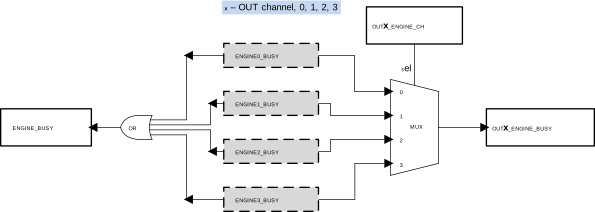
Figure 7-8 Individual and Global Engine Busy Flag