ZHCSEV4A February 2016 – March 2016 DAC8551-Q1
PRODUCTION DATA.
6 Specifications
6.1 Absolute Maximum Ratings
over operating ambient temperature range (unless otherwise noted)(1)| MIN | MAX | UNIT | ||
|---|---|---|---|---|
| VDD to GND | –0.3 | 6 | V | |
| Digital input voltage to GND | DIN, SCLK and SYNC | –0.3 | VDD + 0.3 | V |
| VOUT to GND | –0.3 | VDD + 0.3 | V | |
| VREF to GND | –0.3 | VDD + 0.3 | V | |
| VFB to GND | –0.3 | VDD + 0.3 | V | |
| Junction temperature range, TJ max | –65 | 150 | °C | |
| Storage temperature, Tstg | –65 | 150 | °C | |
(1) Stresses beyond those listed under Absolute Maximum Ratings may cause permanent damage to the device. These are stress ratings only, which do not imply functional operation of the device at these or any other conditions beyond those indicated under Recommended Operating Conditions. Exposure to absolute-maximum-rated conditions for extended periods may affect device reliability.
6.2 ESD Ratings
| VALUE | UNIT | ||||
|---|---|---|---|---|---|
| V(ESD) | Electrostatic discharge | Human-body model (HBM), per AEC Q100-002(1) | ±2000 | V | |
| Charged-device model (CDM), per AEC Q100-011 | All pins | ±500 | |||
| Corner pins (1, 4, 5, and 8) | ±750 | ||||
(1) AEC Q100-002 indicates that HBM stressing shall be in accordance with the ANSI/ESDA/JEDEC JS-001 specification.
6.3 Recommended Operating Conditions
over operating ambient temperature range (unless otherwise noted)| MIN | NOM | MAX | UNIT | |||
|---|---|---|---|---|---|---|
| POWER SUPPLY | ||||||
| Supply voltage | VDD to GND | 3.2 | 5.5 | V | ||
| DIGITAL INPUTS | ||||||
| Digital input voltage | DIN, SCLK and SYNC | 0 | VDD | V | ||
| REFERENCE INPUT | ||||||
| VREF | Reference input voltage | 0 | VDD | V | ||
| AMPLIFIER FEEDBACK INPUT | ||||||
| VFB | Output amplifier feedback input | VOUT | V | |||
| TEMPERATURE RANGE | ||||||
| TA | Operating ambient temperature | –40 | 125 | °C | ||
6.4 Thermal Information
| THERMAL METRIC(1) | DAC8551-Q1 | UNIT | |
|---|---|---|---|
| DGK (VSSOP) | |||
| 8 PINS | |||
| RθJA | Junction-to-ambient thermal resistance | 173.7 | °C/W |
| RθJC(top) | Junction-to-case (top) thermal resistance | 94.2 | °C/W |
| RθJB | Junction-to-board thermal resistance | 65.4 | °C/W |
| ψJT | Junction-to-top characterization parameter | 10.2 | °C/W |
| ψJB | Junction-to-board characterization parameter | 92.7 | °C/W |
(1) For more information about traditional and new thermal metrics, see the Semiconductor and IC Package Thermal Metrics application report, SPRA953.
6.5 Electrical Characteristics
VDD = 3.2 V to 5.5 V, VREF = VDD and TA = –40°C to 125°C, unless otherwise noted.| PARAMETER | TEST CONDITIONS | MIN | TYP | MAX | UNIT | ||
|---|---|---|---|---|---|---|---|
| STATIC PERFORMANCE(1) | |||||||
| Resolution | 16 | Bits | |||||
| Relative accuracy | ±4 | ±16 | LSB | ||||
| Differential nonlinearity | ±0.35 | ±2 | LSB | ||||
| Offset error | ±1 | ±15 | mV | ||||
| Full-scale error | ±0.05 | ±0.5 | % of FSR | ||||
| Gain error | ±0.02 | ±0.2 | % of FSR | ||||
| Offset error drift | ±5 | μV/°C | |||||
| Gain temperature coefficient | ±1 | ppm of FSR/°C | |||||
| PSRR | Power-supply rejection ratio | RL = 2 kΩ, CL = 200 pF | 0.75 | mV/V | |||
| OUTPUT CHARACTERISTICS(2) | |||||||
| Output voltage range | 0 | VREF | V | ||||
| Output voltage settling time | To ±0.003% FSR, 0200h to FD00h RL = 2 kΩ, 0 pF < CL < 200 pF |
8 | μs | ||||
| Slew rate | 1.4 | V/μs | |||||
| Capacitive load stability | RL = ∞ | 470 | pF | ||||
| RL = 2 kΩ | 1000 | pF | |||||
| Code change glitch impulse | 1 LSB change around major carry | 0.1 | nV-s | ||||
| Digital feedthrough | 50 kΩ series resistance on digital lines | 0.1 | nV-s | ||||
| DC output impedance | At mid-code input | 1 | Ω | ||||
| Short-circuit current | VDD = 3.2 V to 5.5 V | 35 | mA | ||||
| AC PERFORMANCE | |||||||
| SNR | Signal-to-noise ratio | BW = 20 kHz, VDD = 5 V, VREF = 4.5 V, fOUT = 1 kHz First 19 harmonics removed for SNR calculation |
84 | dB | |||
| THD | Total harmonic distortion | –80 | dB | ||||
| SFDR | Spurious-free dynamic range | 84 | dB | ||||
| SINAD | Signal to noise and distortion | 76 | dB | ||||
| REFERENCE INPUT | |||||||
| Reference current | VREF = VDD = 5.5 V | 50 | μA | ||||
| VREF = VDD = 3.6 V | 25 | ||||||
| Reference input range | 0 | VDD | V | ||||
| Reference input impedance | 125 | kΩ | |||||
| LOGIC INPUTS(2) | |||||||
| Input current | ±1 | μA | |||||
| VINL | Input low voltage | VDD = 5 V | 0.3×VDD | V | |||
| VDD = 3.3 V | 0.1×VDD | ||||||
| VINH | Input high voltage | VDD = 5 V | 0.7×VDD | V | |||
| VDD = 3.3 V | 0.9×VDD | ||||||
| Pin capacitance | 3 | pF | |||||
| POWER REQUIREMENTS | |||||||
| VDD | Supply voltage | 3.2 | 5.5 | V | |||
| IDD | Supply current | Normal mode, input code = 32,768, no load, does not include reference current. VIH = VDD and VIL = GND, VDD = 3.6 V to 5.5 V |
160 | 250 | μA | ||
| Normal mode, input code = 32,768, no load, does not include reference current. VIH = VDD and VIL = GND, VDD = 3.2 V to 3.6 V |
110 | 240 | |||||
| All power-down modes, VIH = VDD and VIL = GND, VDD = 3.6 V to 5.5 V |
0.8 | 3 | |||||
| All power-down modes, VIH = VDD and VIL = GND, VDD = 3.2 V to 3.6 V |
0.5 | 3 | |||||
| POWER EFFICIENCY | |||||||
| IOUT / IDD | ILOAD = 2 mA, VDD = 5 V | 89% | |||||
| TEMPERATURE RANGE | |||||||
| TA | Ambient temperature | –40 | 125 | °C | |||
(1) Linearity calculated using a reduced code range of 485 to 64,741; output unloaded.
(2) Specified by design and characterization; not production tested.
6.6 Timing Requirements(1)(2)
VDD = 3.2 V to 5.5 V and TA = –40°C to 125°C, unless otherwise noted.| PARAMETER | TEST CONDITIONS | MIN | NOM | MAX | UNIT | |
|---|---|---|---|---|---|---|
| fSCLK | Serial clock frequency | VDD = 3.2 V to 3.6 V | 25 | MHz | ||
| VDD = 3.6 V to 5.5 V | 30 | |||||
| t1 | SCLK cycle time | VDD = 3.2 V to 3.6 V | 40 | ns | ||
| VDD = 3.6 V to 5.5 V | 34 | |||||
| t2 | SCLK high time | VDD = 3.2 V to 3.6 V | 13 | ns | ||
| VDD = 3.6 V to 5.5 V | 13 | |||||
| t3 | SCLK low time | VDD = 3.2 V to 3.6 V | 22.5 | ns | ||
| VDD = 3.6 V to 5.5 V | 13 | |||||
| t4 | SYNC to SCLK rising edge setup time | VDD = 3.2 V to 3.6 V | 0 | ns | ||
| VDD = 3.6 V to 5.5 V | 0 | |||||
| t5 | Data setup time | VDD = 3.2 V to 3.6 V | 5 | ns | ||
| VDD = 3.6 V to 5.5 V | 5 | |||||
| t6 | Data hold time | VDD = 3.2 V to 3.6 V | 5 | ns | ||
| VDD = 3.6 V to 5.5 V | 5 | |||||
| t7 | 24th SCLK falling edge to SYNC rising edge | VDD = 3.2 V to 3.6 V | 0 | ns | ||
| VDD = 3.6 V to 5.5 V | 0 | |||||
| t8 | Minimum SYNC high time | VDD = 3.2 V to 3.6 V | 50 | ns | ||
| VDD = 3.6 V to 5.5 V | 34 | |||||
| t9 | 24th SCLK falling edge to SYNC falling edge | VDD = 3.2 V to 5.5 V | 50 | ns | ||
(1) All input signals are specified with tR = tF = 5 ns (10% to 90% of VDD) and timed from a voltage level of (VIL + VIH) / 2.
(2) See the Serial-Write-Operation Timing Diagram.
6.7 Switching Characteristics
over operating ambient temperature range (unless otherwise noted)| PARAMETER | TEST CONDITIONS | MIN | TYP | MAX | UNIT | |
|---|---|---|---|---|---|---|
| Power-up time | Coming out of power-down mode, VDD = 5 V | 2.5 | µs | |||
| Coming out of power-down mode, VDD = 3.3 V | 5 | |||||
 Figure 1. Serial-Write-Operation Timing Diagram
6.8 Typical Characteristics
At TA = 25°C, VDD = 5 V unless otherwise noted. Figure 2. Linearity Error and Differential Linearity Error vs Digital Input Code (–40°C)
 Figure 4. Linearity Error and Differential Linearity Error vs Digital Input Code (125°C)
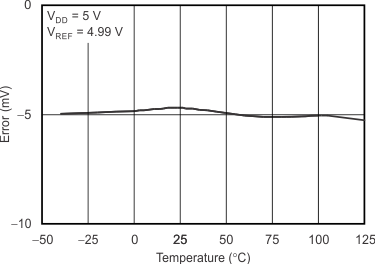 Figure 6. Full-Scale Error vs Temperature
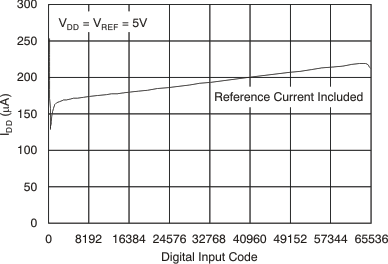 Figure 8. Supply Current vs Digital Input Code
 Figure 10. Supply Current vs Supply Voltage
 Figure 12. Supply Current vs Logic Input Voltage
 Figure 14. Full-Scale Settling Time: 5-V Falling Edge
 Figure 16. Half-Scale Settling Time: 5-V Falling Edge
 Figure 18. Glitch Impulse: 5 V, 1-LSB Step, Falling Edge
 Figure 20. Glitch Impulse: 5 V, 16-LSB Step, Falling Edge
 Figure 22. Glitch Impulse: 5 V, 256-LSB Step, Falling Edge
 Figure 24. Signal-to-Noise Ratio vs Output Frequency
 Figure 26. Output Noise Density
 Figure 3. Linearity Error and Differential Linearity Error vs Digital Input Code (25°C)
 Figure 5. Offset Error vs Temperature
 Figure 7. Source and Sink Current Capability
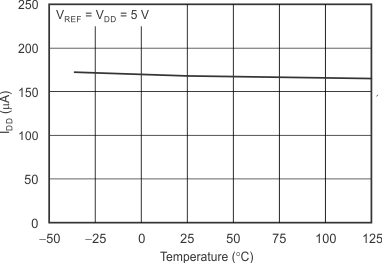 Figure 9. Power-Supply Current vs Temperature
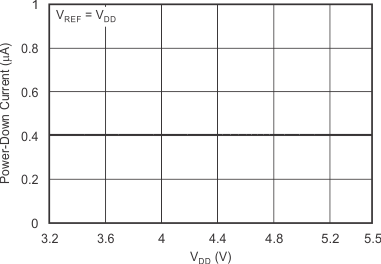 Figure 11. Power-Down Current vs Supply Voltage
 Figure 13. Full-Scale Settling Time: 5-V Rising Edge
 Figure 15. Half-Scale Settling Time: 5-V Rising Edge
 Figure 17. Glitch Impulse: 5 V, 1-LSB Step, Rising Edge
 Figure 19. Glitch Impulse: 5 V, 16-LSB Step, Rising Edge
 Figure 21. Glitch Impulse: 5 V, 256-LSB Step, Rising Edge
 Figure 23. Total Harmonic Distortion vs Output Frequency
 Figure 25. Power Spectral Density