ZHCSEU2C February 2015 – July 2016 CC2620
PRODUCTION DATA.
- 1器件概述
- 2修订历史记录
- 3 Device Comparison
- 4Terminal Configuration and Functions
-
5Specifications
- 5.1 Absolute Maximum Ratings
- 5.2 ESD Ratings
- 5.3 Recommended Operating Conditions
- 5.4 Power Consumption Summary
- 5.5 General Characteristics
- 5.6 IEEE 802.15.4 (Offset Q-PSK DSSS, 250 kbps) - RX
- 5.7 IEEE 802.15.4 (Offset Q-PSK DSSS, 250 kbps) - TX
- 5.8 24-MHz Crystal Oscillator (XOSC_HF)
- 5.9 32.768-kHz Crystal Oscillator (XOSC_LF)
- 5.10 48-MHz RC Oscillator (RCOSC_HF)
- 5.11 32-kHz RC Oscillator (RCOSC_LF)
- 5.12 ADC Characteristics
- 5.13 Temperature Sensor
- 5.14 Battery Monitor
- 5.15 Continuous Time Comparator
- 5.16 Low-Power Clocked Comparator
- 5.17 Programmable Current Source
- 5.18 Synchronous Serial Interface (SSI)
- 5.19 DC Characteristics
- 5.20 Thermal Resistance Characteristics
- 5.21 Timing Requirements
- 5.22 Switching Characteristics
- 5.23 Typical Characteristics
- 6Detailed Description
- 7Application, Implementation, and Layout
- 8器件和文档支持
- 9机械、封装和可订购信息
封装选项
机械数据 (封装 | 引脚)
散热焊盘机械数据 (封装 | 引脚)
订购信息
5 Specifications
5.1 Absolute Maximum Ratings
over operating free-air temperature range (unless otherwise noted)(1)(2)| MIN | MAX | UNIT | ||
|---|---|---|---|---|
| Supply voltage (VDDS, VDDS2, and VDDS3) | VDDR supplied by internal DC-DC regulator or internal GLDO. VDDS_DCDC connected to VDDS on PCB. | –0.3 | 4.1 | V |
| Supply voltage (VDDS(3) and VDDR) | External regulator mode (VDDS and VDDR pins connected on PCB) | –0.3 | 2.25 | V |
| Voltage on any digital pin(4)(5) | –0.3 | VDDSx + 0.3, max 4.1 | V | |
| Voltage on crystal oscillator pins, X32K_Q1, X32K_Q2, X24M_N and X24M_P | –0.3 | VDDR + 0.3, max 2.25 | V | |
| Voltage on ADC input (Vin) | Voltage scaling enabled | –0.3 | VDDS | V |
| Voltage scaling disabled, internal reference | –0.3 | 1.49 | ||
| Voltage scaling disabled, VDDS as reference | –0.3 | VDDS / 2.9 | ||
| Input RF level | 5 | dBm | ||
| Tstg | Storage temperature | –40 | 150 | °C |
(1) All voltage values are with respect to ground, unless otherwise noted.
(2) Stresses beyond those listed under Absolute Maximum Ratings may cause permanent damage to the device. These are stress ratings only, and functional operation of the device at these or any other conditions beyond those indicated under Recommended Operating Conditions is not implied. Exposure to absolute-maximum-rated conditions for extended periods may affect device reliability.
(3) In external regulator mode, VDDS2 and VDDS3 must be at the same potential as VDDS.
(4) Including analog-capable DIO.
(5) Each pin is referenced to a specific VDDSx (VDDS, VDDS2 or VDDS3). For a pin-to-VDDS mapping table, see Table 6-3.
5.2 ESD Ratings
| VALUE | UNIT | ||||
|---|---|---|---|---|---|
| VESD | Electrostatic discharge | Human body model (HBM), per ANSI/ESDA/JEDEC JS001(1) | All pins | ±2500 | V |
| Charged device model (CDM), per JESD22-C101(2) | RF pins | ±750 | |||
| Non-RF pins | ±750 | ||||
(1) JEDEC document JEP155 states that 500-V HBM allows safe manufacturing with a standard ESD control process.
(2) JEDEC document JEP157 states that 250-V CDM allows safe manufacturing with a standard ESD control process.
5.3 Recommended Operating Conditions
over operating free-air temperature range (unless otherwise noted)| MIN | MAX | UNIT | |||
|---|---|---|---|---|---|
| Ambient temperature | –40 | 85 | °C | ||
| Operating supply voltage (VDDS and VDDR), external regulator mode | For operation in 1.8-V systems (VDDS and VDDR pins connected on PCB, internal DC-DC cannot be used) |
1.7 | 1.95 | V | |
| Operating supply voltage VDDS | For operation in battery-powered and 3.3-V systems (internal DC-DC can be used to minimize power consumption) |
1.8 | 3.8 | V | |
| Operating supply voltages VDDS2 and VDDS3 | VDDS < 2.7 V | 1.8 | 3.8 | V | |
| Operating supply voltages VDDS2 and VDDS3 | VDDS ≥ 2.7 V | 1.9 | 3.8 | V | |
5.4 Power Consumption Summary
Measured on the TI CC2650EM-5XD reference design with Tc = 25°C, VDDS = 3.0 V with internal DC-DC converter, unless otherwise noted.| PARAMETER | TEST CONDITIONS | MIN | TYP | MAX | UNIT | |
|---|---|---|---|---|---|---|
| Icore | Core current consumption | Reset. RESET_N pin asserted or VDDS below Power-on-Reset threshold | 100 | nA | ||
| Shutdown. No clocks running, no retention | 150 | |||||
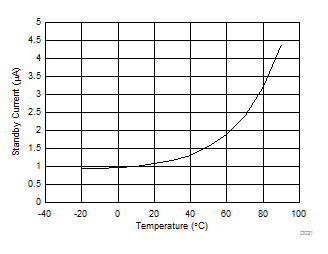
| Standby. With RTC, CPU, RAM and (partial) register retention. RCOSC_LF | 1.1 | µA | ||||
| Standby. With RTC, CPU, RAM and (partial) register retention. XOSC_LF | 1.3 | |||||
| Standby. With Cache, RTC, CPU, RAM and (partial) register retention. RCOSC_LF | 2.8 | |||||
| Standby. With Cache, RTC, CPU, RAM and (partial) register retention. XOSC_LF | 3.0 | |||||
| Idle. Supply Systems and RAM powered. | 550 | |||||
| Active. Core running CoreMark | 1.45 mA + 31 µA/MHz |
|||||
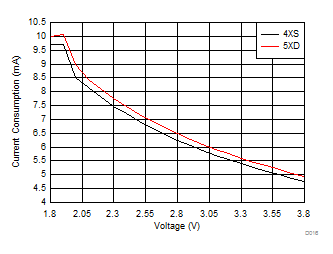
| Radio RX (1) | 5.9 | mA | ||||
| Radio RX(2) | 6.1 | |||||
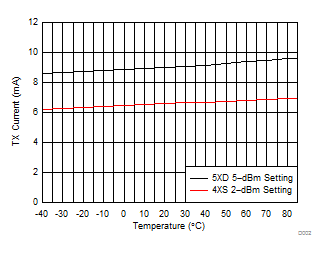
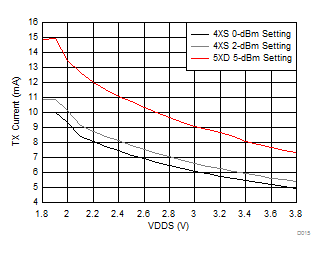
| Radio TX, 0-dBm output power(1) | 6.1 | |||||
| Radio TX, 5-dBm output power(2) | 9.1 | |||||
| Peripheral Current Consumption (Adds to core current Icore for each peripheral unit activated)(3) | ||||||
| Iperi | Peripheral power domain | Delta current with domain enabled | 20 | µA | ||
| Serial power domain | Delta current with domain enabled | 13 | µA | |||
| RF Core | Delta current with power domain enabled, clock enabled, RF core idle | 237 | µA | |||
| µDMA | Delta current with clock enabled, module idle | 130 | µA | |||
| Timers | Delta current with clock enabled, module idle | 113 | µA | |||
| I2C | Delta current with clock enabled, module idle | 12 | µA | |||
| I2S | Delta current with clock enabled, module idle | 36 | µA | |||
| SSI | Delta current with clock enabled, module idle | 93 | µA | |||
| UART | Delta current with clock enabled, module idle | 164 | µA | |||
(1) Single-ended RF mode is optimized for size and power consumption. Measured on CC2650EM-4XS.
(2) Differential RF mode is optimized for RF performance. Measured on CC2650EM-5XD.
(3) Iperi is not supported in Standby or Shutdown.
5.5 General Characteristics
Measured on the TI CC2650EM-5XD reference design with Tc = 25°C, VDDS = 3.0 V, unless otherwise noted.| PARAMETER | TEST CONDITIONS | MIN | TYP | MAX | UNIT |
|---|---|---|---|---|---|
| FLASH MEMORY | |||||
| Supported flash erase cycles before failure | 100 | k Cycles | |||
| Flash page/sector erase current | Average delta current | 12.6 | mA | ||
| Flash page/sector size | 4 | KB | |||
| Flash write current | Average delta current, 4 bytes at a time | 8.15 | mA | ||
| Flash page/sector erase time(1) | 8 | ms | |||
| Flash write time(1) | 4 bytes at a time | 8 | µs | ||
(1) This number is dependent on Flash aging and will increase over time and erase cycles.
5.6 IEEE 802.15.4 (Offset Q-PSK DSSS, 250 kbps) – RX
Measured on the TI CC2650EM-5XD reference design with Tc = 25°C, VDDS = 3.0 V, unless otherwise noted.5.7 IEEE 802.15.4 (Offset Q-PSK DSSS, 250 kbps) – TX
Measured on the TI CC2650EM-5XD reference design with Tc = 25°C, VDDS = 3.0 V, unless otherwise noted.| PARAMETER | TEST CONDITIONS | MIN | TYP | MAX | UNIT |
|---|---|---|---|---|---|
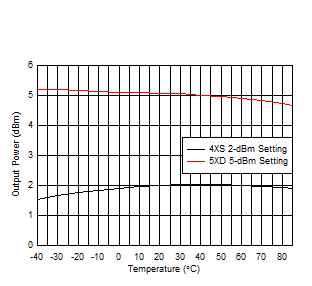
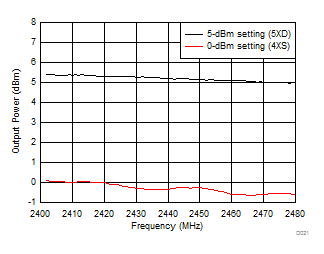
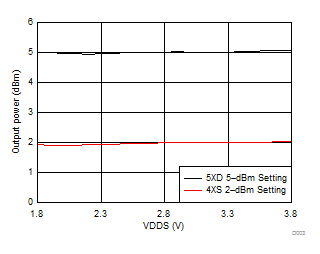
| Output power, highest setting | Delivered to a single-ended 50-Ω load through a balun | 5 | dBm | ||
| Output power, highest setting | Measured on CC2650EM-4XS, delivered to a single-ended 50-Ω load | 2 | dBm | ||
| Output power, lowest setting | Delivered to a single-ended 50-Ω load through a balun | –21 | dBm | ||
| Error vector magnitude | At maximum output power | 2% | |||
| Spurious emission conducted measurement | f < 1 GHz, outside restricted bands | –43 | dBm | ||
| f < 1 GHz, restricted bands ETSI | –65 | ||||
| f < 1 GHz, restricted bands FCC | –76 | ||||
| f > 1 GHz, including harmonics | –46 | ||||
| Suitable for systems targeting compliance with worldwide radio-frequency regulations ETSI EN 300 328 and EN 300 440 Class 2 (Europe), FCC CFR47 Part 15 (US), and ARIB STD-T66 (Japan) | |||||
5.8 24-MHz Crystal Oscillator (XOSC_HF)
Tc = 25°C, VDDS = 3.0 V, unless otherwise noted.(1)| PARAMETER | TEST CONDITIONS | MIN | TYP | MAX | UNIT |
|---|---|---|---|---|---|
| ESR Equivalent series resistance(2) | 6 pF < CL ≤ 9 pF | 20 | 60 | Ω | |
| ESR Equivalent series resistance(2) | 5 pF < CL ≤ 6 pF | 80 | Ω | ||
| LM Motional inductance(2) | Relates to load capacitance (CL in Farads) |
< 1.6 × 10⁻²⁴ / CL2 | H | ||
| CL Crystal load capacitance(2) | 5 | 9 | pF | ||
| Crystal frequency(2)(3) | 24 | MHz | |||
| Crystal frequency tolerance(2)(4) | –40 | 40 | ppm | ||
| Start-up time(3)(5) | 150 | µs |
(1) Probing or otherwise stopping the XTAL while the DC-DC converter is enabled may cause permanent damage to the device.
(2) The crystal manufacturer's specification must satisfy this requirement
(3) Measured on the TI CC2650EM-5XD reference design with Tc = 25°C, VDDS = 3.0 V
(4) Includes initial tolerance of the crystal, drift over temperature, ageing and frequency pulling due to incorrect load capacitance. As per IEEE 802.15.4 specification.
(5) Kick-started based on a temperature and aging compensated RCOSC_HF using precharge injection.
5.9 32.768-kHz Crystal Oscillator (XOSC_LF)
Tc = 25°C, VDDS = 3.0 V, unless otherwise noted.| PARAMETER | TEST CONDITIONS | MIN | TYP | MAX | UNIT | |
|---|---|---|---|---|---|---|
| Crystal frequency(1) | 32.768 | kHz | ||||
| ESR Equivalent series resistance(1) | 30 | 100 | kΩ | |||
| CL Crystal load capacitance(1) | 6 | 12 | pF | |||
(1) The crystal manufacturer's specification must satisfy this requirement
5.10 48-MHz RC Oscillator (RCOSC_HF)
Measured on the TI CC2650EM-5XD reference design with Tc = 25°C, VDDS = 3.0 V, unless otherwise noted.| PARAMETER | TEST CONDITIONS | MIN | TYP | MAX | UNIT |
|---|---|---|---|---|---|
| Frequency | 48 | MHz | |||
| Uncalibrated frequency accuracy | ±1% | ||||
| Calibrated frequency accuracy(1) | ±0.25% | ||||
| Start-up time | 5 | µs |
(1) Accuracy relative to the calibration source (XOSC_HF).
5.11 32-kHz RC Oscillator (RCOSC_LF)
Measured on the TI CC2650EM-5XD reference design with Tc = 25°C, VDDS = 3.0 V, unless otherwise noted.| PARAMETER | TEST CONDITIONS | MIN | TYP | MAX | UNIT |
|---|---|---|---|---|---|
| Calibrated frequency(1) | 32.8 | kHz | |||
| Temperature coefficient | 50 | ppm/°C |
(1) The frequency accuracy of the Real Time Clock (RTC) is not directly dependent on the frequency accuracy of the 32-kHz RC Oscillator. The RTC can be calibrated to an accuracy within ±500 ppm of 32.768 kHz by measuring the frequency error of RCOSC_LF relative to XOSC_HF and compensating the RTC tick speed. The procedure is explained in Running Bluetooth® Low Energy on CC2640 Without 32 kHz Crystal.
5.12 ADC Characteristics
Tc = 25°C, VDDS = 3.0 V and voltage scaling enabled, unless otherwise noted.(1)| PARAMETER | TEST CONDITIONS | MIN | TYP | MAX | UNIT | |
|---|---|---|---|---|---|---|
| Input voltage range | 0 | VDDS | V | |||
| Resolution | 12 | Bits | ||||
| Sample rate | 200 | ksps | ||||
| Offset | Internal 4.3-V equivalent reference(2) | 2 | LSB | |||
| Gain error | Internal 4.3-V equivalent reference(2) | 2.4 | LSB | |||
| DNL(4) | Differential nonlinearity | >–1 | LSB | |||
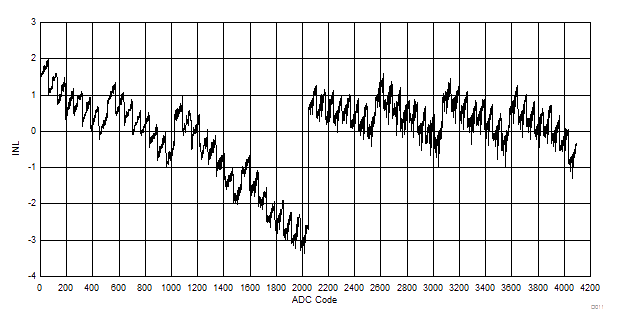
| INL(5) | Integral nonlinearity | ±3 | LSB | |||
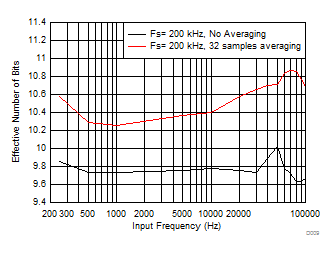
| ENOB | Effective number of bits | Internal 4.3-V equivalent reference(2), 200 ksps, 9.6-kHz input tone |
9.8 | Bits | ||
| VDDS as reference, 200 ksps, 9.6-kHz input tone | 10 | |||||
| Internal 1.44-V reference, voltage scaling disabled, 32 samples average, 200 ksps, 300-Hz input tone |
11.1 | |||||
| THD | Total harmonic distortion | Internal 4.3-V equivalent reference(2), 200 ksps, 9.6-kHz input tone |
–65 | dB | ||
| VDDS as reference, 200 ksps, 9.6-kHz input tone | –69 | |||||
| Internal 1.44-V reference, voltage scaling disabled, 32 samples average, 200 ksps, 300-Hz input tone |
–71 | |||||
| SINAD, SNDR |
Signal-to-noise and Distortion ratio |
Internal 4.3-V equivalent reference(2), 200 ksps, 9.6-kHz input tone |
60 | dB | ||
| VDDS as reference, 200 ksps, 9.6-kHz input tone | 63 | |||||
| Internal 1.44-V reference, voltage scaling disabled, 32 samples average, 200 ksps, 300-Hz input tone |
69 | |||||
| SFDR | Spurious-free dynamic range | Internal 4.3-V equivalent reference(2), 200 ksps, 9.6-kHz input tone |
67 | dB | ||
| VDDS as reference, 200 ksps, 9.6-kHz input tone | 72 | |||||
| Internal 1.44-V reference, voltage scaling disabled, 32 samples average, 200 ksps, 300-Hz input tone |
73 | |||||
| Conversion time | Serial conversion, time-to-output, 24-MHz clock | 50 | clock-cycles | |||
| Current consumption | Internal 4.3-V equivalent reference(2) | 0.66 | mA | |||
| Current consumption | VDDS as reference | 0.75 | mA | |||
| Reference voltage | Equivalent fixed internal reference (input voltage scaling enabled). For best accuracy, the ADC conversion should be initiated through the TIRTOS API in order to include the gain/offset compensation factors stored in FCFG1. | 4.3(2)(3) | V | |||
| Reference voltage | Fixed internal reference (input voltage scaling disabled). For best accuracy, the ADC conversion should be initiated through the TIRTOS API in order to include the gain/offset compensation factors stored in FCFG1. This value is derived from the scaled value (4.3 V) as follows: Vref = 4.3 V × 1408 / 4095 |
1.48 | V | |||
| Reference voltage | VDDS as reference (Also known as RELATIVE) (input voltage scaling enabled) | VDDS | V | |||
| Reference voltage | VDDS as reference (Also known as RELATIVE) (input voltage scaling disabled) | VDDS / 2.82(3) | V | |||
| Input impedance | 200 ksps, voltage scaling enabled. Capacitive input, Input impedance depends on sampling frequency and sampling time | >1 | MΩ | |||
(1) Using IEEE Std
1241™-2010 for terminology and test methods.
(2) Input signal scaled down internally before conversion, as if voltage range was 0 to 4.3 V.
(3) Applied voltage must be within absolute maximum ratings (Section 5.1) at all times.
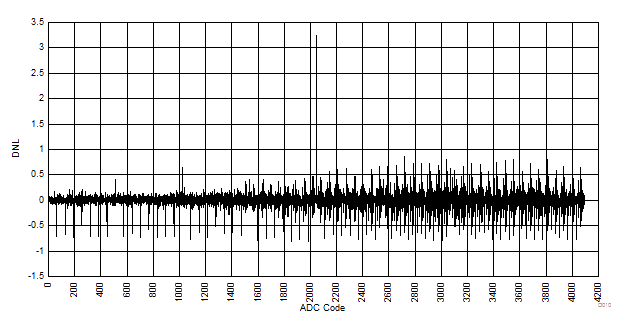
(4) No missing codes. Positive DNL typically varies from +0.3 to +3.5, depending on device (see Figure 5-21).
(5) For a typical example, see Figure 5-22.
5.13 Temperature Sensor
Measured on the TI CC2650EM-5XD reference design with Tc = 25°C, VDDS = 3.0 V, unless otherwise noted.| PARAMETER | TEST CONDITIONS | MIN | TYP | MAX | UNIT |
|---|---|---|---|---|---|
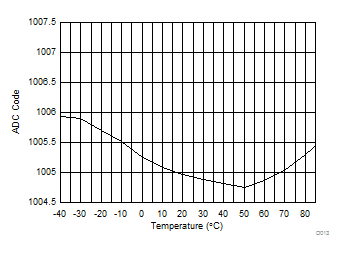
| Resolution | 4 | °C | |||
| Range | –40 | 85 | °C | ||
| Accuracy | ±5 | °C | |||
| Supply voltage coefficient(1) | 3.2 | °C/V |
(1) Automatically compensated when using supplied driver libraries.
5.14 Battery Monitor
Measured on the TI CC2650EM-5XD reference design with Tc = 25°C, VDDS = 3.0 V, unless otherwise noted.| PARAMETER | TEST CONDITIONS | MIN | TYP | MAX | UNIT |
|---|---|---|---|---|---|
| Resolution | 50 | mV | |||
| Range | 1.8 | 3.8 | V | ||
| Accuracy | 13 | mV |
5.15 Continuous Time Comparator
Tc = 25°C, VDDS = 3.0 V, unless otherwise noted.| PARAMETER | TEST CONDITIONS | MIN | TYP | MAX | UNIT |
|---|---|---|---|---|---|
| Input voltage range | 0 | VDDS | V | ||
| External reference voltage | 0 | VDDS | V | ||
| Internal reference voltage | DCOUPL as reference | 1.27 | V | ||
| Offset | 3 | mV | |||
| Hysteresis | <2 | mV | |||
| Decision time | Step from –10 mV to 10 mV | 0.72 | µs | ||
| Current consumption when enabled(1) | 8.6 | µA |
(1) Additionally, the bias module must be enabled when running in standby mode.
5.16 Low-Power Clocked Comparator
Tc = 25°C, VDDS = 3.0 V, unless otherwise noted.| PARAMETER | TEST CONDITIONS | MIN | TYP | MAX | UNIT |
|---|---|---|---|---|---|
| Input voltage range | 0 | VDDS | V | ||
| Clock frequency | 32 | kHz | |||
| Internal reference voltage, VDDS / 2 | 1.49–1.51 | V | |||
| Internal reference voltage, VDDS / 3 | 1.01–1.03 | V | |||
| Internal reference voltage, VDDS / 4 | 0.78–0.79 | V | |||
| Internal reference voltage, DCOUPL / 1 | 1.25–1.28 | V | |||
| Internal reference voltage, DCOUPL / 2 | 0.63–0.65 | V | |||
| Internal reference voltage, DCOUPL / 3 | 0.42–0.44 | V | |||
| Internal reference voltage, DCOUPL / 4 | 0.33–0.34 | V | |||
| Offset | <2 | mV | |||
| Hysteresis | <5 | mV | |||
| Decision time | Step from –50 mV to 50 mV | <1 | clock-cycle | ||
| Current consumption when enabled | 362 | nA |
5.17 Programmable Current Source
Tc = 25°C, VDDS = 3.0 V, unless otherwise noted.| PARAMETER | TEST CONDITIONS | MIN | TYP | MAX | UNIT |
|---|---|---|---|---|---|
| Current source programmable output range | 0.25–20 | µA | |||
| Resolution | 0.25 | µA | |||
| Current consumption(1) | Including current source at maximum programmable output | 23 | µA |
(1) Additionally, the bias module must be enabled when running in standby mode.
5.18 Synchronous Serial Interface (SSI)
Tc = 25°C, VDDS = 3.0 V, unless otherwise noted.| PARAMETER | TEST CONDITIONS | MIN | TYP | MAX | UNIT |
|---|---|---|---|---|---|
| S1(1) tclk_per (SSIClk period) | Device operating as SLAVE | 12 | 65024 | system clocks | |
| S2(1) tclk_high (SSIClk high time) | Device operating as SLAVE | 0.5 | tclk_per | ||
| S3(1) tclk_low (SSIClk low time) | Device operating as SLAVE | 0.5 | tclk_per | ||
| S1 (TX only)(1) tclk_per (SSIClk period) | One-way communication to SLAVE - Device operating as MASTER |
4 | 65024 | system clocks | |
| S1 (TX and RX)(1) tclk_per (SSIClk period) | Normal duplex operation - Device operating as MASTER |
8 | 65024 | system clocks | |
| S2(1) tclk_high (SSIClk high time) | Device operating as MASTER | 0.5 | tclk_per | ||
| S3(1) tclk_low (SSIClk low time) | Device operating as MASTER | 0.5 | tclk_per |
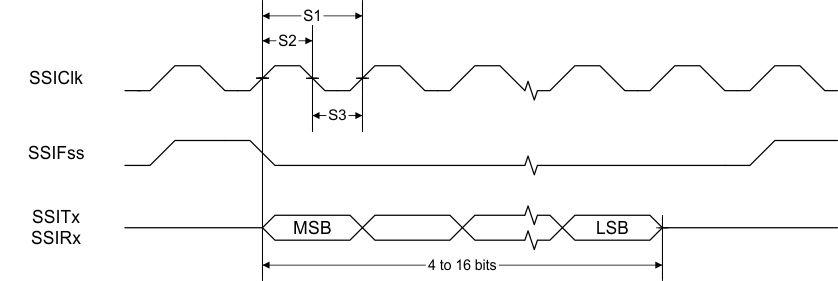 Figure 5-1 SSI Timing for TI Frame Format (FRF = 01), Single Transfer Timing Measurement
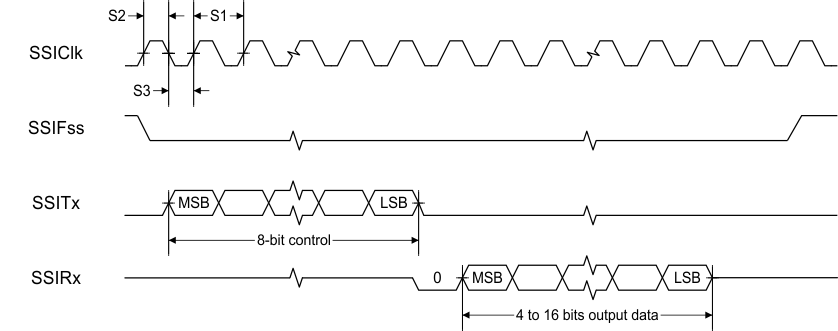 Figure 5-2 SSI Timing for MICROWIRE Frame Format (FRF = 10), Single Transfer
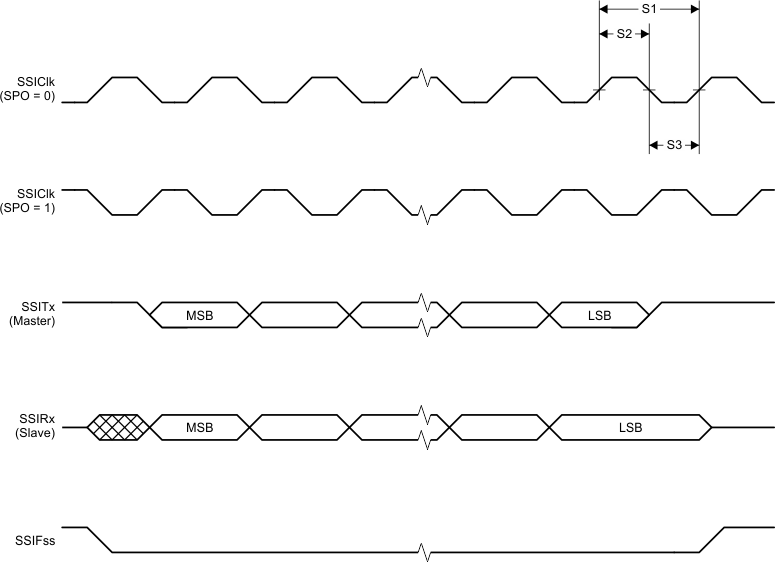 Figure 5-3 SSI Timing for SPI Frame Format (FRF = 00), With SPH = 1
5.19 DC Characteristics
| PARAMETER | TEST CONDITIONS | MIN | TYP | MAX | UNIT |
|---|---|---|---|---|---|
| TA = 25°C, VDDS = 1.8 V | |||||
| GPIO VOH at 8-mA load | IOCURR = 2, high-drive GPIOs only | 1.32 | 1.54 | V | |
| GPIO VOL at 8-mA load | IOCURR = 2, high-drive GPIOs only | 0.26 | 0.32 | V | |
| GPIO VOH at 4-mA load | IOCURR = 1 | 1.32 | 1.58 | V | |
| GPIO VOL at 4-mA load | IOCURR = 1 | 0.21 | 0.32 | V | |
| GPIO pullup current | Input mode, pullup enabled, Vpad = 0 V | 71.7 | µA | ||
| GPIO pulldown current | Input mode, pulldown enabled, Vpad = VDDS | 21.1 | µA | ||
| GPIO high/low input transition, no hysteresis |
IH = 0, transition between reading 0 and reading 1 | 0.88 | V | ||
| GPIO low-to-high input transition, with hysteresis |
IH = 1, transition voltage for input read as 0 → 1 | 1.07 | V | ||
| GPIO high-to-low input transition, with hysteresis |
IH = 1, transition voltage for input read as 1 → 0 | 0.74 | V | ||
| GPIO input hysteresis | IH = 1, difference between 0 → 1 and 1 → 0 points | 0.33 | V | ||
| TA = 25°C, VDDS = 3.0 V | |||||
| GPIO VOH at 8-mA load | IOCURR = 2, high-drive GPIOs only | 2.68 | V | ||
| GPIO VOL at 8-mA load | IOCURR = 2, high-drive GPIOs only | 0.33 | V | ||
| GPIO VOH at 4-mA load | IOCURR = 1 | 2.72 | V | ||
| GPIO VOL at 4-mA load | IOCURR = 1 | 0.28 | V | ||
| TA = 25°C, VDDS = 3.8 V | |||||
| GPIO pullup current | Input mode, pullup enabled, Vpad = 0 V | 277 | µA | ||
| GPIO pulldown current | Input mode, pulldown enabled, Vpad = VDDS | 113 | µA | ||
| GPIO high/low input transition, no hysteresis |
IH = 0, transition between reading 0 and reading 1 | 1.67 | V | ||
| GPIO low-to-high input transition, with hysteresis |
IH = 1, transition voltage for input read as 0 → 1 | 1.94 | V | ||
| GPIO high-to-low input transition, with hysteresis |
IH = 1, transition voltage for input read as 1 → 0 | 1.54 | V | ||
| GPIO input hysteresis | IH = 1, difference between 0 → 1 and 1 → 0 points | 0.4 | V | ||
| TA = 25°C | |||||
| VIH | Lowest GPIO input voltage reliably interpreted as a «High» | 0.8 | VDDS(1) | ||
| VIL | Highest GPIO input voltage reliably interpreted as a «Low» | 0.2 | VDDS(1) | ||
(1) Each GPIO is referenced to a specific VDDS pin. See the technical reference manual listed in Section 8.3 for more details.
5.20 Thermal Resistance Characteristics
| NAME | DESCRIPTION | RSM (°C/W)(1)(2) | RGZ (°C/W)(1)(2) |
|---|---|---|---|
| RθJA | Junction-to-ambient thermal resistance | 36.9 | 29.6 |
| RθJC(top) | Junction-to-case (top) thermal resistance | 30.3 | 15.7 |
| RθJB | Junction-to-board thermal resistance | 7.6 | 6.2 |
| PsiJT | Junction-to-top characterization parameter | 0.4 | 0.3 |
| PsiJB | Junction-to-board characterization parameter | 7.4 | 6.2 |
| RθJC(bot) | Junction-to-case (bottom) thermal resistance | 2.1 | 1.9 |
(1) °C/W = degrees Celsius per watt.
(2) These values are based on a JEDEC-defined 2S2P system (with the exception of the Theta JC [RθJC] value, which is based on a JEDEC-defined 1S0P system) and will change based on environment as well as application. For more information, see these EIA/JEDEC standards:
- JESD51-2, Integrated Circuits Thermal Test Method Environmental Conditions - Natural Convection (Still Air).
- JESD51-3, Low Effective Thermal Conductivity Test Board for Leaded Surface Mount Packages.
- JESD51-7, High Effective Thermal Conductivity Test Board for Leaded Surface Mount Packages.
- JESD51-9, Test Boards for Area Array Surface Mount Package Thermal Measurements.
5.21 Timing Requirements
| MIN | NOM | MAX | UNIT | |||
|---|---|---|---|---|---|---|
| Rising supply-voltage slew rate | 0 | 100 | mV/µs | |||
| Falling supply-voltage slew rate | 0 | 20 | mV/µs | |||
| Falling supply-voltage slew rate, with low-power flash settings(1) | 3 | mV/µs | ||||
| Positive temperature gradient in standby(3) | No limitation for negative temperature gradient, or outside standby mode | 5 | °C/s | |||
| CONTROL INPUT AC CHARACTERISTICS(2) | ||||||
| RESET_N low duration | 1 | µs | ||||
(1) For smaller coin cell batteries, with high worst-case end-of-life equivalent source resistance, a 22-µF VDDS input capacitor (see Figure 7-1) must be used to ensure compliance with this slew rate.
(2) TA = –40°C to +85°C, VDDS = 1.7 V to 3.8 V, unless otherwise noted.
(3) Applications using RCOSC_LF as sleep timer must also consider the drift in frequency caused by a change in temperature (see Section 5.11).
5.22 Switching Characteristics
Measured on the TI CC2650EM-5XD reference design with Tc = 25°C, VDDS = 3.0 V, unless otherwise noted.| PARAMETER | TEST CONDITIONS | MIN | TYP | MAX | UNIT | |
|---|---|---|---|---|---|---|
| WAKEUP AND TIMING | ||||||
| Idle → Active | 14 | µs | ||||
| Standby → Active | 151 | µs | ||||
| Shutdown → Active | 1015 | µs | ||||
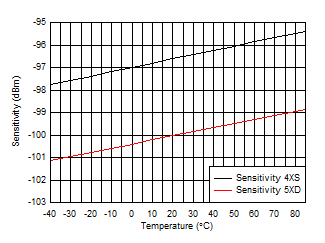
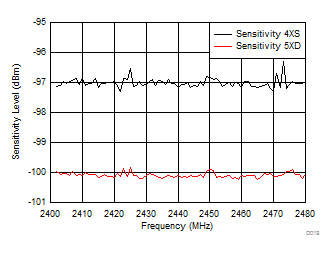
5.23 Typical Characteristics
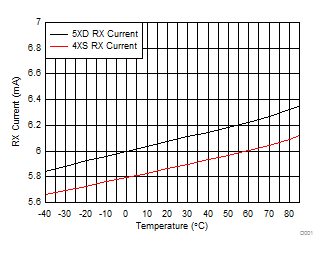
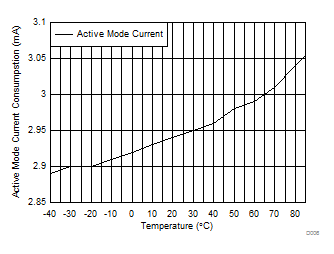
Current Consumption vs Temperature